
长链非编码RNA在抗癌治疗耐药性中的功能作用。
The functional role of long noncoding RNA in resistance to anticancer treatment.
作者信息
Qu Yidi, Tan Hor-Yue, Chan Yau-Tuen, Jiang Hongbo, Wang Ning, Wang Di
机构信息
School of Life Sciences, Jilin University, Changchun, China.
School of Chinese Medicine, The University of Hong Kong, Pokfulam, Hong Kong S.A.R., P.R. China.
出版信息
Ther Adv Med Oncol. 2020 Jun 1;12:1758835920927850. doi: 10.1177/1758835920927850. eCollection 2020.
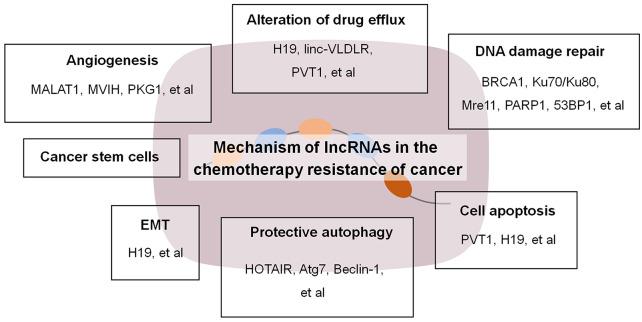
Chemotherapy is one of the fundamental methods of cancer treatment. However, drug resistance remains the main cause of clinical treatment failure. We comprehensively review the newly identified roles of long noncoding RNAs (lncRNAs) in oncobiology that are associated with drug resistance. The expression of lncRNAs is tissue-specific and often dysregulated in human cancers. Accumulating evidence suggests that lncRNAs are involved in chemoresistance of cancer cells. The main lncRNA-driven mechanisms of chemoresistance include regulation of drug efflux, DNA damage repair, cell cycle, apoptosis, epithelial-mesenchymal transition (EMT), induction of signaling pathways, and angiogenesis. LncRNA-driven mechanisms of resistance to various antineoplastic agents have been studied extensively. There are unique mechanisms of resistance against different types of drugs, and each mechanism may have more than one contributing factor. We summarize the emerging strategies that can be used to overcome the technical challenges in studying and addressing lncRNA-mediated drug resistance.
化疗是癌症治疗的基本方法之一。然而,耐药性仍然是临床治疗失败的主要原因。我们全面综述了长链非编码RNA(lncRNA)在肿瘤生物学中与耐药性相关的新发现作用。lncRNA的表达具有组织特异性,在人类癌症中常常失调。越来越多的证据表明,lncRNA参与癌细胞的化疗耐药。lncRNA驱动的化疗耐药主要机制包括药物外排调节、DNA损伤修复、细胞周期、细胞凋亡、上皮-间质转化(EMT)、信号通路诱导和血管生成。lncRNA驱动的对各种抗肿瘤药物的耐药机制已得到广泛研究。针对不同类型药物存在独特的耐药机制,且每种机制可能有多个促成因素。我们总结了可用于克服研究和解决lncRNA介导的耐药性方面技术挑战的新兴策略。
 Zotero 插件