
电沉积参数对作为碱性电解槽阳极材料的锰钴基纳米薄膜性能的影响。
The Influence of the Electrodeposition Parameters on the Properties of Mn-Co-Based Nanofilms as Anode Materials for Alkaline Electrolysers.
作者信息
Cysewska Karolina, Rybarczyk Maria Krystyna, Cempura Grzegorz, Karczewski Jakub, Łapiński Marcin, Jasinski Piotr, Molin Sebastian
机构信息
Faculty of Electronics, Telecommunications and Informatics, Gdansk University of Technology, ul. Narutowicza 11/12, 80-233 Gdansk, Poland.
Department of Process Engineering and Chemical Technology, Chemical Faculty, Gdansk University of Technology, ul. Narutowicza 11/12, 80-233 Gdansk, Poland.
出版信息
Materials (Basel). 2020 Jun 11;13(11):2662. doi: 10.3390/ma13112662.
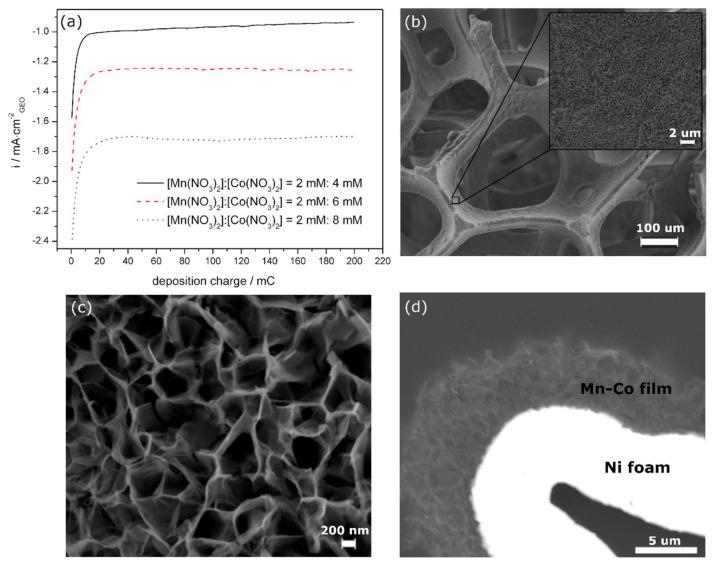
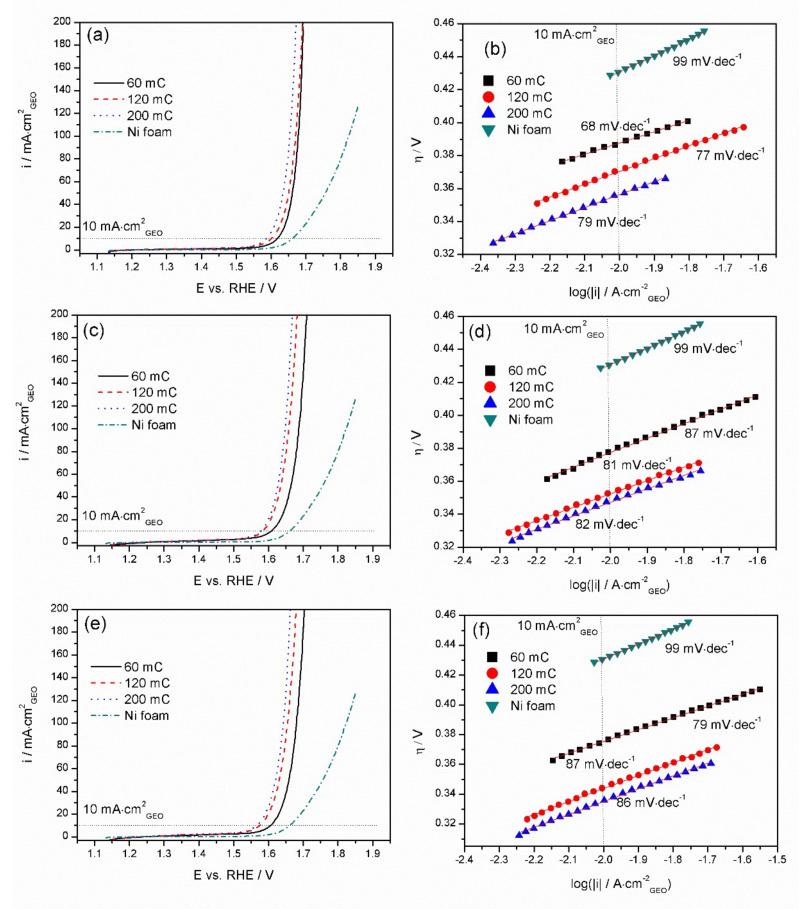
In this work, the influence of the synthesis conditions on the structure, morphology, and electrocatalytic performance for the oxygen evolution reaction (OER) of Mn-Co-based films is studied. For this purpose, Mn-Co nanofilm is electrochemically synthesised in a one-step process on nickel foam in the presence of metal nitrates without any additives. The possible mechanism of the synthesis is proposed. The morphology and structure of the catalysts are studied by various techniques including scanning electron microscopy, X-ray diffraction, X-ray photoelectron spectroscopy, and transmission electron microscopy. The analyses show that the as-deposited catalysts consist mainly of oxides/hydroxides and/or (oxy)hydroxides based on Mn, Co, and Co. The alkaline post-treatment of the film results in the formation of Mn-Co (oxy)hydroxides and crystalline Co(OH) with a β-phase hexagonal platelet-like shape structure, indicating a layered double hydroxide structure, desirable for the OER. Electrochemical studies show that the catalytic performance of Mn-Co was dependent on the concentration of Mn versus Co in the synthesis solution and on the deposition charge. The optimised Mn-Co/Ni foam is characterised by a specific surface area of 10.5 m·g, a pore volume of 0.0042 cm·g, and high electrochemical stability with an overpotential deviation around 330-340 mV at 10 mA·cm for 70 h.
在本工作中,研究了合成条件对锰钴基薄膜结构、形貌以及析氧反应(OER)电催化性能的影响。为此,在无任何添加剂的金属硝酸盐存在下,通过一步法在泡沫镍上电化学合成了锰钴纳米薄膜。提出了可能的合成机理。采用扫描电子显微镜、X射线衍射、X射线光电子能谱和透射电子显微镜等多种技术研究了催化剂的形貌和结构。分析表明,沉积态催化剂主要由基于锰、钴和钴的氧化物/氢氧化物和/或(羟基)氧化物组成。薄膜的碱性后处理导致形成具有β相六角片状结构的锰钴(羟基)氧化物和结晶态Co(OH),表明其具有有利于析氧反应的层状双氢氧化物结构。电化学研究表明,锰钴的催化性能取决于合成溶液中锰与钴的浓度以及沉积电荷。优化后的锰钴/泡沫镍的比表面积为10.5 m·g,孔体积为0.0042 cm·g,在10 mA·cm下70小时内具有高电化学稳定性,过电位偏差约为330 - 340 mV。




 Zotero 插件