
管理新冠疫情信息疫情的框架:世卫组织在线众包技术磋商会的方法与结果
Framework for Managing the COVID-19 Infodemic: Methods and Results of an Online, Crowdsourced WHO Technical Consultation.
作者信息
Tangcharoensathien Viroj, Calleja Neville, Nguyen Tim, Purnat Tina, D'Agostino Marcelo, Garcia-Saiso Sebastian, Landry Mark, Rashidian Arash, Hamilton Clayton, AbdAllah Abdelhalim, Ghiga Ioana, Hill Alexandra, Hougendobler Daniel, van Andel Judith, Nunn Mark, Brooks Ian, Sacco Pier Luigi, De Domenico Manlio, Mai Philip, Gruzd Anatoliy, Alaphilippe Alexandre, Briand Sylvie
机构信息
International Health Policy Program, Ministry of Public Health, Nonthaburi, Thailand.
Directorate for Health Information and Research, Ministry for Health, Valetta, Malta.
出版信息
J Med Internet Res. 2020 Jun 26;22(6):e19659. doi: 10.2196/19659.
BACKGROUND
An infodemic is an overabundance of information-some accurate and some not-that occurs during an epidemic. In a similar manner to an epidemic, it spreads between humans via digital and physical information systems. It makes it hard for people to find trustworthy sources and reliable guidance when they need it.
OBJECTIVE
A World Health Organization (WHO) technical consultation on responding to the infodemic related to the coronavirus disease (COVID-19) pandemic was held, entirely online, to crowdsource suggested actions for a framework for infodemic management.
METHODS
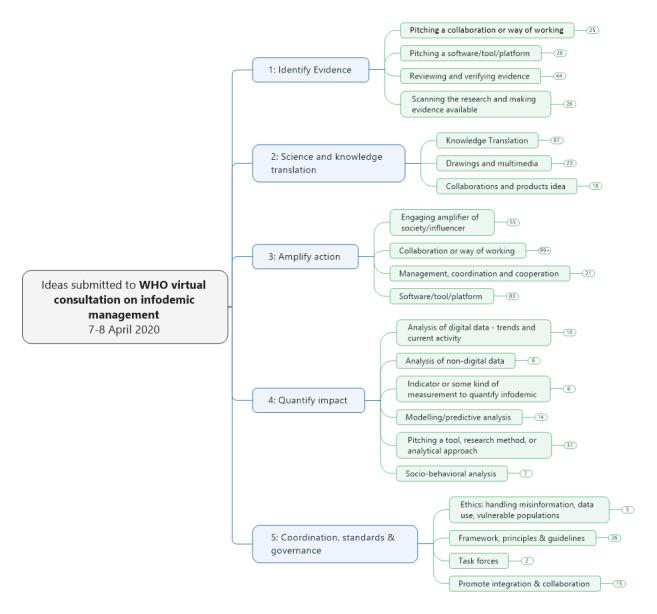
A group of policy makers, public health professionals, researchers, students, and other concerned stakeholders was joined by representatives of the media, social media platforms, various private sector organizations, and civil society to suggest and discuss actions for all parts of society, and multiple related professional and scientific disciplines, methods, and technologies. A total of 594 ideas for actions were crowdsourced online during the discussions and consolidated into suggestions for an infodemic management framework.
RESULTS
The analysis team distilled the suggestions into a set of 50 proposed actions for a framework for managing infodemics in health emergencies. The consultation revealed six policy implications to consider. First, interventions and messages must be based on science and evidence, and must reach citizens and enable them to make informed decisions on how to protect themselves and their communities in a health emergency. Second, knowledge should be translated into actionable behavior-change messages, presented in ways that are understood by and accessible to all individuals in all parts of all societies. Third, governments should reach out to key communities to ensure their concerns and information needs are understood, tailoring advice and messages to address the audiences they represent. Fourth, to strengthen the analysis and amplification of information impact, strategic partnerships should be formed across all sectors, including but not limited to the social media and technology sectors, academia, and civil society. Fifth, health authorities should ensure that these actions are informed by reliable information that helps them understand the circulating narratives and changes in the flow of information, questions, and misinformation in communities. Sixth, following experiences to date in responding to the COVID-19 infodemic and the lessons from other disease outbreaks, infodemic management approaches should be further developed to support preparedness and response, and to inform risk mitigation, and be enhanced through data science and sociobehavioral and other research.
CONCLUSIONS
The first version of this framework proposes five action areas in which WHO Member States and actors within society can apply, according to their mandate, an infodemic management approach adapted to national contexts and practices. Responses to the COVID-19 pandemic and the related infodemic require swift, regular, systematic, and coordinated action from multiple sectors of society and government. It remains crucial that we promote trusted information and fight misinformation, thereby helping save lives.
背景
信息疫情是指在疫情期间出现的信息过剩现象,其中一些信息准确,一些不准确。与疫情类似,它通过数字和物理信息系统在人与人之间传播。这使得人们在需要时难以找到可靠的信息来源和指导。
目的
世界卫生组织(WHO)举行了一次关于应对与冠状病毒病(COVID-19)大流行相关的信息疫情的技术磋商会,该会议完全在线举行,旨在通过众包的方式为信息疫情管理框架提出建议行动。
方法
一组政策制定者、公共卫生专业人员、研究人员、学生和其他相关利益攸关方与媒体、社交媒体平台、各种私营部门组织和民间社会的代表共同参与,为社会各阶层以及多个相关专业和科学学科、方法和技术提出并讨论行动建议。在讨论期间,共通过在线众包收集到594条行动建议,并整合为信息疫情管理框架的建议。
结果
分析团队将这些建议提炼为一套针对卫生紧急情况中信息疫情管理框架的50项拟议行动。磋商会揭示了六项需要考虑的政策影响。第一,干预措施和信息必须基于科学和证据,并且必须传达给公民,使他们能够在卫生紧急情况下就如何保护自己和社区做出明智的决定。第二,知识应转化为可采取行动的行为改变信息,以所有社会各阶层的所有人都能理解和获取的方式呈现。第三,政府应与关键社区接触,确保了解他们的关切和信息需求,根据所代表的受众量身定制建议和信息。第四,为加强对信息影响的分析和放大,应在包括但不限于社交媒体和技术部门、学术界和民间社会在内的所有部门建立战略伙伴关系。第五,卫生当局应确保这些行动以可靠信息为依据,这些信息有助于他们了解社区中流传的说法以及信息、问题和错误信息流动的变化。第六,根据应对COVID-19信息疫情的经验以及其他疾病爆发的教训,应进一步制定信息疫情管理方法,以支持防范和应对工作,并为降低风险提供信息,并通过数据科学以及社会行为和其他研究加以完善。
结论
该框架的第一版提出了五个行动领域,世卫组织会员国和社会行为体可根据其任务授权,采用适合本国情况和做法的信息疫情管理方法。应对COVID-19大流行及相关信息疫情需要社会和政府多个部门迅速、定期、系统和协调的行动。我们促进可信信息并打击错误信息,从而帮助拯救生命,这一点仍然至关重要。
 Zotero 插件