
2018-2019 年德国血香肠相关侵袭性李斯特菌病的全国性大规模暴发
Large Nationwide Outbreak of Invasive Listeriosis Associated with Blood Sausage, Germany, 2018-2019.
出版信息
Emerg Infect Dis. 2020 Jul;26(7):1456-1464. doi: 10.3201/eid2607.200225.
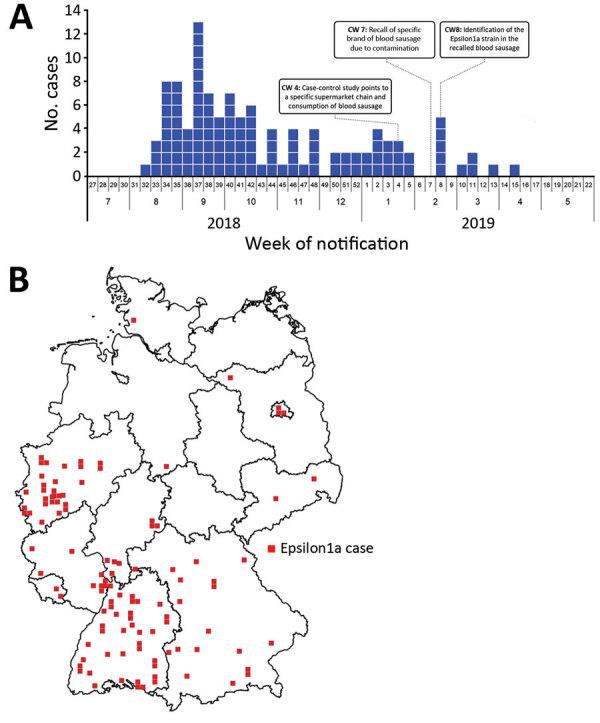
Invasive listeriosis is a severe foodborne infection in humans and is difficult to control. Listeriosis incidence is increasing worldwide, but some countries have implemented molecular surveillance programs to improve recognition and management of listeriosis outbreaks. In Germany, routine whole-genome sequencing, core genome multilocus sequence typing, and single nucleotide polymorphism calling are used for subtyping of Listeria monocytogenes isolates from listeriosis cases and suspected foods. During 2018-2019, an unusually large cluster of L. monocytogenes isolates was identified, including 134 highly clonal, benzalkonium-resistant sequence type 6 isolates collected from 112 notified listeriosis cases. The outbreak was one of the largest reported in Europe during the past 25 years. Epidemiologic investigations identified blood sausage contaminated with L. monocytogenes highly related to clinical isolates; withdrawal of the product from the market ended the outbreak. We describe how epidemiologic investigations and complementary molecular typing of food isolates helped identify the outbreak vehicle.
侵袭性李斯特菌病是一种严重的食源性人类感染,难以控制。李斯特菌病的发病率在全球范围内呈上升趋势,但一些国家已实施分子监测计划,以提高对李斯特菌病暴发的认识和管理。在德国,对李斯特菌病病例和疑似食品中的单核细胞增生李斯特菌分离株进行常规全基因组测序、核心基因组多位点序列分型和单核苷酸多态性分析,用于对其进行分型。在 2018-2019 年,鉴定出了一组异常庞大的李斯特菌分离株,其中包括从 112 例报告的李斯特菌病病例中收集的 134 株高度克隆、苯扎氯铵耐药的 6 型序列型分离株。该暴发是过去 25 年来欧洲报告的最大暴发之一。流行病学调查确定了受污染的血肠中含有与临床分离株高度相关的单核细胞增生李斯特菌;该产品从市场上撤出结束了此次暴发。我们描述了流行病学调查和食品分离株的补充分子分型如何帮助确定了暴发源。


 Zotero 插件