
转移性透明细胞肾细胞癌中 DNA 损伤修复途径的改变及其对系统治疗的影响。
DNA damage repair pathway alterations in metastatic clear cell renal cell carcinoma and implications on systemic therapy.
机构信息
Department of Medicine, Memorial Sloan Kettering Cancer Center, New York, New York, USA.
Department of Radiology, Memorial Sloan Kettering Cancer Center, New York, New York, USA.
出版信息
J Immunother Cancer. 2020 Jun;8(1). doi: 10.1136/jitc-2019-000230.
BACKGROUND
Loss-of-function alterations in DNA damage repair (DDR) genes are associated with human tumorigenesis and may determine benefit from immune-oncology (I/O) agents as shown in colon cancer. However, biologic significance and relevance to I/O in metastatic clear cell RCC (ccRCC) are unknown.
METHODS
Genomic data and treatment outcomes were retrospectively collected for patients with metastatic ccRCC. Tumor and germline DNA were subject to targeted next generation sequencing across >400 genes of interest, including 34 DDR genes. Patients were dichotomized according to underlying DDR gene alteration into (1) deleterious DDR gene alterations present (Del DDR); (2) wild-type (WT) and variants of unknown significance (VUS) DDR gene alterations present (WT/VUS DDR). Association between DDR status and therapeutic benefit was investigated separately for I/O and vascular endothelial growth factor (VEGF) tyrosine kinase inhibitor (TKI) therapy.
RESULTS
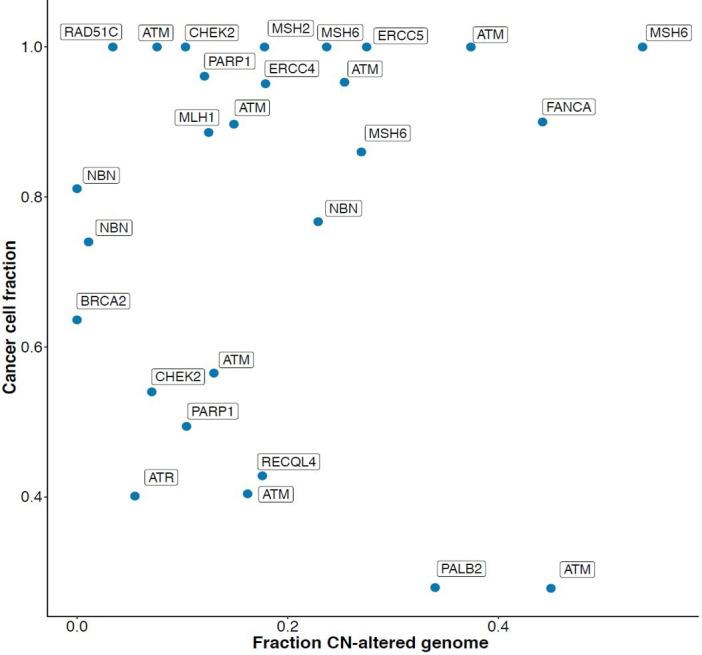
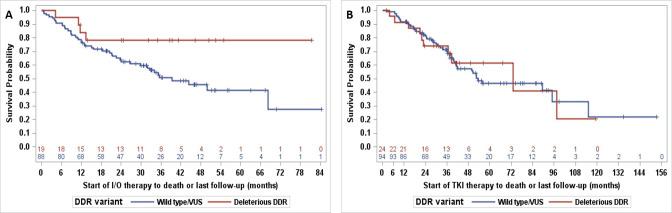
Del DDR were detected in 43/229 patients (19%). The most frequently altered genes were and . Clonality analysis was performed in 27 somatic DDR mutations and 17 were clonal (63%). For patients with I/O treatment, Del DDR status was associated with superior overall survival (log-rank p=0.049); after adjusting for International Metastatic Renal Cell Carcinoma Database Consortium risks and extent of prior therapy, the HR for Del DDR was 0.41 (95% CI: 0.14-1.14; p=0.09). No association was seen with VEGF-TKI treatment (log-rank p=0.903).
CONCLUSION
Del DDR alterations are recurrent genomic events in patients with advanced RCC and were mostly clonal in this cohort. Loss-of-function events in these genes may affect outcome with I/O therapy in metastatic RCC, and these hypothesis-generating results deserve further study.
背景
在结直肠癌中,DNA 损伤修复 (DDR) 基因的功能丧失改变与人类肿瘤发生有关,并且可能决定免疫肿瘤学 (I/O) 药物的获益。然而,在转移性透明细胞肾细胞癌 (ccRCC) 中,这些生物标志物的意义和与 I/O 的相关性尚不清楚。
方法
回顾性收集转移性 ccRCC 患者的基因组数据和治疗结果。对肿瘤和种系 DNA 进行靶向下一代测序,涵盖 34 个 DDR 基因在内的 400 多个感兴趣基因。根据潜在的 DDR 基因改变,将患者分为以下两组:(1)存在有害 DDR 基因改变 (Del DDR);(2)存在野生型 (WT) 和意义不明的变异 (VUS) DDR 基因改变 (WT/VUS DDR)。分别研究 DDR 状态与 I/O 和血管内皮生长因子 (VEGF) 酪氨酸激酶抑制剂 (TKI) 治疗的治疗获益之间的关系。
结果
在 229 名患者中有 43 名 (19%) 检测到 Del DDR。最常改变的基因是 和 。对 27 个体细胞 DDR 突变进行克隆性分析,其中 17 个是克隆性的 (63%)。对于接受 I/O 治疗的患者,Del DDR 状态与总生存获益相关 (对数秩检验,p=0.049);在调整国际转移性肾细胞癌数据库联盟风险和既往治疗范围后,Del DDR 的 HR 为 0.41(95%CI:0.14-1.14;p=0.09)。与 VEGF-TKI 治疗无相关性 (对数秩检验,p=0.903)。
结论
在晚期肾细胞癌患者中,Del DDR 改变是反复出现的基因组事件,在本队列中大多数是克隆性的。这些基因的功能丧失事件可能影响转移性肾细胞癌的 I/O 治疗结果,这些产生假说的结果值得进一步研究。

 Zotero 插件