
复发 B 细胞淋巴瘤治疗耐药的遗传和进化模式。
Genetic and evolutionary patterns of treatment resistance in relapsed B-cell lymphoma.
机构信息
Department of Molecular Biology and Biochemistry, Simon Fraser University, Burnaby, BC, Canada.
Centre for Lymphoid Cancer, BC Cancer, Vancouver, BC, Canada.
出版信息
Blood Adv. 2020 Jul 14;4(13):2886-2898. doi: 10.1182/bloodadvances.2020001696.
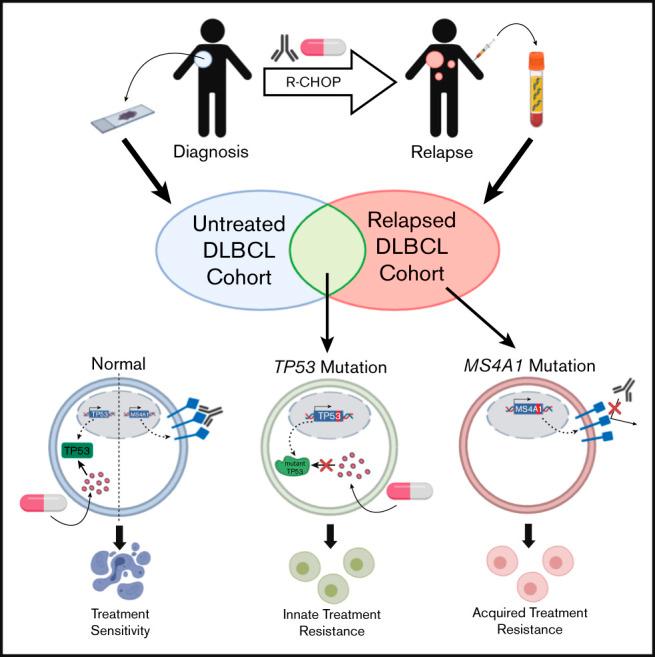
Diffuse large B-cell lymphoma (DLBCL) patients are typically treated with immunochemotherapy containing rituximab (rituximab, cyclophosphamide, hydroxydaunorubicin-vincristine (Oncovin), and prednisone [R-CHOP]); however, prognosis is extremely poor if R-CHOP fails. To identify genetic mechanisms contributing to primary or acquired R-CHOP resistance, we performed target-panel sequencing of 135 relapsed/refractory DLBCLs (rrDLBCLs), primarily comprising circulating tumor DNA from patients on clinical trials. Comparison with a metacohort of 1670 diagnostic DLBCLs identified 6 genes significantly enriched for mutations upon relapse. TP53 and KMT2D were mutated in the majority of rrDLBCLs, and these mutations remained clonally persistent throughout treatment in paired diagnostic-relapse samples, suggesting a role in primary treatment resistance. Nonsense and missense mutations affecting MS4A1, which encodes CD20, are exceedingly rare in diagnostic samples but show recurrent patterns of clonal expansion following rituximab-based therapy. MS4A1 missense mutations within the transmembrane domains lead to loss of CD20 in vitro, and patient tumors harboring these mutations lacked CD20 protein expression. In a time series from a patient treated with multiple rounds of therapy, tumor heterogeneity and minor MS4A1-harboring subclones contributed to rapid disease recurrence, with MS4A1 mutations as founding events for these subclones. TP53 and KMT2D mutation status, in combination with other prognostic factors, may be used to identify high-risk patients prior to R-CHOP for posttreatment monitoring. Using liquid biopsies, we show the potential to identify tumors with loss of CD20 surface expression stemming from MS4A1 mutations. Implementation of noninvasive assays to detect such features of acquired treatment resistance may allow timely transition to more effective treatment regimens.
弥漫性大 B 细胞淋巴瘤 (DLBCL) 患者通常接受包含利妥昔单抗的免疫化疗(利妥昔单抗、环磷酰胺、阿霉素 - 长春新碱 (Oncovin) 和泼尼松 [R-CHOP])治疗;然而,如果 R-CHOP 治疗失败,预后极差。为了确定导致原发性或获得性 R-CHOP 耐药的遗传机制,我们对 135 例复发/难治性 DLBCL(rrDLBCL)进行了靶向面板测序,主要包括临床试验中患者的循环肿瘤 DNA。与 1670 例诊断性 DLBCL 的荟萃队列比较,发现 6 个基因在复发时发生突变的频率明显增加。TP53 和 KMT2D 在大多数 rrDLBCL 中发生突变,这些突变在配对的诊断-复发样本中在整个治疗过程中保持克隆持续存在,提示其在原发性治疗耐药中起作用。影响 CD20 编码基因 MS4A1 的无义和错义突变在诊断样本中极为罕见,但在基于利妥昔单抗的治疗后显示出克隆扩展的反复模式。MS4A1 跨膜结构域内的错义突变导致 CD20 体外丢失,并且携带这些突变的患者肿瘤缺乏 CD20 蛋白表达。在一名接受多轮治疗的患者的时间序列中,肿瘤异质性和携带 MS4A1 的亚克隆导致疾病快速复发,MS4A1 突变是这些亚克隆的创始事件。TP53 和 KMT2D 突变状态,结合其他预后因素,可用于在接受 R-CHOP 治疗前识别高危患者,用于治疗后监测。通过液体活检,我们展示了识别源自 MS4A1 突变的 CD20 表面表达缺失肿瘤的潜力。实施非侵入性检测此类获得性治疗耐药特征的检测方法可能会及时过渡到更有效的治疗方案。
 Zotero 插件