
抗阻运动与高强度间歇训练或中等强度持续训练相结合的联合训练对代谢综合征的影响
The Effects of Concurrent Training Combining Both Resistance Exercise and High-Intensity Interval Training or Moderate-Intensity Continuous Training on Metabolic Syndrome.
作者信息
Da Silva Marco Antônio R, Baptista Liliana C, Neves Rafael S, De França Elias, Loureiro Helena, Lira Fabio Santos, Caperuto Erico C, Veríssimo Manuel T, Martins Raul A
机构信息
Faculty of Sport Sciences and Physical Education, University of Coimbra, Coimbra, Portugal.
Department of Physical Education, Universidade da Amazônia, Belém, Brazil.
出版信息
Front Physiol. 2020 Jun 11;11:572. doi: 10.3389/fphys.2020.00572. eCollection 2020.
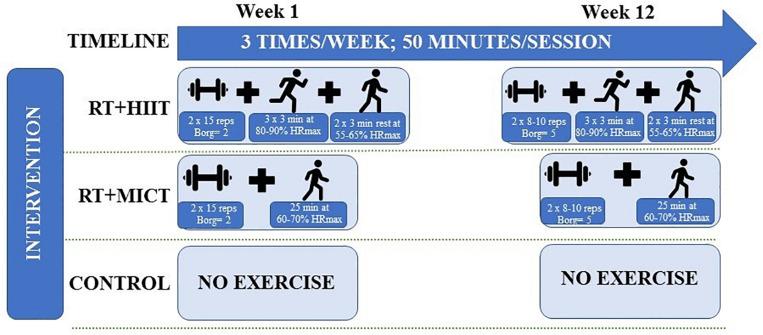
To date, there are several knowledge gaps on how to properly prescribe concurrent training to achieve the best dose-response, especially regarding the optimal intensity or volume of the aerobic component. Thus, the objective of this study is to analyze the effects of different aerobic exercise modes and intensities [i.e. aerobic high-intensity interval training (HIIT) versus moderate-intensity continuous aerobic training (MICT) combined with a resistance training (RT) program] on metabolic outcomes in participants with metabolic syndrome (MetS). Thirty-nine men and women (67.0 ± 6.7 years) volunteered to a 12-weeks exercise intervention (3 week, 50 min/session) and were randomly assigned to one of three groups: (a) RT plus MICT (RT+MICT) (2 males; 11 females); (b) RT plus HIIT (RT+HIIT) (4 males; 9 females); and (c) control group (CON) - without formal exercise (4 males; 9 females). Intensity was established between 60 and 70% of maximum heart rate (HRmax) in RT+MICT and ranged from 55-65% to 80-90% HRmax in the RT+HIIT group. Dependent outcomes included morphological, metabolic and hemodynamic variables. Both training groups improved waist circumference (RT+MICT: = 0.019; RT+HIIT: = 0.003), but not body weight, fat mass or fat-free mass ( ≥ 0.114). RT+HIIT group improved fasting glucose ( = 0.014), low density lipoprotein [LDL ( = 0.022)], insulin ( = 0.034) and homeostatic model assessment ( = 0.028). RT+MICT group reduced triglycerides ( = 0.053). Both exercise interventions did not change high sensitivity C-reactive protein, glycated hemoglobin, high density lipoprotein and total cholesterol, systolic, diastolic or mean arterial blood pressure ( ≥ 0.05). The CON group reduced the LDL ( = 0.031). This trial suggests that short-term exercise mode and intensity may differently impact the metabolic profile of individuals with MetS. Further, our data suggests that both concurrent trainings promote important cardiometabolic gains, particularly in the RT+HIIT. Nonetheless, due to the small-to-moderate effect size and the short-term intervention length, our data suggests that the intervention length also has an important modulating role in these benefits in older adults with MetS. Therefore, more research is needed to confirm our results using longer exercise interventions and larger groups.
迄今为止,在如何恰当地安排联合训练以实现最佳剂量反应方面存在一些知识空白,尤其是关于有氧训练部分的最佳强度或运动量。因此,本研究的目的是分析不同有氧运动模式和强度[即有氧高强度间歇训练(HIIT)与中等强度持续有氧运动训练(MICT)结合阻力训练(RT)计划]对代谢综合征(MetS)参与者代谢指标的影响。39名男性和女性(67.0±6.7岁)自愿参加为期12周的运动干预(每周3次,每次50分钟),并被随机分配到三个组之一:(a)RT加MICT(RT+MICT)组(2名男性;11名女性);(b)RT加HIIT(RT+HIIT)组(4名男性;9名女性);以及(c)对照组(CON)——不进行正式运动(4名男性;9名女性)。RT+MICT组的运动强度设定为最大心率(HRmax)的60%至70%,RT+HIIT组的运动强度范围为HRmax的55%-65%至80%-90%。相关指标包括形态学、代谢和血液动力学变量。两个训练组的腰围均有所改善(RT+MICT组: = 0.019;RT+HIIT组: = 0.003),但体重、脂肪量或去脂体重无变化( ≥ 0.114)。RT+HIIT组的空腹血糖( = 0.014)、低密度脂蛋白[LDL( = 0.022)]、胰岛素( = 0.034)和稳态模型评估( = 0.028)得到改善。RT+MICT组的甘油三酯降低( = 0.053)。两种运动干预均未改变高敏C反应蛋白、糖化血红蛋白、高密度脂蛋白和总胆固醇、收缩压、舒张压或平均动脉压( ≥ 0.05)。CON组的LDL降低( = 0.031)。该试验表明,短期运动模式和强度可能对MetS个体的代谢状况产生不同影响。此外,我们的数据表明,两种联合训练均能带来重要的心脏代谢益处,尤其是在RT+HIIT组。尽管如此,由于效应量小至中等且干预时间短,我们的数据表明干预时间对患有MetS的老年人的这些益处也具有重要的调节作用。因此,需要更多研究使用更长时间的运动干预和更大规模的人群来证实我们的结果。

 Zotero 插件