
CD19 和 CD20 靶向嵌合抗原受体 T 细胞联合给药治疗复发/难治性弥漫性大 B 细胞淋巴瘤的 II 期临床试验。
Phase II trial of co-administration of CD19- and CD20-targeted chimeric antigen receptor T cells for relapsed and refractory diffuse large B cell lymphoma.
机构信息
Department of Hematology, the Affiliated Hospital of Xuzhou Medical University, Xuzhou, China.
Cancer Institute, Xuzhou Medical University, Xuzhou, China.
出版信息
Cancer Med. 2020 Aug;9(16):5827-5838. doi: 10.1002/cam4.3259. Epub 2020 Jul 1.
PURPOSE
Anti-CD19 chimeric antigen receptor T (CAR-T) cell therapy has demonstrated remarkable efficacy for refractory and relapsed diffuse large B cell lymphoma (R/R DLBCL). However, this therapy failed in nearly 25% patients mainly due to antigen loss. The authors performed a phase Ⅱ trial by coadministration of anti-CD19 and anti-CD20 CAR-T cells treatment for R/R DLBCL and evaluated its efficacy and toxicity.
METHODS
Totally 21 patients with DLBCL were enrolled in this study. The patients were conditioned with fludarabine and cyclophosphamide before the infusion of anti-CD19 and anti-CD20 CAR-T cells. Treatment response, toxicity, and persistence were monitored continuously.
RESULTS
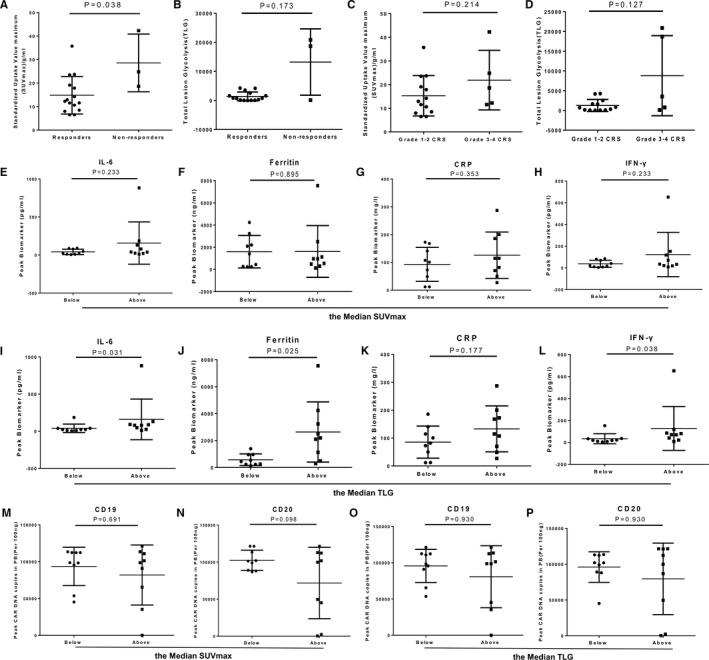
Of the 21 patients received the treatment, the objective response rate (ORR) is 81.0% (95% confidence interval [CI], 58.1%-94.6%) with four cases of bulk (4/5) and one case of testis involvement; 52.4% (95% CI, 29.8%-74.3%) had a complete response (CR). Peak levels of anti-CD19 and anti-CD20 CAR cells were associated with response (P = .007 and .002). Grade 3-4 cytokine release syndrome (CRS) and neurologic events occurred in 28.5% and 9.5% patients, respectively. Median overall survival (OS) and progression-free survival (PFS) were 8.1 and 5.0 months, respectively. The maximum standard uptake value (SUVmax) of CD4/CD8 ratio before and after infusion were associated with responses, and the total lesion glycolysis (TLG) before infusion correlates with cytokines level.
CONCLUSIONS
Coadministration of anti-CD19 and CD20 CAR-T cells therapy for DLBCL is feasible with manageable toxicity. Cytokine markers are related to toxicity and SUVmax could predict efficacy. This trial was registered at www.clinicaltrials.gov as NCT03207178.
目的
嵌合抗原受体 T(CAR-T)细胞抗 CD19 治疗在复发/难治弥漫性大 B 细胞淋巴瘤(R/R DLBCL)中显示出显著疗效。然而,该疗法在近 25%的患者中失败,主要是由于抗原丢失。作者进行了一项 R/R DLBCL 患者联合使用抗 CD19 和抗 CD20 CAR-T 细胞治疗的 II 期试验,并评估了其疗效和毒性。
方法
本研究共纳入 21 例 DLBCL 患者。患者在输注抗 CD19 和抗 CD20 CAR-T 细胞前接受氟达拉滨和环磷酰胺预处理。连续监测治疗反应、毒性和持续时间。
结果
21 例患者接受治疗,客观缓解率(ORR)为 81.0%(95%置信区间 [CI],58.1%-94.6%),4 例肿块(4/5)和 1 例睾丸受累;完全缓解(CR)率为 52.4%(95% CI,29.8%-74.3%)。抗 CD19 和抗 CD20 CAR 细胞的峰值水平与反应相关(P =.007 和.002)。3-4 级细胞因子释放综合征(CRS)和神经系统事件分别发生在 28.5%和 9.5%的患者中。中位总生存期(OS)和无进展生存期(PFS)分别为 8.1 和 5.0 个月。输注前后 CD4/CD8 比值的最大标准摄取值(SUVmax)与反应相关,输注前的总病变糖酵解(TLG)与细胞因子水平相关。
结论
联合使用抗 CD19 和 CD20 CAR-T 细胞治疗 DLBCL 是可行的,毒性可控制。细胞因子标志物与毒性相关,SUVmax 可预测疗效。该试验在 www.clinicaltrials.gov 注册,编号为 NCT03207178。


 Zotero 插件