
采用新型饲料添加药物制剂时鸡体内钙的生物利用度更高。
Higher Bioavailability of Calcium in Chickens With a Novel In-Feed Pharmaceutical Formulation.
作者信息
Carrillo Lizbeth, Bernad María-José, Monroy-Barreto Minerva, Coello Carlos L, Sumano Héctor, Gutiérrez Lilia
机构信息
Departamento de Fisiología y Farmacología, Facultad de Medicina Veterinaria, Universidad Nacional Autónoma de México, Ciudad de México, Mexico.
Departamento de Farmacia, Facultad de Química, Universidad Nacional Autónoma de México, Ciudad de México, Mexico.
出版信息
Front Vet Sci. 2020 Jun 17;7:343. doi: 10.3389/fvets.2020.00343. eCollection 2020.
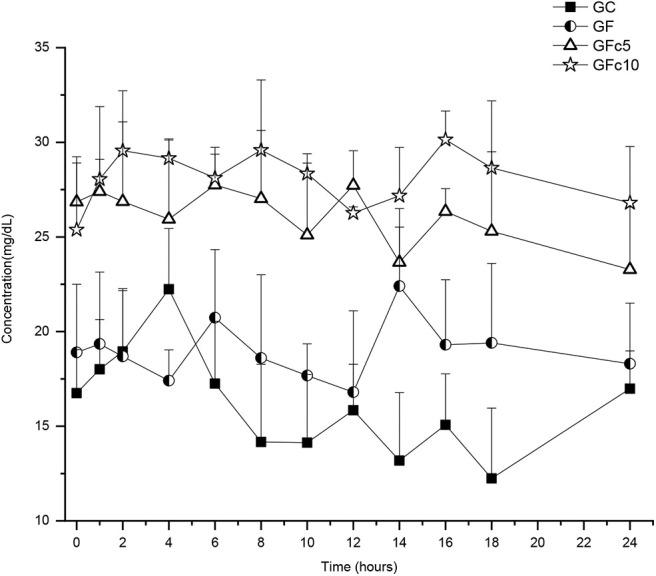
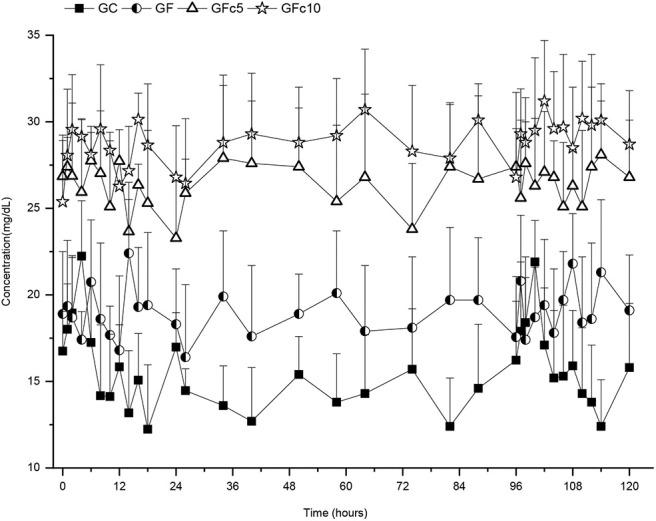
Egg production and egg shell quality decrease toward the end of the first laying cycle in hens (approximately by week 80). Even so, farmers often choose to work a second cycle with them. Defective egg shell production has been mainly linked to a decrease in gastrointestinal absorption of calcium. Here we studied pharmaceutically-designed modified-release small pellets (FOLAs) containing calcium to improve calcium bioavailability (F). The influence of FOLA alone or with capsicum-oleoresin was studied in a total of 400 Bovans-White hens randomly divided into four groups of 20 laying hens each and with five replicates per group ( = 100) as follows: (1) control group (GC) receiving a diet containing basal levels of 4.1% of calcium-carbonate; (2) group GF treated as GC but with the same dose of calcium-carbonate in FOLA; (3) group GFc5 was treated as GF but with 6 ppm of capsicum-oleoresin (500,000 Scoville Heat Units [SHU]); and (4) group GFc10 treated as GFc5 but with 1,000,000 SHU capsicum-oleoresin. Plasma concentrations of calcium were determined during 5 days at predetermined times sampling more often on days 1 and 5 for blood plasma kinetics of calcium. Relative bioavailability (Fr) values based on the area under the serum calcium concentration vs. time curve (AUC) were obtained and compared to GC. The AUC was statistically different among all groups ( < 0.5), but the GFc10 had the greatest Fr (194%), with serum calcium concentrations ranging from 25.37 to 31.2 μg/dL. Calcium residence time (RT) between GC and GF showed no statistical differences while GFc5 and GFc10 had statistically superior RT values. Simultaneously, the number of shell-less eggs per group and their thickness was evaluated by utilizing the same groups but with 150 hens per group on 6 days. Shell-less eggs decreased to zero in Group GFc10 and produced eggs with the greatest shell thickness from day 2 onwards. The inclusion of calcium-carbonate in the pharmaceutical form FOLA induced higher serum calcium concentrations (GF, GFc5, and GFc10) particularly during the night-phase of the hen's cycle-this coincides with the time at which egg shell formation occurs.
母鸡在第一个产蛋周期接近尾声时(大约在第80周),产蛋量和蛋壳质量会下降。即便如此,养殖户通常仍会选择让它们进入第二个产蛋周期。蛋壳缺陷主要与胃肠道对钙的吸收减少有关。在此,我们研究了经药物设计的含钙缓释小丸(FOLAs),以提高钙的生物利用度(F)。单独使用FOLA或与辣椒油树脂联合使用的影响,在总共400只博万斯 - 怀特母鸡中进行了研究,这些母鸡被随机分为四组,每组20只产蛋母鸡,每组有五个重复(共100只),分组如下:(1)对照组(GC),接受含有基础水平4.1%碳酸钙的日粮;(2)GF组,处理方式同GC组,但日粮中碳酸钙剂量相同,以FOLA形式提供;(3)GFc5组,处理方式同GF组,但添加6 ppm辣椒油树脂(500,000史高维尔辣度单位[SHU]);(4)GFc10组,处理方式同GFc5组,但添加1,000,000 SHU辣椒油树脂。在5天内的预定时间测定血浆钙浓度,在第1天和第5天更频繁地采样以研究钙的血浆动力学。基于血清钙浓度与时间曲线下面积(AUC)获得相对生物利用度(Fr)值,并与GC组进行比较。所有组之间的AUC存在统计学差异(P < 0.5),但GFc10组的Fr最高(194%),血清钙浓度范围为25.37至31.2 μg/dL。GC组和GF组之间的钙驻留时间(RT)无统计学差异,而GFc5组和GFc10组的RT值在统计学上更优。同时,利用相同的分组,但每组150只母鸡,在6天内评估每组无壳蛋的数量及其厚度。GFc10组的无壳蛋数量降至零,并且从第2天起产出的蛋蛋壳厚度最大。以FOLA形式添加碳酸钙会导致血清钙浓度升高(GF组、GFc5组和GFc10组),特别是在母鸡产蛋周期的夜间阶段——这与蛋壳形成的时间相吻合。
 Zotero 插件