
埃塞俄比亚麻疹免疫覆盖率的不平等:2000-2016 年人口与健康调查的横断面分析。
Inequalities in measles immunization coverage in Ethiopia: a cross-sectional analysis of demographic and health surveys 2000-2016.
机构信息
Department of Reproductive, Family and Population Health, School of Public Health, Addis Ababa University, Addis Ababa, Ethiopia.
Shewarobit Field Office, HaSET Maternal and Child Health Research Program, Addis Ababa, Ethiopia.
出版信息
BMC Infect Dis. 2020 Jul 7;20(1):481. doi: 10.1186/s12879-020-05201-5.
BACKGROUND
Ethiopia has low measles immunization coverage and little is known about the disparities surrounding what coverage is provided. This study assessed disparities in measles immunization and its change over time using the four Ethiopia Demographic and Health Surveys conducted between 2000 and 2016.
METHODS
This is a cross-sectional analysis of data using Ethiopia Demographic and Health Surveys (EDHS) conducted between 2000 and 2016. We used the World Health Organization's (WHO) Health Equity Assessment Toolkit (HEAT) to present the inequalities. Four measures of inequality were calculated: Difference (D), Ratio (R), Population Attributable Fraction (PAF) and Population Attributable Risk (PAR). The results were disaggregated by wealth, education, residence, sex and sub-national regions and 95% Uncertainty Intervals (UIs) were computed for each point estimate to boost confidence of the findings.
RESULTS
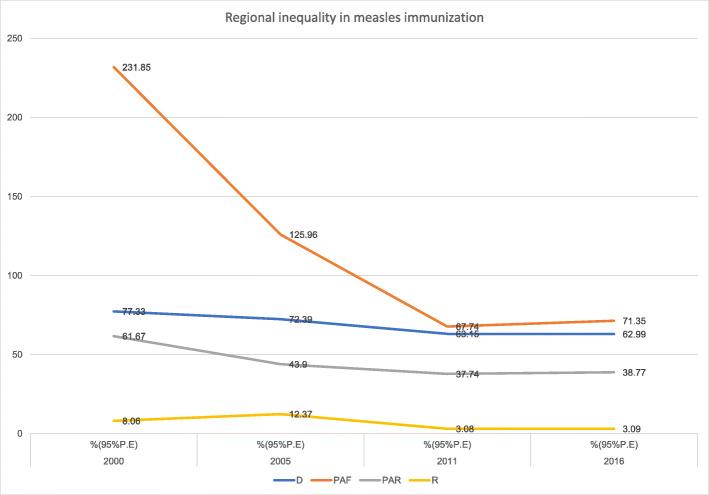
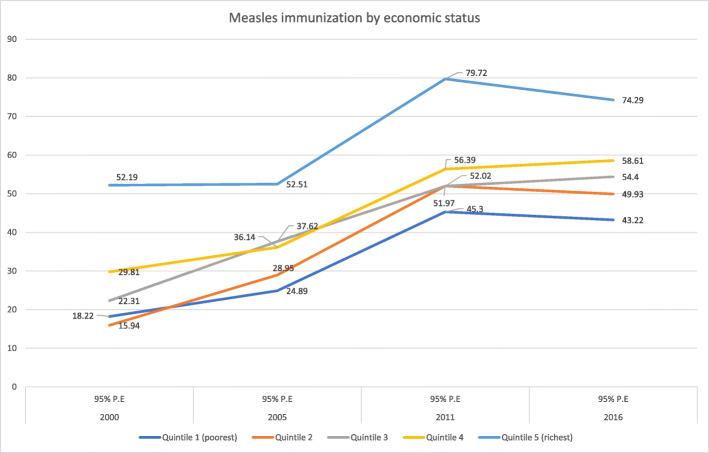
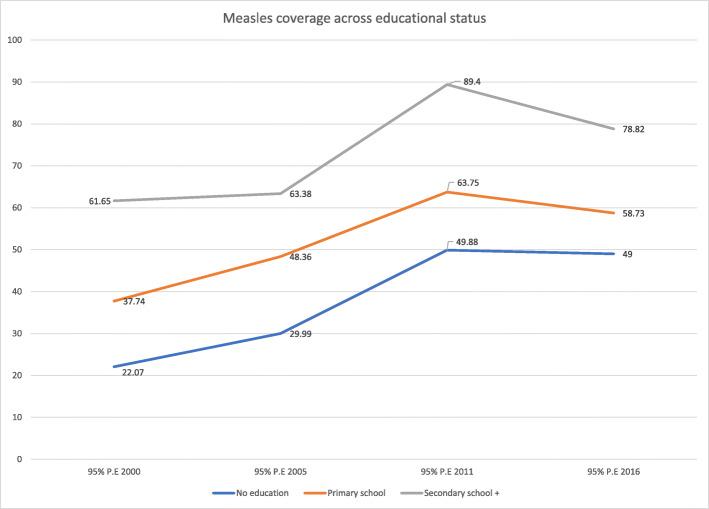
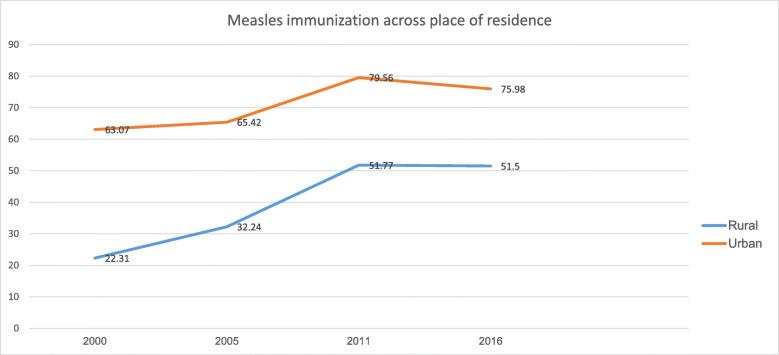
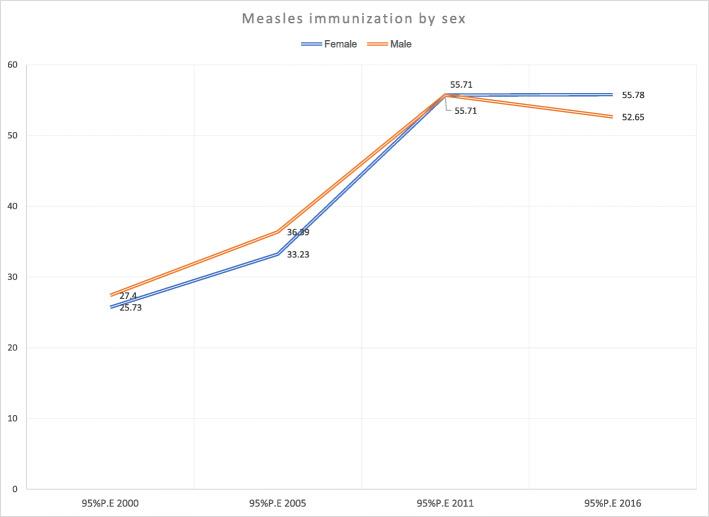
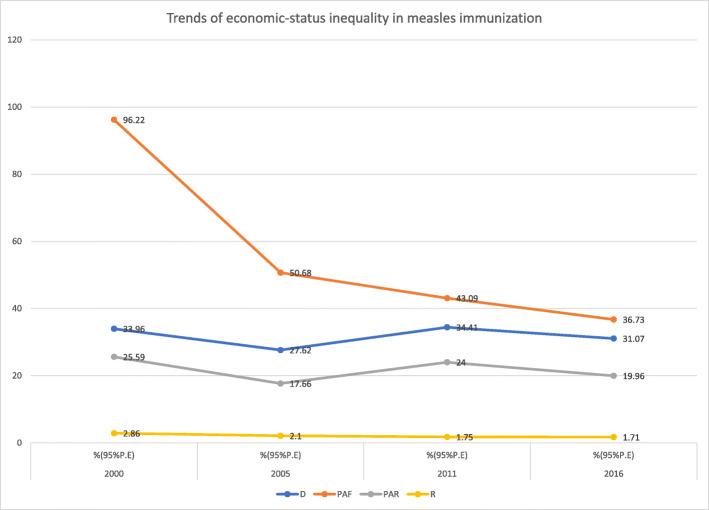
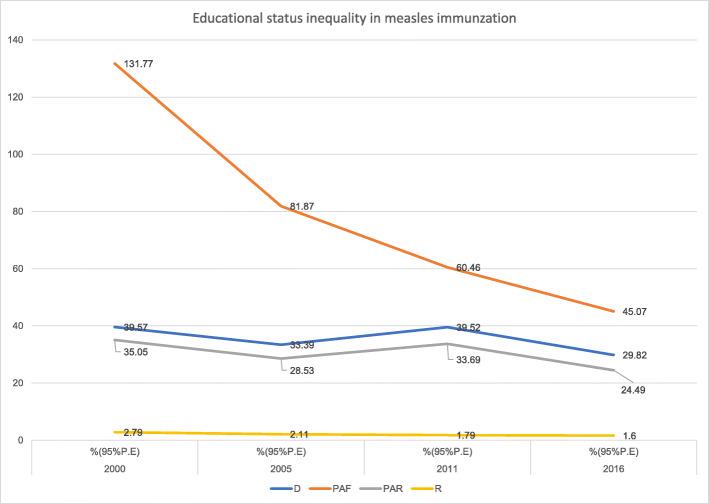
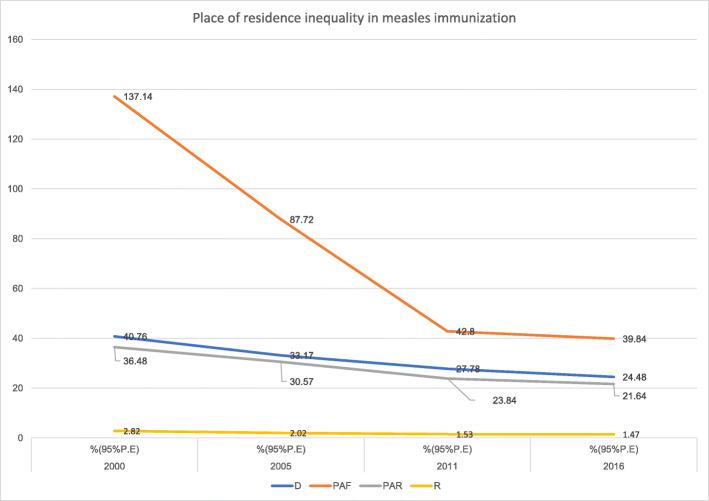
Measles immunization coverage was higher among the richest and secondary and above schools' subgroup by nearly 30 to 31 percentage points based on point estimates (D = 31%; 95% CI; 19.48, 42.66) and 29.8 percentage points (D = 29.8%; 95% CI; 16.57, 43.06) as compared to the poorest and no education subgroup respectively in the 2016 survey. Still, in the 2016 survey, substantial economic status (PAF = 36.73; 95%CI: 29.78, 43.68), (R = 1.71; 95%CI: 1.35, 2.08), education status (PAF = 45.07; 95% CI: 41.95, 48.18), (R = 1.60; 95% CI: 1.30, 1.90), place of residence (PAF = 39.84, 95% CI: 38.40, 41.27), (R = 1.47, 95% CI: 1.20, 1. 74) and regional (PAF = 71.35, 95% CI: 31.76, 110.95), (R = 3.09, 95%CI: 2.01, 4.17) inequality were observed with both simple and complex measures. There was no statistically significant difference in the prevalence of measles immunization between male and female children in all the studied years, as indicated, for instance, by measures of PAF in 2000 (PAF = 0; 95%CI: - 6.79, 6.79), 2005 (PAF = 0; 95%CI: - 6.04, 6.04), 2011(PAF = 0; 95%CI: - 3.79, 3.79) and 2016 (PAF = 2.66; - 1.67; 6.99). Overall, the inequality of measles immunization narrowed significantly by at least some of the measures between the first and the last survey periods across all the studied subgroups.
CONCLUSIONS
National, regional and district levels of government should make a pledge to reduce inequalities in coverage of measles immunization. Equity-sensitive strategies, sufficient human and financial resources as well as continued research and monitoring of immunization coverage inequalities are necessary to achieve related sustainable development goals.
背景
埃塞俄比亚的麻疹免疫覆盖率较低,对提供的覆盖率存在差异的情况知之甚少。本研究使用 2000 年至 2016 年期间进行的四次埃塞俄比亚人口与健康调查,评估了麻疹免疫接种的差异及其随时间的变化。
方法
这是对 2000 年至 2016 年期间进行的埃塞俄比亚人口与健康调查(EDHS)数据的横断面分析。我们使用世界卫生组织(WHO)的健康公平评估工具包(HEAT)来呈现不平等现象。计算了四种不平等衡量标准:差异(D)、比率(R)、人群归因分数(PAF)和人群归因风险(PAR)。结果按财富、教育、居住地、性别和次国家地区进行了细分,并为每个点估计值计算了 95%的置信区间(UI),以提高发现结果的可信度。
结果
根据点估计值,最富有的和接受过中等和以上教育的亚组的麻疹免疫接种率比最贫穷的和没有接受过教育的亚组高近 30-31 个百分点(D=31%;95%置信区间;19.48,42.66)和 29.8%(D=29.8%;95%置信区间;16.57,43.06)。尽管如此,在 2016 年的调查中,仍然存在显著的经济地位(PAF=36.73;95%CI:29.78,43.68)、(R=1.71;95%CI:1.35,2.08)、教育地位(PAF=45.07;95%CI:41.95,48.18)、(R=1.60;95%CI:1.30,1.90)、居住地(PAF=39.84,95%CI:38.40,41.27)、(R=1.47;95%CI:1.20,1.74)和区域(PAF=71.35,95%CI:31.76,110.95)、(R=3.09;95%CI:2.01,4.17),这表明存在复杂的不平等现象。在所有研究年份中,男童和女童的麻疹免疫接种率均无统计学差异,例如,2000 年的 PAF 测量值(PAF=0;95%CI:-6.79,6.79)、2005 年(PAF=0;95%CI:-6.04,6.04)、2011 年(PAF=0;95%CI:-3.79,3.79)和 2016 年(PAF=2.66;-1.67;6.99)均为零。总的来说,在所有研究的亚组中,麻疹免疫接种的不平等程度至少在某些方面随着第一和最后调查期间的缩小而显著降低。
结论
国家、地区和地区各级政府应承诺减少麻疹免疫接种覆盖率的不平等。为了实现相关的可持续发展目标,需要采取公平敏感的战略,提供充足的人力和财力资源,并继续研究和监测免疫接种覆盖率的不平等。
 Zotero 插件