
托珠单抗治疗 COVID-19 机械通气患者。
Tocilizumab for Treatment of Mechanically Ventilated Patients With COVID-19.
机构信息
Department of Internal Medicine, University of Michigan, Ann Arbor, Michigan, USA.
Department of Environmental Health Sciences, University of Michigan, Ann Arbor, Michigan, USA.
出版信息
Clin Infect Dis. 2021 Jul 15;73(2):e445-e454. doi: 10.1093/cid/ciaa954.
BACKGROUND
Severe coronavirus disease 2019 (COVID-19) can manifest in rapid decompensation and respiratory failure with elevated inflammatory markers, consistent with cytokine release syndrome for which IL-6 blockade is an approved treatment.
METHODS
We assessed effectiveness and safety of IL-6 blockade with tocilizumab in a single-center cohort of patients with COVID-19 requiring mechanical ventilation. The primary endpoint was survival probability postintubation; secondary analyses included an ordinal illness severity scale integrating superinfections. Outcomes in patients who received tocilizumab compared with tocilizumab-untreated controls were evaluated using multivariable Cox regression with propensity score inverse probability of treatment weighting (IPTW).
RESULTS
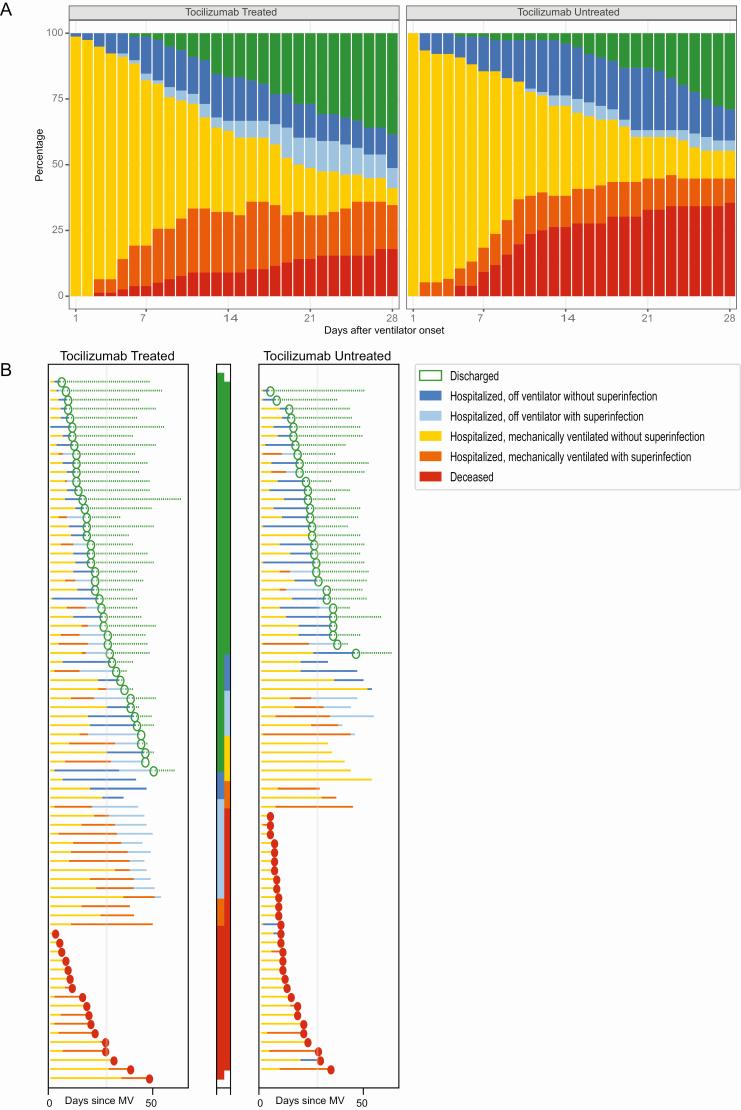
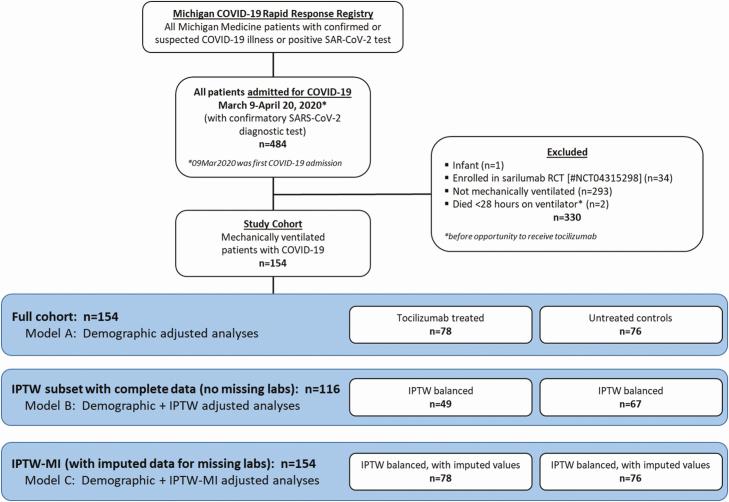
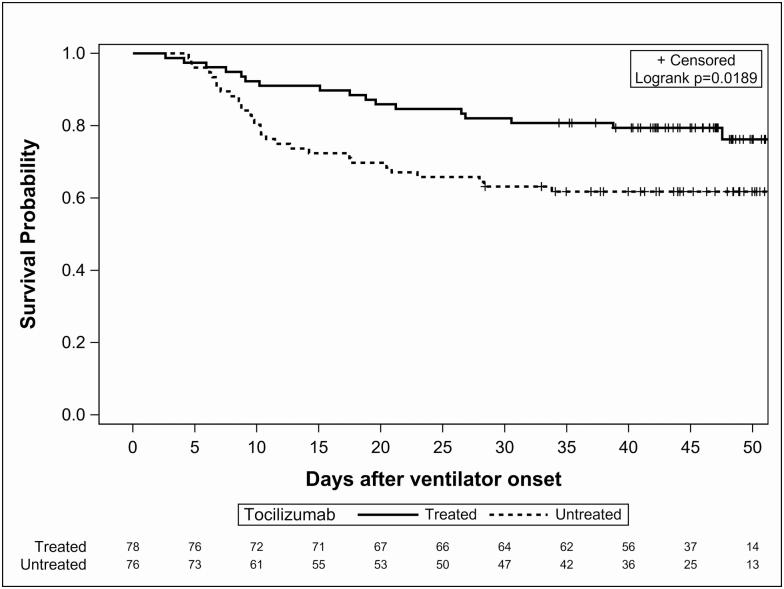
154 patients were included, of whom 78 received tocilizumab and 76 did not. Median follow-up was 47 days (range, 28-67). Baseline characteristics were similar between groups, although tocilizumab-treated patients were younger (mean: 55 vs 60 years), less likely to have chronic pulmonary disease (10% vs 28%), and had lower D-dimer values at time of intubation (median: 2.4 vs 6.5 mg/dL). In IPTW-adjusted models, tocilizumab was associated with a 45% reduction in hazard of death (HR, .55; 95% CI, .33-.90) and improved status on the ordinal outcome scale [OR per 1-level increase, .58; .36-.94). Although tocilizumab was associated with an increased proportion of patients with superinfections (54% vs 26%; P < .001), there was no difference in 28-day case fatality rate among tocilizumab-treated patients with versus without superinfection (22% vs 15%; P = .42). Staphylococcus aureus accounted for ~50% of bacterial pneumonia.
CONCLUSIONS
In this cohort of mechanically ventilated COVID-19 patients, tocilizumab was associated with lower mortality despite higher superinfection occurrence.
背景
严重的 2019 年冠状病毒病(COVID-19)可表现为炎症标志物升高导致的快速失代偿和呼吸衰竭,符合细胞因子释放综合征,其 IL-6 阻断是一种已批准的治疗方法。
方法
我们评估了托珠单抗治疗 COVID-19 机械通气患者的疗效和安全性。主要终点是插管后存活概率;次要分析包括整合了继发感染的疾病严重程度序数量表。采用多变量 Cox 回归和倾向评分逆概率治疗加权(IPTW)比较接受托珠单抗治疗与未接受托珠单抗治疗的患者的结局。
结果
共纳入 154 例患者,其中 78 例接受托珠单抗治疗,76 例未接受托珠单抗治疗。中位随访时间为 47 天(范围 28-67 天)。两组患者的基线特征相似,但托珠单抗治疗组患者年龄较小(平均 55 岁 vs 60 岁)、慢性肺部疾病较少(10% vs 28%),插管时 D-二聚体值较低(中位数 2.4 毫克/分升 vs 6.5 毫克/分升)。在 IPTW 调整模型中,托珠单抗与死亡风险降低 45%相关(风险比,0.55;95%CI,0.33-0.90),改善了序数结局量表上的状态[每增加 1 级的比值比,0.58;0.36-0.94]。尽管托珠单抗与继发感染患者比例增加有关(54% vs 26%;P<0.001),但继发感染的 COVID-19 机械通气患者 28 天病死率无差异(22% vs 15%;P=0.42)。金黄色葡萄球菌约占细菌性肺炎的 50%。
结论
在本队列中,与更高的继发感染发生率相比,COVID-19 机械通气患者接受托珠单抗治疗与死亡率降低相关。
 Zotero 插件