
维生素 D 缺乏和空气污染通过抑制抗病毒肽 LL37 加重 COVID-19。
Vitamin D Deficiency and Air Pollution Exacerbate COVID-19 Through Suppression of Antiviral Peptide LL37.
机构信息
Department of Immunology and Microbiology, Geisel School of Medicine at Dartmouth, Lebanon, NH, United States.
Bodymind Science, LLC, Arlington, VT, United States.
出版信息
Front Public Health. 2020 May 28;8:232. doi: 10.3389/fpubh.2020.00232. eCollection 2020.
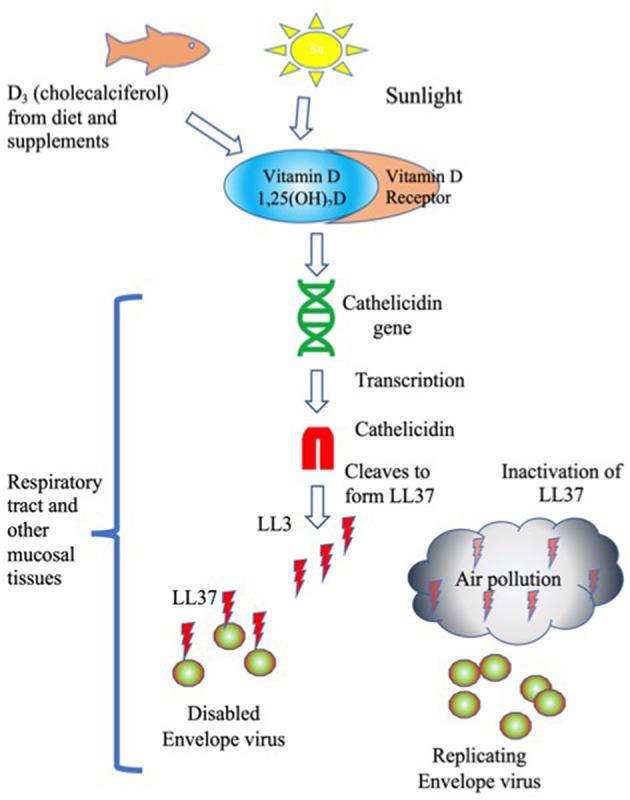
Vitamin D deficiency and insufficiency (VDD) are widely recognized as risk factors for respiratory tract infections. Vitamin D influences expression of many genes with well-established relevance to airway infections and relevant to immune system function. Recently, VDD has been shown to be a risk factor for acquisition and severity of COVID-19. Thus, treating VDD presents a safe and inexpensive opportunity for modulating the severity of the disease. VDD is common in those over 60 years of age, many with co-morbid conditions and in people with skin pigmentation sufficient to reduce synthesis of vitamin D. Exposure to fine particulate air pollution is also associated with worse outcomes from COVID19. Vitamin D stimulates transcription of cathelicidin which is cleaved to generate LL37. LL37 is an innate antimicrobial with demonstrated activity against a wide range of microbes including envelope viruses. LL37 also modulates cytokine signaling at the site of infections. Fine particles in air pollution can interfere with LL37 destruction of viruses and may reduce effective immune signaling modulation by LL37. While vitamin D influences transcription of many immune related genes, the weakened antimicrobial response of those with VDD against SARS-CoV-2 may be in part due to reduced LL37. Vitamin D plays an important role reducing the impact of viral lung disease processes. VDD is an acknowledged public health threat that warrants population-wide action to reduce COVID-19 morbidity and mortality. While vitamin D influences transcription of many immune related genes, the weakened antimicrobial response of those with VDD against SARS-CoV-2 may be in part due to reduced LL37. Action is needed to address COVID-19 associated risks of air pollution from industry, transportation, domestic sources and from primary and second hand tobacco smoke.
维生素 D 缺乏和不足(VDD)被广泛认为是呼吸道感染的危险因素。维生素 D 影响许多与气道感染相关的基因的表达,这些基因与免疫系统功能有关。最近,VDD 已被证明是 COVID-19 发病和严重程度的一个危险因素。因此,治疗 VDD 为调节疾病严重程度提供了一个安全且廉价的机会。VDD 在 60 岁以上的人群中很常见,许多人患有合并症,并且皮肤色素沉着足以减少维生素 D 的合成。细颗粒物空气污染的暴露也与 COVID19 预后不良有关。维生素 D 刺激抗菌肽 cathelicidin 的转录,然后被切割生成 LL37。LL37 是一种先天抗菌肽,对多种微生物包括包膜病毒具有活性。LL37 还可调节感染部位的细胞因子信号。空气污染中的细颗粒物会干扰 LL37 对病毒的破坏作用,并可能降低 LL37 通过有效免疫信号调节的作用。虽然维生素 D 影响许多与免疫相关的基因的转录,但 VDD 患者对 SARS-CoV-2 的抗菌反应减弱可能部分归因于 LL37 的减少。维生素 D 在减轻病毒引起的肺部疾病过程方面发挥着重要作用。VDD 是一个公认的公共卫生威胁,需要在人群中采取行动,以降低 COVID-19 的发病率和死亡率。虽然维生素 D 影响许多与免疫相关的基因的转录,但 VDD 患者对 SARS-CoV-2 的抗菌反应减弱可能部分归因于 LL37 的减少。需要采取行动解决与工业、交通、家庭来源以及一手和二手烟草烟雾有关的 COVID-19 相关空气污染风险。
 Zotero 插件