
现代滤泡性淋巴瘤:生存、治疗结果和高危亚组的识别。
Follicular lymphoma in the modern era: survival, treatment outcomes, and identification of high-risk subgroups.
机构信息
Department of Medicine, Lymphoma Service, Memorial Sloan Kettering Cancer Center, New York, NY, USA.
Department of Epidemiology and Biostatistics, Memorial Sloan Kettering Cancer Center, New York, NY, USA.
出版信息
Blood Cancer J. 2020 Jul 17;10(7):74. doi: 10.1038/s41408-020-00340-z.
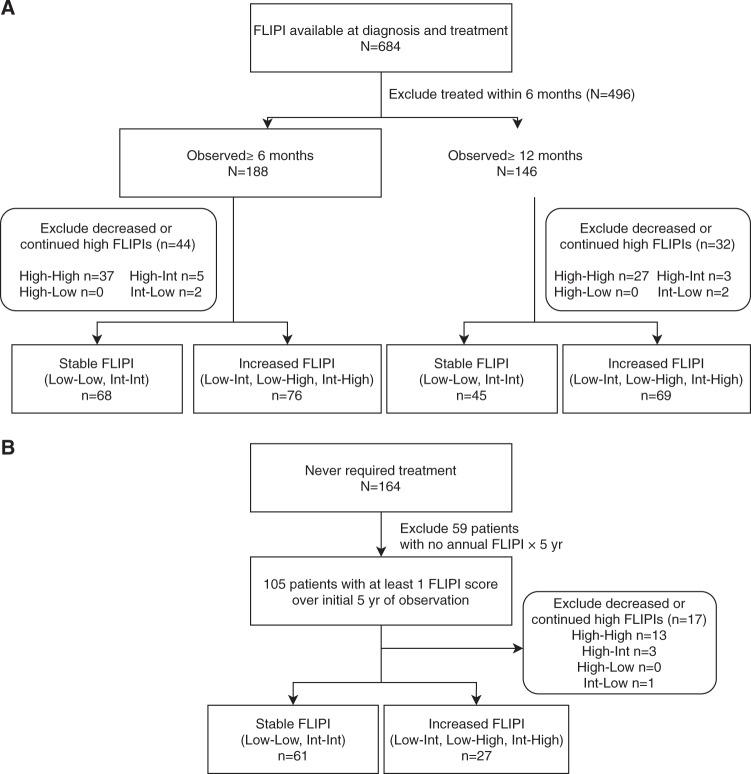
Patients with follicular lymphoma (FL) frequently require multiple treatments during their disease course; however, survival based on lines of treatment remains poorly described in the post-rituximab era. Also, the Follicular Lymphoma International Prognostic Index (FLIPI) score was developed to predict survival at diagnosis, yet it remains unknown whether increase in FLIPI score following an initial observation period is associated with less-favorable outcomes. To address these knowledge gaps, we retrospectively studied 1088 patients with FL grade 1-3A managed between 1998 and 2009 at our institution. Median overall survival (OS) and progression-free survival (PFS) after first-line treatment were not reached and 4.73 years, respectively. Following successive lines of treatment, years of median OS and PFS were, respectively: after second-line, 11.7 and 1.5; third-line, 8.8 and 1.1; fourth-line, 5.3 and 0.9; fifth-line, 3.1 and 0.6; sixth-line, 1.9 and 0.5. In initially observed, subsequently treated patients, FLIPI score increase after observation was associated with inferior survival following first-line treatment. The reduced survival we observed after second-line and later therapy supports the development of new treatments for relapsed patients and benchmarks historical targets for clinical endpoints. This study also highlights the utility of changes in FLIPI score at diagnosis and after observation in identifying patients likely to have worse outcomes.
滤泡性淋巴瘤(FL)患者在疾病过程中经常需要多次治疗;然而,在利妥昔单抗时代之后,基于治疗线的生存情况仍描述不佳。此外,滤泡性淋巴瘤国际预后指数(FLIPI)评分旨在预测诊断时的生存情况,但尚不清楚初始观察期后 FLIPI 评分的增加是否与预后较差相关。为了解决这些知识空白,我们回顾性研究了 1998 年至 2009 年在我们机构接受治疗的 1088 例 1-3A 级滤泡性淋巴瘤患者。首次治疗后的中位总生存期(OS)和无进展生存期(PFS)均未达到,分别为 4.73 年。在接受连续治疗后,中位 OS 和 PFS 的年数分别为:二线治疗后为 11.7 和 1.5;三线治疗后为 8.8 和 1.1;四线治疗后为 5.3 和 0.9;五线治疗后为 3.1 和 0.6;六线治疗后为 1.9 和 0.5。在最初观察、随后治疗的患者中,观察后 FLIPI 评分增加与一线治疗后生存状况较差相关。我们在二线及以后治疗中观察到的生存减少支持为复发患者开发新的治疗方法,并为临床终点设定历史目标。这项研究还强调了在诊断时和观察后 FLIPI 评分变化在识别可能预后较差的患者方面的效用。


 Zotero 插件