
近期发病的1型糖尿病治疗反应的定量测量。
A quantitative measure of treatment response in recent-onset type 1 diabetes.
作者信息
Bundy Brian N, Krischer Jeffrey P
机构信息
Health Informatics Institute University of South Florida Tampa FL USA.
出版信息
Endocrinol Diabetes Metab. 2020 May 14;3(3):e00143. doi: 10.1002/edm2.143. eCollection 2020 Jul.
INTRODUCTION
This paper develops a methodology and defines a measure that can be used to separate subjects that received an experimental therapy into those that benefitted from those that did not in recent-onset type 1 diabetes. Benefit means a slowing (or arresting) the decline in beta-cell function over time. The measure can be applied to comparing treatment arms from a clinical trial or to response at the individual level.
METHODS
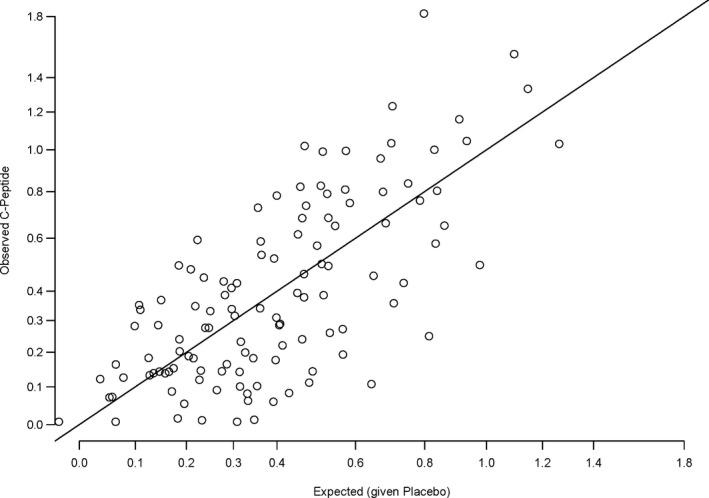
An analysis of covariance model was fitted to the 12-month area under the curve C-peptide following a 2-hour mixed meal tolerance test from 492 individuals enrolled on five TrialNet studies of recent-onset type 1 diabetes. Significant predictors in the model were age and C-peptide at study entry. The observed minus the model-based expected C-peptide value (quantitative response, QR) is defined to reflect the effect of the therapy.
RESULTS
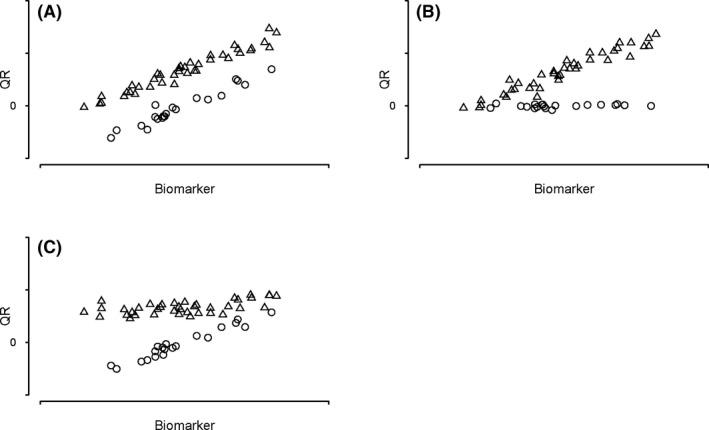
A comparison of the primary hypothesis test for each study included and a t test of the QR value by treatment group were comparable. The results were also confirmed for a new TrialNet study, independent of the set of studies used to derive the model. With our proposed analytical method and using QR as the end-point, we conducted simulation studies, to estimate statistical power in detecting a biomarker that expresses differential treatment effect. The QR in its continuous form provided the greatest statistical power when compared to several ways of defining responder/non-responder using various QR thresholds.
CONCLUSIONS
This paper illustrates the use of the QR, as a measure of the magnitude of treatment effect at the aggregate and subject-level. We show that the QR distribution by treatment group provides a better sense of the treatment effect than simply giving the mean estimates. Using the QR in its continuous form is shown to have higher statistical power in comparison with dichotomized categorization.
引言
本文开发了一种方法并定义了一种度量,可用于将接受实验性治疗的近期发病1型糖尿病患者分为受益组和未受益组。受益是指随着时间推移β细胞功能下降减缓(或停止)。该度量可用于比较临床试验中的治疗组或个体水平的反应。
方法
对492名参加五项近期发病1型糖尿病TrialNet研究的个体进行2小时混合餐耐量试验后12个月C肽曲线下面积拟合协方差分析模型。模型中的显著预测因素为研究入组时的年龄和C肽。观察到的C肽值减去基于模型预期的C肽值(定量反应,QR)被定义为反映治疗效果。
结果
对纳入的每项研究的主要假设检验以及按治疗组对QR值进行的t检验具有可比性。对于一项新的TrialNet研究也证实了该结果,该研究独立于用于推导模型的研究集。使用我们提出的分析方法并以QR作为终点,我们进行了模拟研究,以估计检测表达差异治疗效果的生物标志物的统计功效。与使用各种QR阈值定义反应者/非反应者的几种方法相比,连续形式的QR提供了最大的统计功效。
结论
本文阐述了使用QR作为总体和个体水平治疗效果大小的度量。我们表明,按治疗组划分的QR分布比简单给出均值估计更能体现治疗效果。与二分法分类相比,使用连续形式的QR显示具有更高的统计功效。


 Zotero 插件