
揭示微粒对地质聚合物合成及孔隙率的影响。
Revealing the Influence of Microparticles on Geopolymers' Synthesis and Porosity.
作者信息
Burduhos Nergis Dumitru Doru, Vizureanu Petrica, Ardelean Ioan, Sandu Andrei Victor, Corbu Ofelia Cornelia, Matei Ecaterina
机构信息
Faculty of Materials Science and Engineering, Gheorghe Asachi Technical University of Iași, 700050 Iasi, Romania.
Department of Physics and Chemistry, Technical University of Cluj Napoca, 400114 Cluj-Napoca, Romania.
出版信息
Materials (Basel). 2020 Jul 18;13(14):3211. doi: 10.3390/ma13143211.
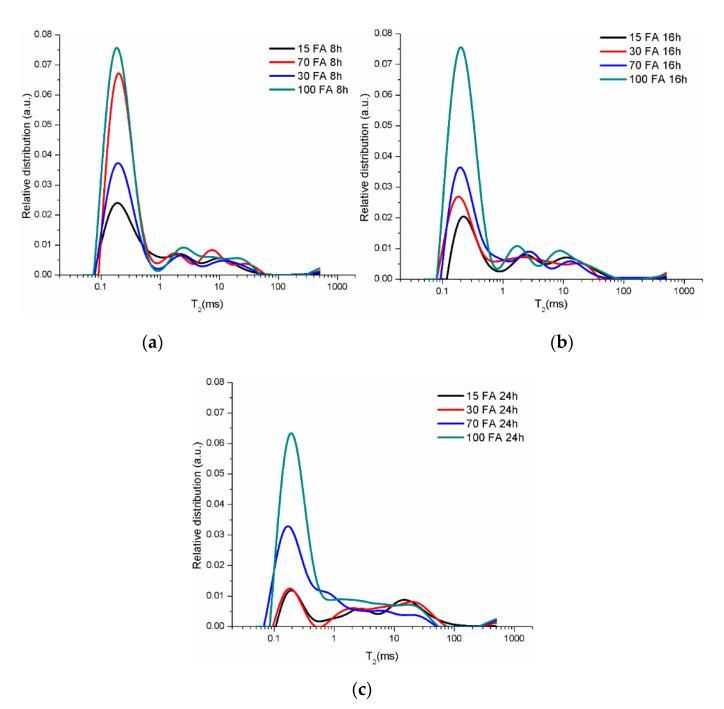
Geopolymers are zeolites like structures based on hydrated aluminosilicates units of SiO and AlO. These units, known as poly(sialate), poly(sialate)-siloxo or poly(sialate)-disiloxo are chemically balanced by the group I cations of K, Li, or Na. Simultaneously, the chemical reaction of formation, known as geopolymerization, governs the orientation of the unit, generating mesoporous structures. Multiple methods can be used for pore structure and porosity characterization. Among them, nuclear magnetic resonance (NMR) relaxometry allows the detection of the porous structure in a completely nonperturbative manner. NMR relaxometry may be used to monitor the relaxation of protons belonging to the liquid molecules confined inside the porous structure and, thus, to get access to the pore size distribution. This monitoring can take place even during the polymerization process. The present study implements transverse relaxation measurements to monitor the influence introduced by the curing time on the residual liquid phase of geopolymers prepared with two different types of reinforcing particles. According to our results, the obtained geopolymers contain three types of pores formed by the arrangement of the OH and Si groups (Si-OH), Si-O-Si groups, Si-O-Al groups, and Si-O rings. After 48 days, the samples cured for 8 h show a high percentage of all three types of pores, however, by increasing the curing time and the percentage of reinforcing particle, the percent of pores decrease, especially, the gel pores.
地质聚合物是基于SiO和AlO的水合铝硅酸盐单元的类似沸石的结构。这些单元,称为聚(硅铝酸盐)、聚(硅铝酸盐)-硅氧烷或聚(硅铝酸盐)-二硅氧烷,通过K、Li或Na的I族阳离子进行化学平衡。同时,称为地质聚合的形成化学反应控制着单元的取向,产生介孔结构。可以使用多种方法进行孔结构和孔隙率表征。其中,核磁共振(NMR)弛豫测量法能够以完全非扰动的方式检测多孔结构。NMR弛豫测量法可用于监测属于限制在多孔结构内的液体分子的质子的弛豫,从而获得孔径分布。即使在聚合过程中也可以进行这种监测。本研究采用横向弛豫测量来监测固化时间对用两种不同类型增强颗粒制备的地质聚合物残余液相的影响。根据我们的结果,所得地质聚合物包含由OH和Si基团(Si-OH)、Si-O-Si基团、Si-O-Al基团和Si-O环的排列形成的三种类型的孔。48天后固化8小时的样品显示出所有三种类型的孔的比例都很高,然而,通过增加固化时间和增强颗粒的比例,孔的比例会降低,尤其是凝胶孔。



 Zotero 插件