
吡嗪酰胺、富马酸和异烟肼之间新型三元共晶的振动光谱研究
Vibrational Spectroscopic Investigation into Novel Ternary Eutectic Formed between Pyrazinamide, Fumaric Acid, and Isoniazid.
作者信息
Zhang Ziming, Wang Qiqi, Xue Jiadan, Du Yong, Liu Jianjun, Hong Zhi
机构信息
Centre for THz Research, China Jiliang University, Hangzhou 310018, Zhejiang, China.
Department of Chemistry, Zhejiang Sci-Tech University, Hangzhou 310018, Zhejiang, China.
出版信息
ACS Omega. 2020 Jul 6;5(28):17266-17274. doi: 10.1021/acsomega.0c01486. eCollection 2020 Jul 21.
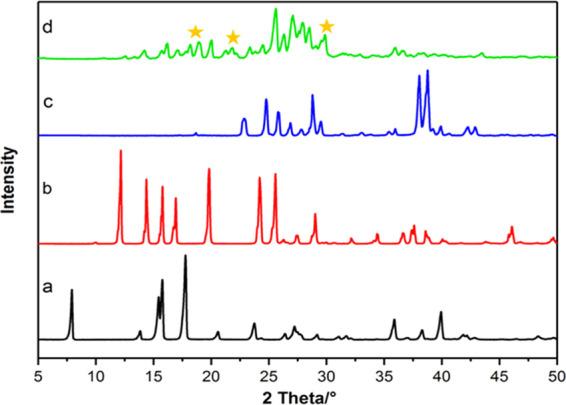
To improve the efficacy of anti-tuberculosis (anti-TB) therapy, drug-drug co-crystallization stands for an alternative approach to settle the tuberculosis problem. Directly co-crystallizing two typical parent anti-TB drugs (pyrazinamide, PZA and isoniazid, INH) into a single binary co-crystal could not be obtained successfully. Multicomponent eutectic are highly effective and useful for enhancing the dissolution rate, bioavailability, and physical stability of the poorly water-soluble active pharmaceutical ingredient (API) drugs, when the attempts of forming a binary co-crystal have failed. Therefore, the ternary eutectic composition conception was proposed in this study, in which fumaric acid (FA) was chosen as the molecule to connect two first-line anti-tubercular drugs. First of all, three starting materials (including PZA, INH, and FA) were grinded at a 1:1:1 molar ratio, the eutectic composition was investigated through vibrational spectroscopic techniques, including terahertz time-domain spectroscopy (THz-TDS) and Raman spectroscopy. Additionally, the density functional theory (DFT) was utilized to simulate the optimized structures and vibrational modes of two possible theoretical eutectic composition forms. The THz absorption spectrum of the theoretical form I shows much more consistency with the experimental results than that of form II. Raman spectra also help to characterize the differences in vibrational modes between the eutectic composition and the starting parent compounds. The results provide us with both structural information and intermolecular hydrogen bonding interactions within specific multicomponent eutectic composition formulations based on Raman and terahertz vibrational spectroscopic techniques in combination with theoretical calculations.
为提高抗结核治疗的疗效,药物共结晶是解决结核病问题的一种替代方法。将两种典型的抗结核原药(吡嗪酰胺,PZA和异烟肼,INH)直接共结晶成单一的二元共晶体未能成功获得。当形成二元共晶体的尝试失败时,多组分低共熔物对于提高难溶性活性药物成分(API)药物的溶解速率、生物利用度和物理稳定性非常有效且有用。因此,本研究提出了三元低共熔物组成概念,其中选择富马酸(FA)作为连接两种一线抗结核药物的分子。首先,将三种起始原料(包括PZA、INH和FA)按1:1:1的摩尔比研磨,通过振动光谱技术研究低共熔物组成,包括太赫兹时域光谱(THz-TDS)和拉曼光谱。此外,利用密度泛函理论(DFT)模拟两种可能的理论低共熔物组成形式的优化结构和振动模式。理论形式I的太赫兹吸收光谱与实验结果的一致性比形式II更高。拉曼光谱也有助于表征低共熔物组成与起始母体化合物之间振动模式的差异。这些结果基于拉曼光谱和太赫兹振动光谱技术结合理论计算,为我们提供了特定多组分低共熔物组成配方中的结构信息和分子间氢键相互作用。




 Zotero 插件