
妊娠期接种呼吸道合胞病毒疫苗及其对婴儿的影响。
Respiratory Syncytial Virus Vaccination during Pregnancy and Effects in Infants.
机构信息
From the Medical Research Council, Respiratory and Meningeal Pathogens Research Unit, and the Department of Science and Technology-National Research Foundation, Vaccine Preventable Diseases, University of the Witwatersrand (S.A.M., C.L.C.), and Shandukani Research Centre, Wits Reproductive Health and HIV Institute (M.S.M.), Johannesburg, Setshaba Research Centre, Soshanguve (K.A., A.O.), and the Family Centre for Research with Ubuntu, Department of Paediatrics and Child Health, Stellenbosch University, Tygerberg Hospital (M.F.C.), and the Department of Paediatrics and Child Health, Red Cross War Memorial Children's Hospital, South African Medical Research Council Unit on Child and Adolescent Health, University of Cape Town (H.J.Z.), Cape Town - all in South Africa; Fundación INFANT (F.P.P., R.L.), Hospital Militar Central Dr. Cosme Argerich (G.P.M.), and the National Scientific and Technical Research Council (R.L.), Buenos Aires, and the Department of Pediatric Pulmonology, Hospital del Niño Jesús, Tucumán (C.J.L.) - both in Argentina; the Departments of Pediatrics and Molecular Virology and Microbiology, Baylor College of Medicine, Houston (P.A.P., F.M.M.); the University of Auckland, Middlemore Hospital, Auckland, New Zealand (A.A.T.); the Department of Pediatrics, University of Colorado School of Medicine, and the Children's Hospital Colorado, Center for Global Health, Colorado School of Public Health, Aurora (E.A.F.S.); the Department of Obstetrics and Gynecology, Duke University, Durham, NC (G.K.S.); Novavax (S.A., A.A., J.C., I.C., A.F., J.S.P., V.S., D.N.T., J.W., G.M.G., L.F.F.), Gaithersburg, and the Department of International Health, International Center for Maternal and Newborn Health (A.H.B.), and the Center for American Indian Health, Department of International Health (L.H.), Johns Hopkins Bloomberg School of Public Health, Baltimore - all in Maryland; the Vaccine Institute (A.C., P.T.H.) and the Vascular Biology Research Centre, Molecular and Clinical Sciences Research Institute (A.K.), St. George's, University of London, London, Paediatric Infectious Diseases, Clinical and Experimental Sciences, University of Southampton and University Hospital Southampton NHS Foundation Trust, Southampton (C.E.J.), and the Oxford Vaccine Group, Department of Paediatrics, University of Oxford and National Institute for Health Research Oxford Biomedical Research Centre (M.D.S.), and the Nuffield Department of Women's and Reproductive Health, University of Oxford (M.V.), Oxford - all in the United Kingdom; the Department of Pediatrics, Seattle Children's Hospital, University of Washington, Seattle (J.A.E.);the Department of Obstetrics and Gynecology, Wayne State University, Detroit (B.G.); the Research Institute for Tropical Medicine, Muntinlupa, Philippines (J.N.J., M.L.); the Department of Pediatrics (D.W.K.) and the Division of Maternal-Fetal Medicine, Department of Obstetrics and Gynecology and Center for Women's Reproductive Health (A.T.T.), University of Alabama, Birmingham; the Women's and Children's Hospital and Robinson Research Institute, University of Adelaide, Adelaide, SA (H.S.M.), the Melbourne School of Population and Global Health, University of Melbourne, and Murdoch Children's Research Institute, Parkville, VIC (T.M.N., K.P.P.), and Wesfarmers Center of Vaccines and Infectious Diseases, Telethon Kids Institute, Division of Paediatrics, School of Medicine, University of Western Australia, Perth Children's Hospital, Perth (P.C.R., T.S.) - all in Australia; Marshfield Clinic Research Institute, Marshfield, WI (J.K.M.); Pediatría Clínica, Infectología y Traslacional Hospital Clínico Universitario de Santiago de Compostela, Santiago de Compostela, Spain (F.M.-T.); the Division of General Pediatrics, Department of Pediatrics, School of Medicine (J.H.S.), and the Department of Obstetrics and Gynecology (M.W.V.), University of Utah Health Sciences Center, Salt Lake City; Meridian Clinical Research, Norfolk, NE (K.V.); and the International Center for Diarrhoeal Disease Research Bangladesh, Dhaka (K.Z.).
出版信息
N Engl J Med. 2020 Jul 30;383(5):426-439. doi: 10.1056/NEJMoa1908380.
BACKGROUND
Respiratory syncytial virus (RSV) is the dominant cause of severe lower respiratory tract infection in infants, with the most severe cases concentrated among younger infants.
METHODS
Healthy pregnant women, at 28 weeks 0 days through 36 weeks 0 days of gestation, with an expected delivery date near the start of the RSV season, were randomly assigned in an overall ratio of approximately 2:1 to receive a single intramuscular dose of RSV fusion (F) protein nanoparticle vaccine or placebo. Infants were followed for 180 days to assess outcomes related to lower respiratory tract infection and for 364 days to assess safety. The primary end point was RSV-associated, medically significant lower respiratory tract infection up to 90 days of life, and the primary analysis of vaccine efficacy against the primary end point was performed in the per-protocol population of infants (prespecified criterion for success, lower bound of the 97.52% confidence interval [CI] of ≥30%).
RESULTS
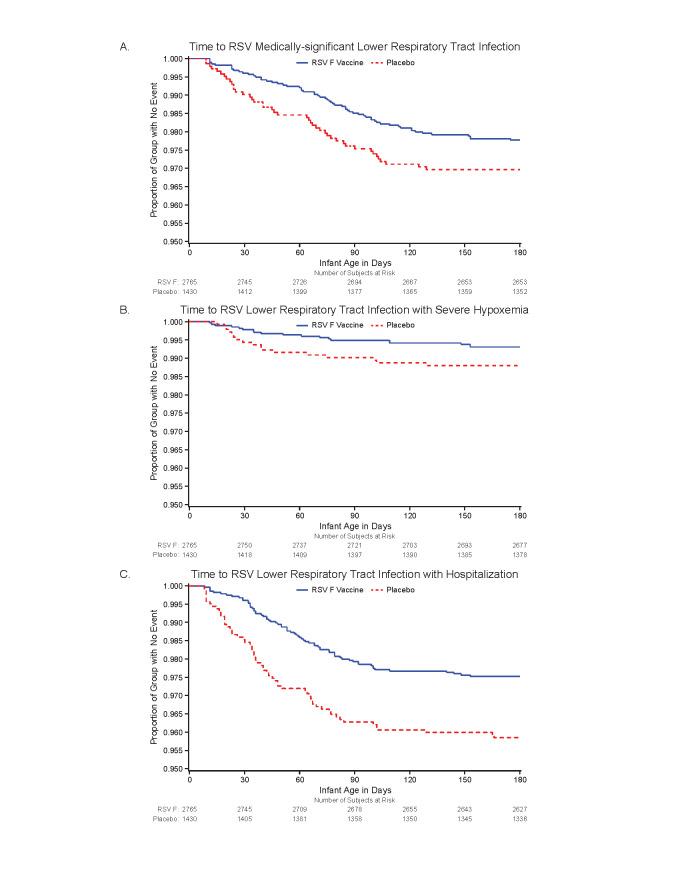
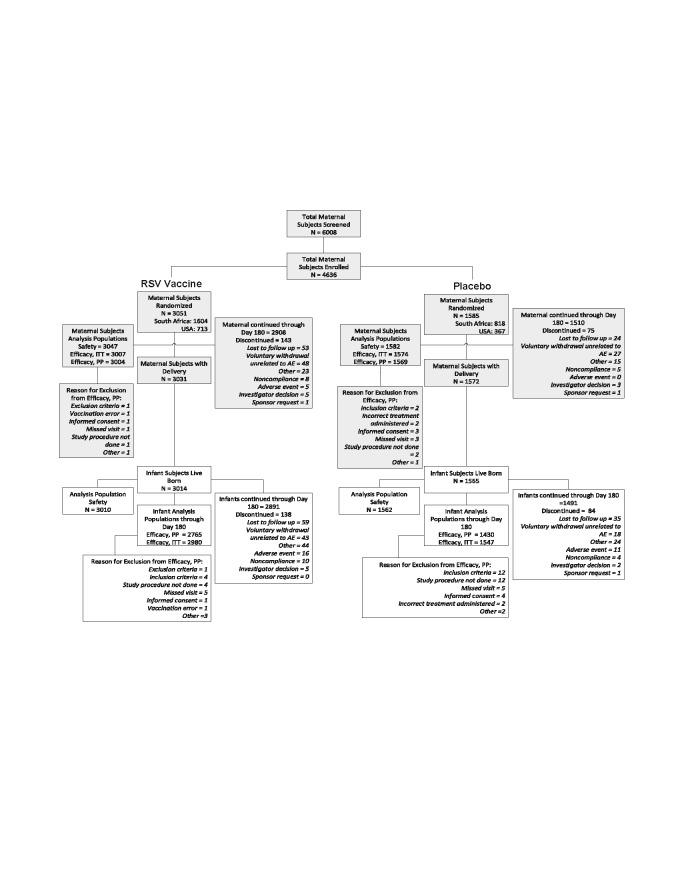
A total of 4636 women underwent randomization, and there were 4579 live births. During the first 90 days of life, the percentage of infants with RSV-associated, medically significant lower respiratory tract infection was 1.5% in the vaccine group and 2.4% in the placebo group (vaccine efficacy, 39.4%; 97.52% CI, -1.0 to 63.7; 95% CI, 5.3 to 61.2). The corresponding percentages for RSV-associated lower respiratory tract infection with severe hypoxemia were 0.5% and 1.0% (vaccine efficacy, 48.3%; 95% CI, -8.2 to 75.3), and the percentages for hospitalization for RSV-associated lower respiratory tract infection were 2.1% and 3.7% (vaccine efficacy, 44.4%; 95% CI, 19.6 to 61.5). Local injection-site reactions among the women were more common with vaccine than with placebo (40.7% vs. 9.9%), but the percentages of participants who had other adverse events were similar in the two groups.
CONCLUSIONS
RSV F protein nanoparticle vaccination in pregnant women did not meet the prespecified success criterion for efficacy against RSV-associated, medically significant lower respiratory tract infection in infants up to 90 days of life. The suggestion of a possible benefit with respect to other end-point events involving RSV-associated respiratory disease in infants warrants further study. (Funded by Novavax and the Bill and Melinda Gates Foundation; ClinicalTrials.gov NCT02624947.).
背景
呼吸道合胞病毒(RSV)是导致婴儿严重下呼吸道感染的主要原因,最严重的病例集中在较小的婴儿中。
方法
健康孕妇在妊娠 28 周零 0 天至 36 周零 0 天期间,预产期接近 RSV 季节开始时,随机分为约 2:1 的比例,接受单次肌肉注射 RSV 融合(F)蛋白纳米颗粒疫苗或安慰剂。对婴儿进行 180 天的随访,以评估与下呼吸道感染相关的结果,并进行 364 天的随访,以评估安全性。主要终点是出生后 90 天内与 RSV 相关的有临床意义的下呼吸道感染,对主要终点的疫苗疗效的主要分析是在婴儿的方案人群中进行的(预先指定的成功标准为,97.52%置信区间[CI]下限≥30%)。
结果
共有 4636 名女性接受了随机分组,有 4579 名活产婴儿。在生命的头 90 天里,疫苗组婴儿 RSV 相关、有临床意义的下呼吸道感染的百分比为 1.5%,安慰剂组为 2.4%(疫苗疗效,39.4%;97.52%CI,-1.0 至 63.7;95%CI,5.3 至 61.2)。与 RSV 相关的严重低氧血症的下呼吸道感染的相应百分比为 0.5%和 1.0%(疫苗疗效,48.3%;95%CI,-8.2 至 75.3),与 RSV 相关的下呼吸道感染住院的百分比为 2.1%和 3.7%(疫苗疗效,44.4%;95%CI,19.6 至 61.5)。与安慰剂相比,疫苗组妇女的局部注射部位反应更为常见(40.7%比 9.9%),但两组参与者发生其他不良事件的百分比相似。
结论
在孕妇中接种 RSV F 蛋白纳米颗粒疫苗并没有达到预先指定的预防出生后 90 天内 RSV 相关、有临床意义的下呼吸道感染的疗效标准。提示 RSV 相关呼吸道疾病的其他终点事件可能有获益,这需要进一步研究。(由 Novavax 和比尔及梅琳达·盖茨基金会资助;ClinicalTrials.gov NCT02624947)。
 Zotero 插件