
台湾地区孕妇使用中草药的处方模式及影响因素:基于人群的回顾性研究。
Prescription patterns and factors influencing the use of Chinese herbal medicine among pregnant women in Taiwan: a population-based retrospective study.
机构信息
Department of Public Health, College of Medicine, Tzu Chi University, Hualien, Taiwan.
Department of Medical Research, Buddhist Tzu Chi General Hospital, Hualien, Taiwan.
出版信息
BMC Complement Med Ther. 2020 Jul 30;20(1):240. doi: 10.1186/s12906-020-03032-0.
BACKGROUND
The use of Chinese herbal medicine (CHM) has been widely promoted as a natural and safe way to treat illness during pregnancy. However, prescription patterns and factors influencing its use are largely unknown. Therefore, we conducted a population-based study to address these questions.
METHODS
Pregnant women aged 18-50 years were selected from Taiwan's National Health Insurance Research Database between 2001 to 2011. CHM prescriptions and diagnostic records were collected. Demographic data and pre-existing diseases were compared between CHM users and non-users. A multivariate logistic regression analysis was performed to identify possible factors influencing the use of CHM during pregnancy.
RESULTS
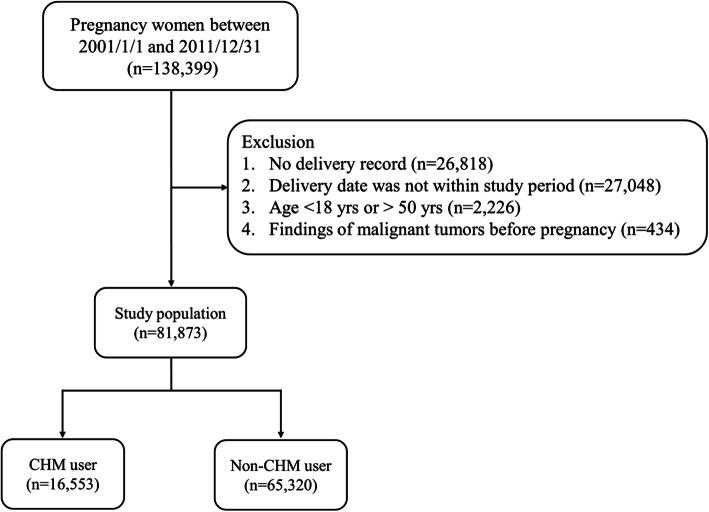
A total of 81,873 eligible prescription records were identified, and 16,553 pregnant women were prescribed CHM during pregnancy, yielding a CHM prescription rate of 20.2%. The three most frequently used herbs were Scutellariae Radix (Huang Qin) (4.4%), Eucommiae cortex (Du Zhong) (2.5%), and Atractylodes Rhizome (Bai Zhu) (2.4%). The most frequently used herbal formulae were Dang-Guei-Shao-Yao-San (4.1%), Jia-Wei-Xiao-Yao-San (3.5%), and Xiang-Sha-Liu-Jun-Zi-Tang (2.6%). Multivariate logistic regression revealed that subjects with an older age, a university education, a pre-pregnancy history of CHM use, asthma, chronic renal disease, and cardiac valvular disease and living in a residential area other than northern Taiwan had an increase in adjusted odds ratio for CHM use during pregnancy.
CONCLUSIONS
In this population-based study, we found that demographic factors and pre-existing diseases were associated with the use of CHM among pregnant women. It is worth noting that Leonuri Herba (Yi Mu Cao) and Shao-Fu-Zhu-Yu-Tang should be used with caution in the first trimester. Further research is needed to explore the safety and effectiveness of the use of CHM in pregnant women.
背景
中草药(CHM)的使用已被广泛推广为治疗孕期疾病的天然和安全方式。然而,其处方模式和影响其使用的因素在很大程度上尚不清楚。因此,我们进行了一项基于人群的研究来解决这些问题。
方法
我们从 2001 年至 2011 年的台湾全民健康保险研究数据库中选择了 18-50 岁的孕妇。收集了 CHM 处方和诊断记录。比较了 CHM 用户和非用户的人口统计学数据和既往疾病。使用多变量逻辑回归分析来确定可能影响孕期 CHM 使用的因素。
结果
共确定了 81873 份合格的处方记录,有 16553 名孕妇在孕期开具了 CHM 处方,CHM 处方率为 20.2%。使用最多的三种草药是黄芩(Huang Qin)(4.4%)、杜仲(Du Zhong)(2.5%)和白术(Bai Zhu)(2.4%)。使用最多的草药方剂是当归芍药散(Dang-Guei-Shao-Yao-San)(4.1%)、加味逍遥散(Jia-Wei-Xiao-Yao-San)(3.5%)和香砂六君子汤(Xiang-Sha-Liu-Jun-Zi-Tang)(2.6%)。多变量逻辑回归显示,年龄较大、受过大学教育、有孕前 CHM 使用史、哮喘、慢性肾脏病、心脏瓣膜病和居住在台湾北部以外地区的孕妇,其孕期使用 CHM 的调整优势比增加。
结论
在这项基于人群的研究中,我们发现人口统计学因素和既往疾病与孕妇使用 CHM 有关。值得注意的是,益母草(Yi Mu Cao)和少腹逐瘀汤(Shao-Fu-Zhu-Yu-Tang)应在孕早期谨慎使用。需要进一步研究来探索孕妇使用 CHM 的安全性和有效性。
 Zotero 插件