
西班牙绵羊群中弓形虫的分离与遗传特征分析。
Isolation and genetic characterization of Toxoplasma gondii in Spanish sheep flocks.
机构信息
SALUVET, Animal Health Department, Faculty of Veterinary Sciences, Complutense University of Madrid, Ciudad Universitaria s/n, 28040, Madrid, Spain.
Instituto de Ganadería de Montaña (CSIC-ULE), 24346, León, Spain.
出版信息
Parasit Vectors. 2020 Aug 5;13(1):396. doi: 10.1186/s13071-020-04275-z.
BACKGROUND
Toxoplasma gondii is a major cause of abortion in small ruminants and presents a zoonotic risk when undercooked meat containing cysts is consumed. The aim of the present study was to investigate the genetic diversity among the T. gondii strains circulating in ovine livestock in Spain.
METHODS
Selected samples collected from abortion outbreaks due to toxoplasmosis (n = 31) and from chronically infected adult sheep at slaughterhouses (n = 50) in different Spanish regions were bioassayed in mice, aiming at parasite isolation. In addition, all original clinical samples and the resulting isolates were genotyped by multi-nested PCR-RFLP analysis of 11 molecular markers and by PCR-DNA sequencing of portions of the SAG3, GRA6 and GRA7 genes.
RESULTS
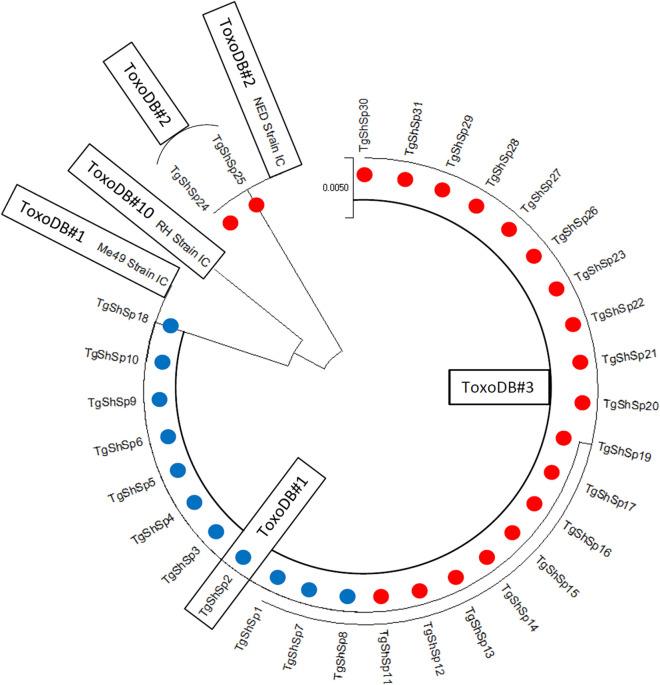
As a result, 30 isolates were obtained from 9 Spanish regions: 10 isolates from abortion-derived samples and 20 isolates from adult myocardial tissues. Overall, 3 genotypes were found: ToxoDB#3 (type II PRU variant) in 90% (27/30) of isolates, ToxoDB#2 (clonal type III) in 6.7% (2/30), and ToxoDB#1 (clonal type II) in 3.3% (1/30). When T. gondii-positive tissue samples (n = 151) were directly subjected to RFLP genotyping, complete restriction profiles were obtained for 33% of samples, and up to 98% of the specimens belonged to the type II PRU variant. A foetal brain showed a clonal type II pattern, and four specimens showed unexpected type I alleles at the SAG3 marker, including two foetal brains that showed I + II alleles as co-infection events. Amplicons of SAG3, GRA6 and GRA7 obtained from isolates and clinical samples were subjected to sequencing, allowing us to confirm RFLP results and to detect different single-nucleotide polymorphisms.
CONCLUSIONS
The present study informed the existence of a predominant type II PRU variant genotype (ToxoDB#3) infecting domestic sheep in Spain, in both abortion cases and chronic infections in adults, coexisting with other clonal (ToxoDB#1 and ToxoDB#2), much less frequent genotypes, as well as polymorphic strains as revealed by clinical sample genotyping. The use of multilocus sequence typing aided in accurately estimating T. gondii intragenotype diversity.
背景
刚地弓形虫是导致小型反刍动物流产的主要原因,当食用未煮熟的含有包囊的肉时,会对人类健康造成潜在的威胁。本研究的目的是调查西班牙绵羊家畜中循环的刚地弓形虫株的遗传多样性。
方法
从不同西班牙地区因弓形虫病导致的流产爆发(n=31)和屠宰场慢性感染的成年绵羊(n=50)中选择样本进行生物测定,以进行寄生虫分离。此外,所有原始临床样本和分离株均通过 11 个分子标记的多巢式 PCR-RFLP 分析和 SAG3、GRA6 和 GRA7 基因部分的 PCR-DNA 测序进行基因分型。
结果
结果,从西班牙 9 个地区获得了 30 个分离株:10 个来自流产来源的样本,20 个来自成年心肌组织。总体而言,发现了 3 种基因型:90%(27/30)的分离株为 ToxoDB#3(PRU 变体 II 型),6.7%(2/30)为 ToxoDB#2(克隆型 III),3.3%(1/30)为 ToxoDB#1(克隆型 II)。当直接对 T. gondii 阳性组织样本(n=151)进行 RFLP 基因分型时,33%的样本获得了完整的限制图谱,98%的标本属于 PRU 变体 II 型。一个胎脑显示出克隆型 II 模式,4 个标本在 SAG3 标记处显示出意想不到的 I 型等位基因,包括两个胎脑显示出作为合并感染事件的 I+II 等位基因。从分离株和临床样本中获得的 SAG3、GRA6 和 GRA7 扩增子进行测序,使我们能够确认 RFLP 结果并检测到不同的单核苷酸多态性。
结论
本研究表明,在西班牙,无论是流产病例还是成年慢性感染,都存在主要的 II 型 PRU 变体基因型(ToxoDB#3)感染绵羊,同时还存在其他克隆(ToxoDB#1 和 ToxoDB#2)基因型,以及临床样本基因分型揭示的多态菌株。多基因座序列分型的使用有助于准确估计刚地弓形虫种内多样性。

 Zotero 插件