
斑马鱼杏仁核复合体——功能基础图谱、分子解析及外翻拓扑结构
The Zebrafish Amygdaloid Complex - Functional Ground Plan, Molecular Delineation, and Everted Topology.
作者信息
Porter Baylee A, Mueller Thomas
机构信息
Division of Biology, Kansas State University, Manhattan, KS, United States.
Department of Biochemistry and Molecular Biology, Department of Urology, SUNY Upstate Medical University, Syracuse, NY, United States.
出版信息
Front Neurosci. 2020 Jul 16;14:608. doi: 10.3389/fnins.2020.00608. eCollection 2020.
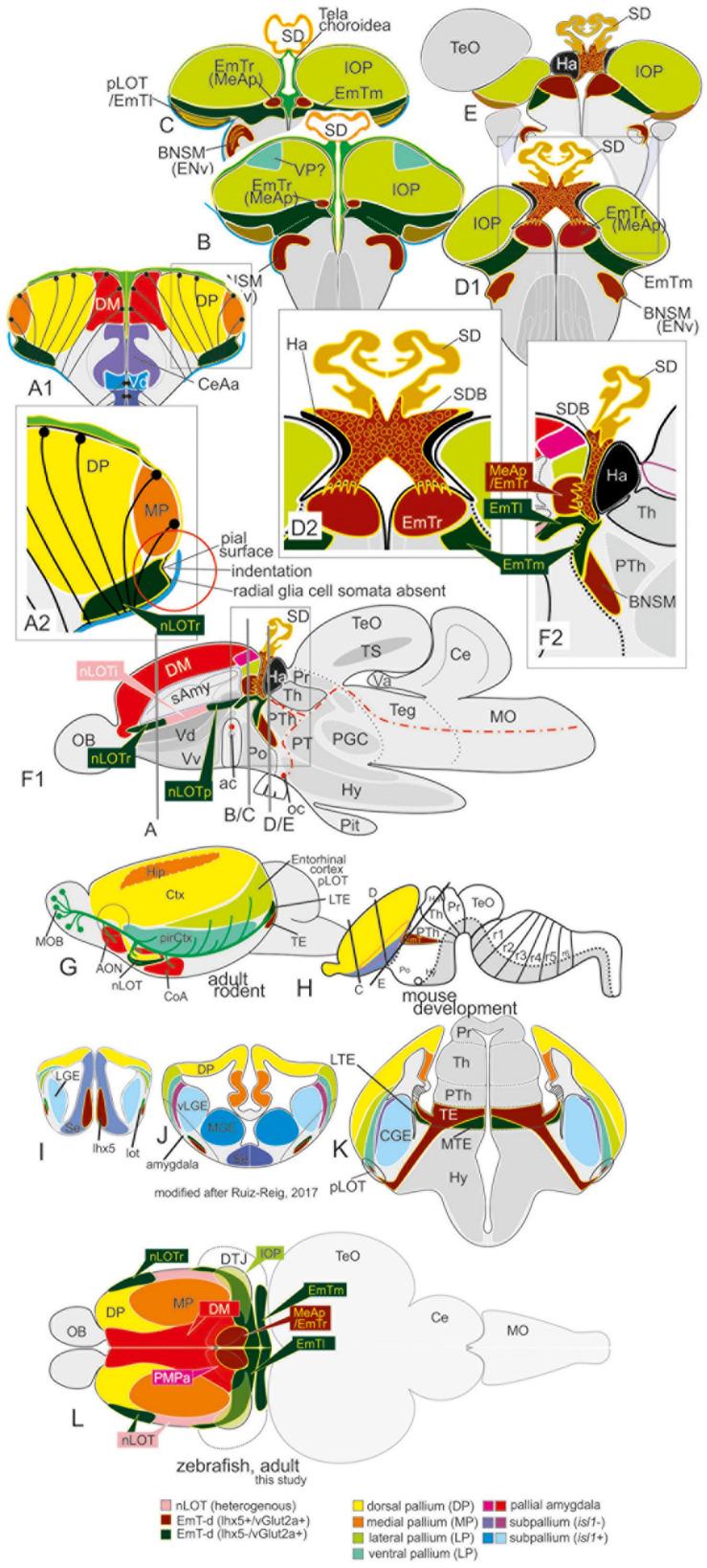
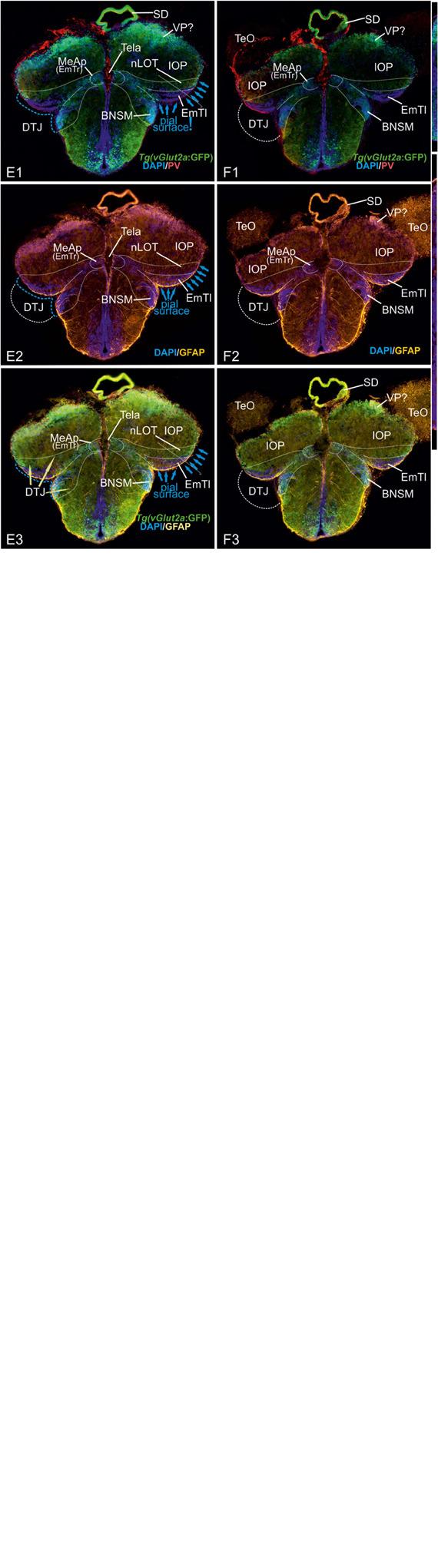
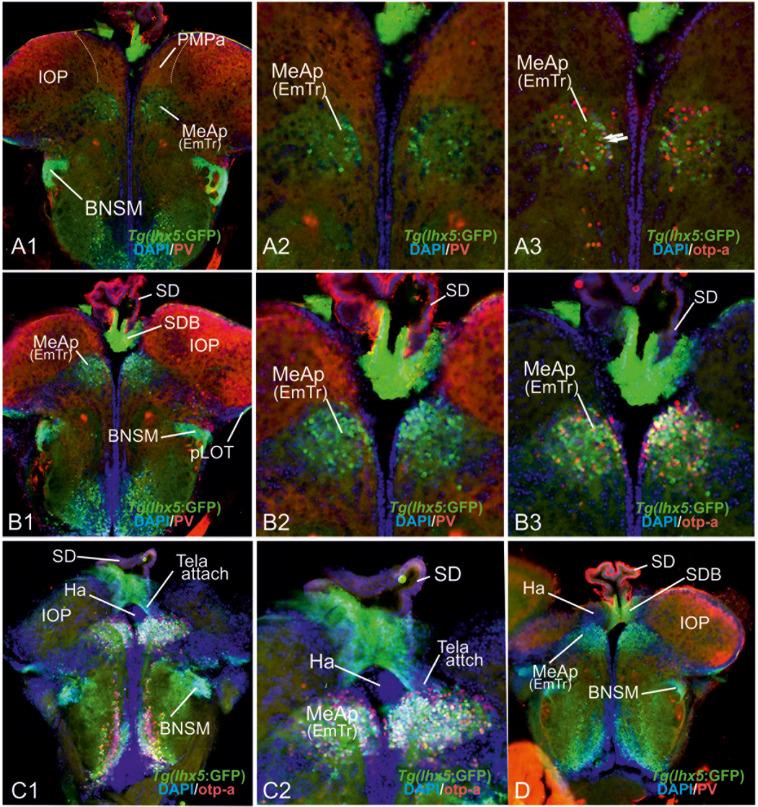
In mammals and other tetrapods, a multinuclear forebrain structure, called the amygdala, forms the neuroregulatory core essential for emotion, cognition, and social behavior. Currently, higher circuits of affective behavior in anamniote non-tetrapod vertebrates ("fishes") are poorly understood, preventing a comprehensive understanding of amygdala evolution. Through molecular characterization and evolutionary-developmental considerations, we delineated the complex amygdala ground plan of zebrafish, whose everted telencephalon has made comparisons to the evaginated forebrains of tetrapods challenging. In this radical paradigm, thirteen telencephalic territories constitute the zebrafish amygdaloid complex and each territory is distinguished by conserved molecular properties and structure-functional relationships with other amygdaloid structures. Central to our paradigm, the study identifies the teleostean amygdaloid nucleus of the lateral olfactory tract (nLOT), an olfactory integrative structure that links dopaminergic telencephalic groups to the amygdala alongside redefining the putative zebrafish olfactory pallium ("Dp"). Molecular characteristics such as the distribution of substance P and the calcium-binding proteins parvalbumin (PV) and calretinin (CR) indicate, that the zebrafish extended centromedial (autonomic and reproductive) amygdala is predominantly located in the GABAergic and -negative territory. Like in tetrapods, medial amygdaloid (MeA) nuclei are defined by the presence of substance P immunoreactive fibers and calretinin-positive neurons, whereas central amygdaloid (CeA) nuclei lack these characteristics. A detailed comparison of -driven and -driven GFP in transgenic reporter lines revealed ancestral topological relationships between the thalamic eminence (EmT), the medial amygdala (MeA), the nLOT, and the integrative olfactory pallium. Thus, the study explains how the zebrafish amygdala and the complexly everted telencephalon topologically relate to the corresponding structures in mammals indicating that an elaborate amygdala ground plan evolved early in vertebrates, in a common ancestor of teleosts and tetrapods.
在哺乳动物和其他四足动物中,一种被称为杏仁核的多核前脑结构构成了对情绪、认知和社会行为至关重要的神经调节核心。目前,无羊膜非四足脊椎动物(“鱼类”)中情感行为的高级回路了解甚少,这妨碍了对杏仁核进化的全面理解。通过分子特征分析和进化发育方面的考量,我们勾勒出了斑马鱼复杂的杏仁核基础蓝图,其外翻的端脑使得与四足动物内陷前脑的比较颇具挑战性。在这种截然不同的模式中,十三个端脑区域构成了斑马鱼杏仁核复合体,每个区域都以保守的分子特性以及与其他杏仁核结构的结构 - 功能关系为特征。该模式的核心在于,这项研究确定了外侧嗅束的硬骨鱼杏仁核(nLOT),这是一种嗅觉整合结构,它将多巴胺能端脑群与杏仁核相连,同时重新定义了假定的斑马鱼嗅觉皮质(“Dp”)。诸如P物质、钙结合蛋白小白蛋白(PV)和钙视网膜蛋白(CR)的分布等分子特征表明,斑马鱼扩展的中央内侧(自主和生殖)杏仁核主要位于GABA能和阴性区域。与四足动物一样,内侧杏仁核(MeA)核由P物质免疫反应纤维和钙视网膜蛋白阳性神经元的存在来定义,而中央杏仁核(CeA)核则缺乏这些特征。对转基因报告系中由 - 驱动和 - 驱动的绿色荧光蛋白的详细比较揭示了丘脑隆起(EmT)、内侧杏仁核(MeA)、nLOT和整合性嗅觉皮质之间的祖先拓扑关系。因此,该研究解释了斑马鱼杏仁核和复杂外翻的端脑在拓扑结构上如何与哺乳动物中的相应结构相关,表明精心设计的杏仁核基础蓝图在硬骨鱼和四足动物的共同祖先——脊椎动物早期就已进化形成。



 Zotero 插件