
第二代嵌合抗原受体T细胞疗法治疗弥漫性大B细胞淋巴瘤的疗效与安全性:一项荟萃分析。
Efficacy and safety of second-generation CAR T-cell therapy in diffuse large B-cell lymphoma: A meta-analysis.
作者信息
Al-Mansour Mubarak, Al-Foheidi Meteb, Ibrahim Ezzeldin
机构信息
Adult Medical Oncology, Princess Noorah Oncology Center, King Abdulaziz Medical City, Ministry of National Guard Health Affairs-Western Region, Jeddah 21451, Kingdom of Saudi Arabia.
College of Medicine, King Saud Bin Abdulaziz University for Health Sciences, Jeddah 21423, Kingdom of Saudi Arabia.
出版信息
Mol Clin Oncol. 2020 Oct;13(4):33. doi: 10.3892/mco.2020.2103. Epub 2020 Jul 29.
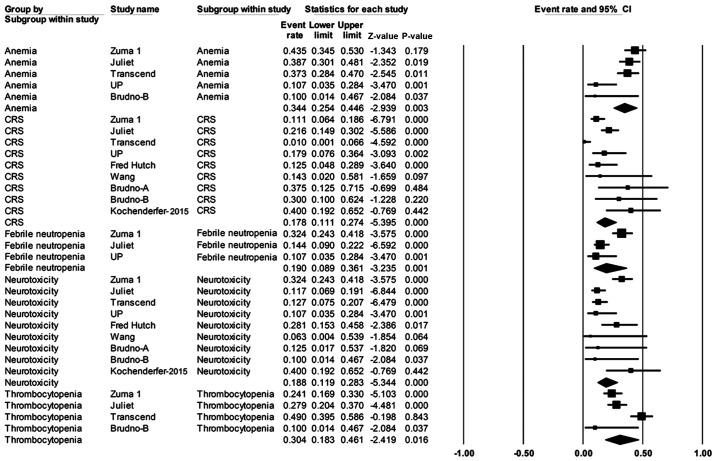
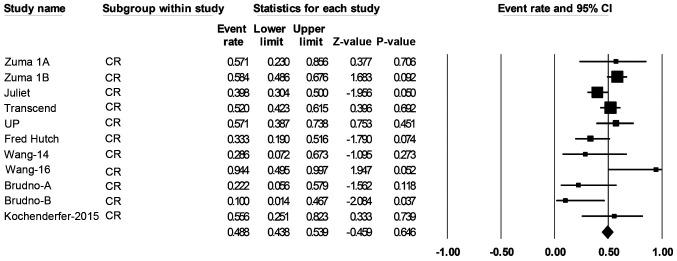
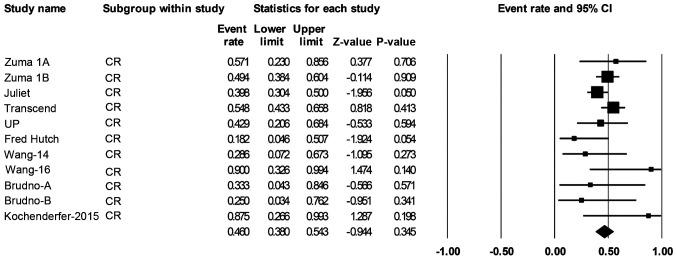
Diffuse large B-cell lymphoma (DLBCL) is the most common subtype of non-Hodgkin's lymphoma (NHL), representing 30% of all lymphoma cases. Within the first 2-3 years following immunochemotherapy, 30-40% of patients will experience a relapse or a refractory disease, thereby exhibiting a poor prognosis. High-dose immunotherapy followed by autologous stem cell transplantation is the standard care for relapsed/refractory (RR) patients with DLBCL. However, >60% of patients are ineligible for a transplant, presenting a therapeutic challenge. Chimeric antigen receptor (CAR) T-cell therapy has shown promising efficacy in patients with DLBCL, including those with R/R disease. The present study conducted a meta-analysis that showed highly favorable outcomes [objective response rate (ORR): 69%; complete remission (CR): 49%] in B-cell NHL patients (n=419) who were treated with second-generation CAR T cells. The response rate varied in different types of B-cell NHL. In 306 patients with R/R DLBCL eligible for rate evaluation, the ORR and CR rate mean estimates were 68% [95% confidence interval (CI), 55-79%] and 46% (95% CI, 38-54%), respectively. Thus, the findings indicated that immunotherapy with CAR T cells has improved outcomes for patients with R/R DLBCL and other subtypes of B-cell NHL compared with standard chemotherapy regimens. The study revealed that grade ≥3 anemia (34%) and thrombocytopenia (30%) were the most common adverse effects of CAR T-cell therapy. Incidence of grade ≥3 cytokine release syndrome and neurotoxicity associated with CAR T-cell therapy was effectively managed.
弥漫性大B细胞淋巴瘤(DLBCL)是非霍奇金淋巴瘤(NHL)最常见的亚型,占所有淋巴瘤病例的30%。在免疫化疗后的最初2 - 3年内,30% - 40%的患者会出现复发或难治性疾病,预后较差。大剂量免疫疗法联合自体干细胞移植是复发/难治性(RR)DLBCL患者的标准治疗方法。然而,超过60%的患者不符合移植条件,这带来了治疗挑战。嵌合抗原受体(CAR)T细胞疗法在DLBCL患者中显示出了有前景的疗效,包括那些复发/难治性(R/R)疾病患者。本研究进行了一项荟萃分析,结果显示接受第二代CAR T细胞治疗的B细胞NHL患者(n = 419)取得了非常好的疗效[客观缓解率(ORR):69%;完全缓解(CR):49%]。不同类型的B细胞NHL的缓解率有所不同。在306例符合缓解率评估条件的R/R DLBCL患者中,ORR和CR率的平均估计值分别为68%[95%置信区间(CI),55 - 79%]和46%(95%CI,38 - 54%)。因此,研究结果表明,与标准化疗方案相比,CAR T细胞免疫疗法改善了R/R DLBCL和其他B细胞NHL亚型患者的治疗效果。研究表明,≥3级贫血(34%)和血小板减少(30%)是CAR T细胞疗法最常见的不良反应。与CAR T细胞疗法相关的≥3级细胞因子释放综合征和神经毒性的发生率得到了有效控制。


 Zotero 插件