
脑内葡萄糖转运体:在健康与疾病中的作用
Glucose transporters in brain in health and disease.
机构信息
Institute for Anatomy and Cell Biology, University of Würzburg, Koellikerstr 6, 97070, Würzburg, Germany.
出版信息
Pflugers Arch. 2020 Sep;472(9):1299-1343. doi: 10.1007/s00424-020-02441-x. Epub 2020 Aug 13.
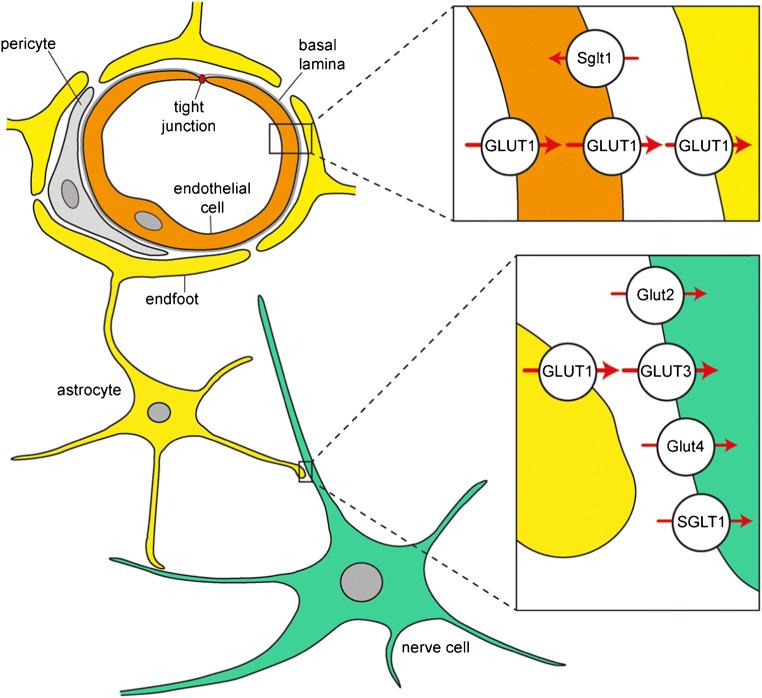
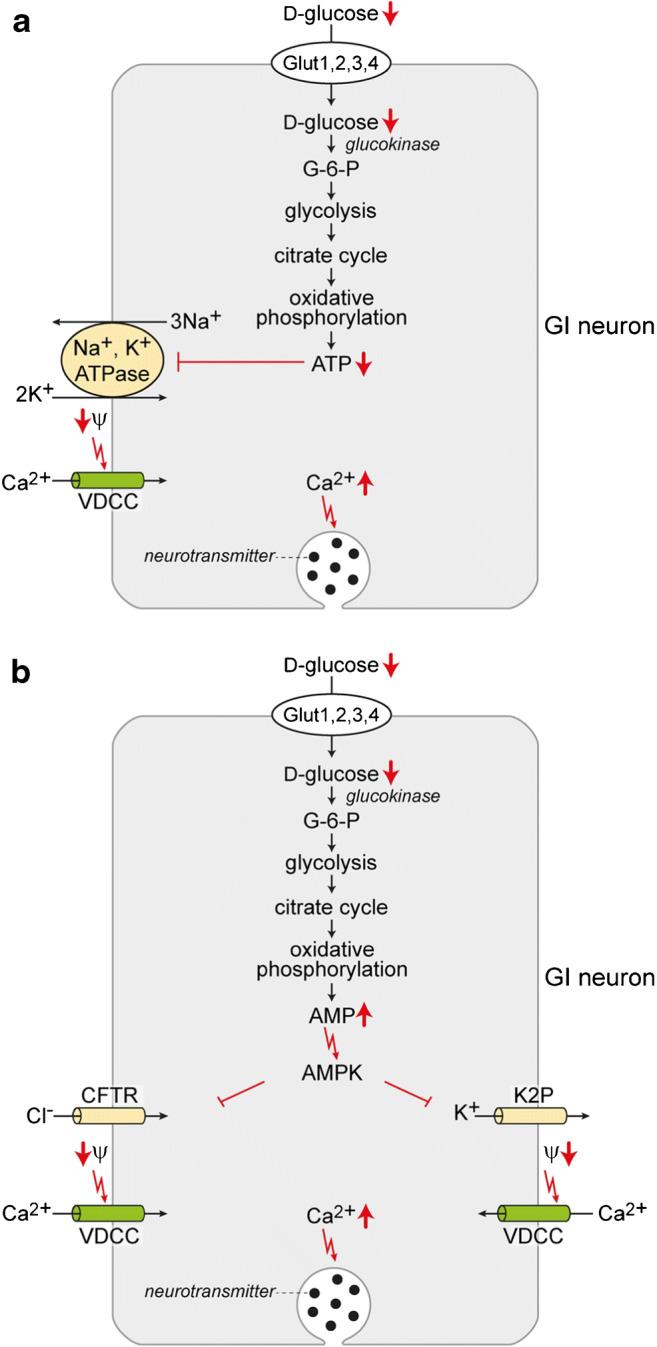
Energy demand of neurons in brain that is covered by glucose supply from the blood is ensured by glucose transporters in capillaries and brain cells. In brain, the facilitative diffusion glucose transporters GLUT1-6 and GLUT8, and the Na-D-glucose cotransporters SGLT1 are expressed. The glucose transporters mediate uptake of D-glucose across the blood-brain barrier and delivery of D-glucose to astrocytes and neurons. They are critically involved in regulatory adaptations to varying energy demands in response to differing neuronal activities and glucose supply. In this review, a comprehensive overview about verified and proposed roles of cerebral glucose transporters during health and diseases is presented. Our current knowledge is mainly based on experiments performed in rodents. First, the functional properties of human glucose transporters expressed in brain and their cerebral locations are described. Thereafter, proposed physiological functions of GLUT1, GLUT2, GLUT3, GLUT4, and SGLT1 for energy supply to neurons, glucose sensing, central regulation of glucohomeostasis, and feeding behavior are compiled, and their roles in learning and memory formation are discussed. In addition, diseases are described in which functional changes of cerebral glucose transporters are relevant. These are GLUT1 deficiency syndrome (GLUT1-SD), diabetes mellitus, Alzheimer's disease (AD), stroke, and traumatic brain injury (TBI). GLUT1-SD is caused by defect mutations in GLUT1. Diabetes and AD are associated with changed expression of glucose transporters in brain, and transporter-related energy deficiency of neurons may contribute to pathogenesis of AD. Stroke and TBI are associated with changes of glucose transporter expression that influence clinical outcome.
大脑中受血液葡萄糖供应覆盖的神经元的能量需求由毛细血管和脑细胞中的葡萄糖转运蛋白来保证。在大脑中,表达了易化扩散葡萄糖转运蛋白 GLUT1-6 和 GLUT8,以及 Na-D-葡萄糖协同转运蛋白 SGLT1。葡萄糖转运蛋白介导 D-葡萄糖穿过血脑屏障,并将 D-葡萄糖递送至星形胶质细胞和神经元。它们在调节适应不同神经元活动和葡萄糖供应的不同能量需求方面起着至关重要的作用。在这篇综述中,介绍了脑葡萄糖转运蛋白在健康和疾病中的已证实和提出的作用的全面概述。我们目前的知识主要基于在啮齿动物中进行的实验。首先,描述了在脑中表达的人葡萄糖转运蛋白的功能特性及其脑内位置。然后,编译了 GLUT1、GLUT2、GLUT3、GLUT4 和 SGLT1 为神经元提供能量、葡萄糖感应、中枢葡萄糖稳态调节和进食行为的拟议生理功能,并讨论了它们在学习和记忆形成中的作用。此外,还描述了与脑葡萄糖转运蛋白功能变化相关的疾病。这些疾病包括葡萄糖转运蛋白 1 缺乏综合征(GLUT1-SD)、糖尿病、阿尔茨海默病(AD)、中风和创伤性脑损伤(TBI)。GLUT1-SD 是由 GLUT1 缺陷突变引起的。糖尿病和 AD 与脑中葡萄糖转运蛋白表达的改变有关,神经元的转运体相关能量不足可能有助于 AD 的发病机制。中风和 TBI 与葡萄糖转运蛋白表达的变化有关,这些变化会影响临床结果。



 Zotero 插件