
CFTR调节剂可抑制囊性纤维化吞噬细胞诱导的活性氧生成。
CFTR Modulators Dampen -Induced Reactive Oxygen Species Production by Cystic Fibrosis Phagocytes.
作者信息
Currie Alexander J, Main Ellen T, Wilson Heather M, Armstrong-James Darius, Warris Adilia
机构信息
Aberdeen Fungal Group, Institute of Medical Sciences, University of Aberdeen, Aberdeen, United Kingdom.
Medical Research Council Centre for Medical Mycology, University of Exeter, Exeter, United Kingdom.
出版信息
Front Cell Infect Microbiol. 2020 Jul 24;10:372. doi: 10.3389/fcimb.2020.00372. eCollection 2020.
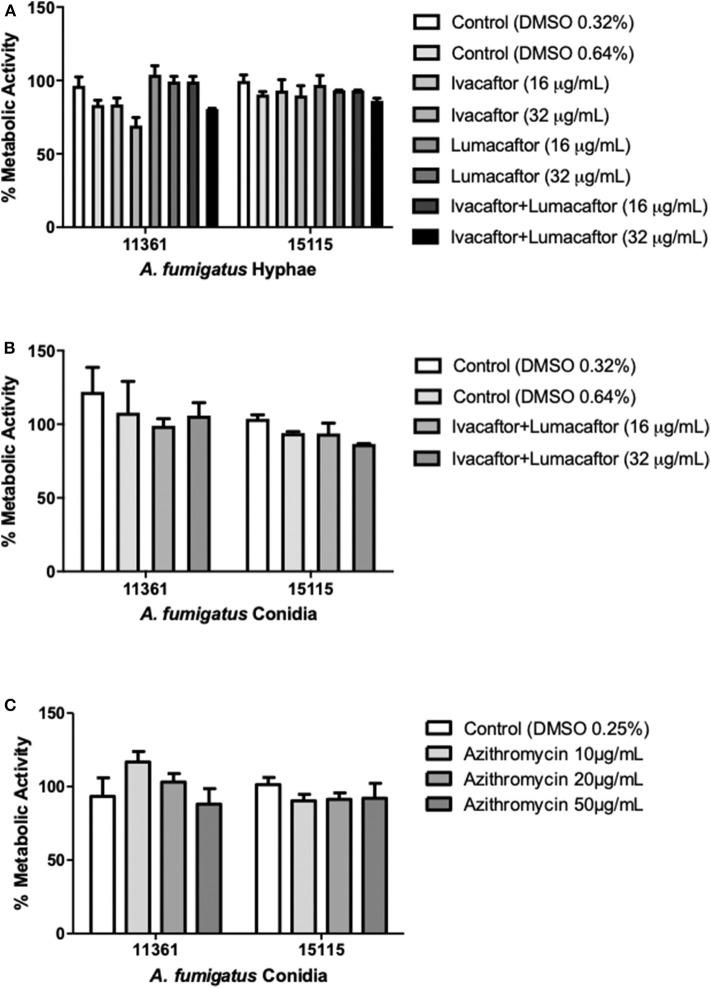
Excessive inflammation by phagocytes during infection is thought to promote lung function decline in CF patients. CFTR modulators have been shown to reduce colonization , however, their antifungal and anti-inflammatory mechanisms are unclear. Other treatments including azithromycin and acebilustat may dampen -induced inflammation due to their immunomodulatory properties. Therefore, we set out in this study to determine the effects of current CF therapies on ROS production and fungal killing, either direct or indirect by enhancing antifungal immune mechanisms in peripheral blood immune cells from CF patients upon infection. Isolated peripheral blood mononuclear cells (PBMCs) and polymorphonuclear cells (PMNs) from CF patients and healthy volunteers were challenged with following pre-treatment with CFTR modulators, azithromycin or acebilustat. Ivacaftor/lumacaftor treated CF and control subject PMNs resulted in a significant reduction ( < 0.05) in -induced ROS. For CF PBMC, -induced ROS was significantly reduced when pre-treated with ivacaftor alone ( < 0.01) or in combination with lumacaftor ( < 0.01), with a comparable significant reduction in control subject PBMC ( < 0.05). Azithromycin and acebilustat had no effect on ROS production by CF or control subject phagocytes. None of the treatments showed an indirect or direct antifungal activity. In summary, CFTR modulators have potential for additional immunomodulatory benefits to prevent or treat -induced inflammation in CF. The comparable effects of CFTR modulators observed in phagocytes from control subjects questions their exact mechanism of action.
感染期间吞噬细胞的过度炎症被认为会促进囊性纤维化(CF)患者的肺功能下降。CFTR调节剂已被证明可减少细菌定植,然而,它们的抗真菌和抗炎机制尚不清楚。包括阿奇霉素和阿西必利斯塔在内的其他治疗方法可能因其免疫调节特性而减轻感染诱导的炎症。因此,我们在本研究中着手确定当前CF治疗对活性氧(ROS)产生和真菌杀伤的影响,无论是直接影响还是通过增强CF患者感染后外周血免疫细胞中的抗真菌免疫机制产生的间接影响。用CFTR调节剂、阿奇霉素或阿西必利斯塔预处理后,对CF患者和健康志愿者分离的外周血单核细胞(PBMC)和多形核细胞(PMN)进行刺激。依伐卡托/鲁马卡托治疗的CF患者和对照受试者的PMN导致感染诱导的ROS显著降低(P<0.05)。对于CF患者的PBMC,单独用依伐卡托预处理(P<0.01)或与鲁马卡托联合预处理(P<0.01)时,感染诱导的ROS显著降低,对照受试者的PBMC也有类似的显著降低(P<0.05)。阿奇霉素和阿西必利斯塔对CF患者或对照受试者吞噬细胞产生ROS没有影响。所有治疗均未显示出间接或直接的抗真菌活性。总之,CFTR调节剂具有潜在的额外免疫调节益处,可预防或治疗CF患者感染诱导的炎症。在对照受试者的吞噬细胞中观察到的CFTR调节剂的类似作用对其确切作用机制提出了疑问。



 Zotero 插件