
血栓调节蛋白通过调节 M1/M2 转换促进周围神经再生。
Thrombomodulin facilitates peripheral nerve regeneration through regulating M1/M2 switching.
机构信息
Department of Cell Biology and Anatomy, College of Medicine, National Cheng Kung University, No. 1, University Rd, Tainan, 701, Taiwan.
Institute of Basic Medical Sciences, College of Medicine, National Cheng Kung University, Tainan, Taiwan.
出版信息
J Neuroinflammation. 2020 Aug 14;17(1):240. doi: 10.1186/s12974-020-01897-z.
BACKGROUND
Excessive inflammation within damaged tissue usually leads to delayed or insufficient regeneration, and nerves in the peripheral nervous system (PNS) generally do not recover fully following damage. Consequently, there is growing interest in whether modulation of the inflammatory response could help to promote nerve regeneration in the PNS. However, to date, there are no practical therapeutic strategies for manipulating inflammation after nerve injury. Thrombomodulin (TM) is a transmembrane glycoprotein containing five domains. The lectin-like domain of TM has the ability to suppress the inflammatory response. However, whether TM can modulate inflammation in the PNS during nerve regeneration has yet to be elucidated.
METHODS
We investigated the role of TM in switching proinflammatory type 1 macrophages (M1) to anti-inflammatory type 2 macrophages (M2) in a human monocytic cell line (THP-1) and evaluated the therapeutic application of TM in transected sciatic nerve injury in rats.
RESULTS
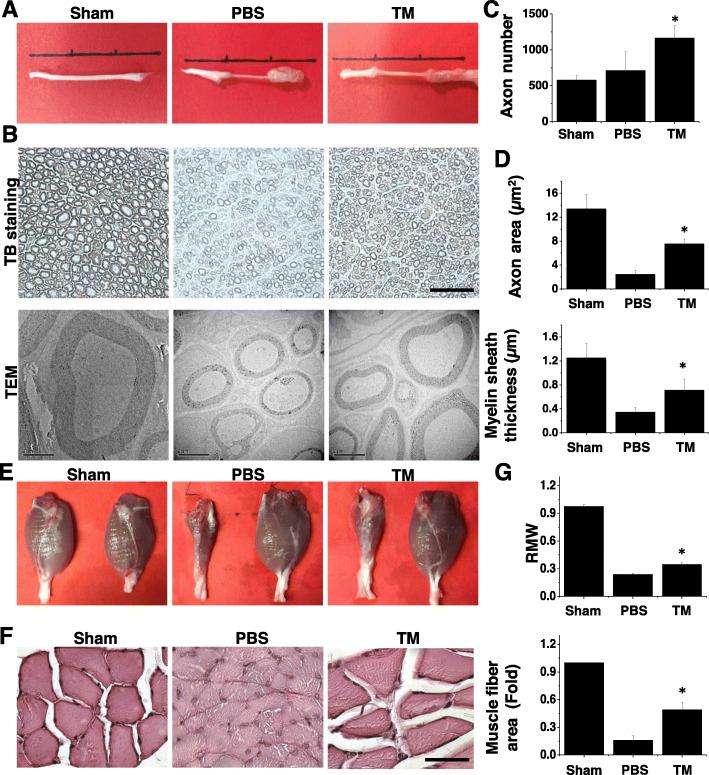
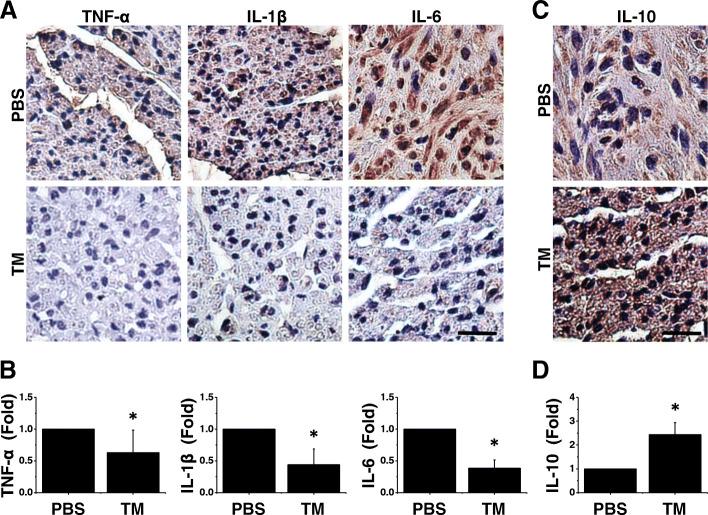
The administration of TM during M1 induction significantly reduced the expression levels of inflammatory cytokines, including TNF-a (p < 0.05), IL-6 (p < 0.05), and CD86 (p < 0.05), in THP-1 cells. Simultaneously, the expression levels of M2 markers, including IL-10 (p < 0.05) and CD206 (p < 0.05), were significantly increased in TM-treated THP-1 cells. Inhibition of IL-4R-c-Myc-pSTAT6-PPARγ signaling abolished the expression levels of IL-10 (p < 0.05) and CD206 (p < 0.05). The conditioned medium (CM) collected from M1 cells triggered an inflammatory response in primary Schwann cells, while CM collected from M1 cells treated with TM resulted in a dose-dependent reduction in inflammation. TM treatment led to better nerve regeneration when tested 6 weeks after injury and preserved effector muscle function. In addition, TM treatment reduced macrophage infiltration at the site of injury and led to potent M1 to M2 transition, thus indicating the anti-inflammatory capacity of TM.
CONCLUSIONS
Collectively, our findings demonstrate the anti-inflammatory role of TM during nerve regeneration. Therefore, TM represents a potential drug for the promotion and modulation of functional recovery in peripheral nerves that acts by regulating the M1/M2 ratio.
背景
受损组织内过度的炎症通常会导致再生延迟或不足,而外周神经系统 (PNS) 的神经在损伤后通常不能完全恢复。因此,人们越来越关注调节炎症反应是否有助于促进 PNS 中的神经再生。然而,迄今为止,尚无针对神经损伤后炎症调节的实用治疗策略。血栓调节蛋白 (TM) 是一种含有五个结构域的跨膜糖蛋白。TM 的凝集素样结构域具有抑制炎症反应的能力。然而,TM 是否可以在神经再生过程中调节 PNS 中的炎症仍有待阐明。
方法
我们研究了 TM 在人单核细胞系 (THP-1) 中转导促炎型 1 型巨噬细胞 (M1) 向抗炎型 2 型巨噬细胞 (M2) 中的作用,并评估了 TM 在大鼠坐骨神经横断损伤中的治疗应用。
结果
在 M1 诱导期间给予 TM 可显著降低 THP-1 细胞中炎症细胞因子 TNF-a(p<0.05)、IL-6(p<0.05)和 CD86(p<0.05)的表达水平。同时,TM 处理的 THP-1 细胞中 M2 标志物的表达水平,包括 IL-10(p<0.05)和 CD206(p<0.05),显著增加。抑制 IL-4R-c-Myc-pSTAT6-PPARγ 信号通路可消除 IL-10(p<0.05)和 CD206(p<0.05)的表达水平。从 M1 细胞收集的条件培养基 (CM) 可引发原代施万细胞的炎症反应,而从用 TM 处理的 M1 细胞收集的 CM 则导致炎症呈剂量依赖性降低。在损伤后 6 周进行测试时,TM 治疗导致更好的神经再生,并保持效应肌肉功能。此外,TM 治疗减少了损伤部位的巨噬细胞浸润,并导致强烈的 M1 向 M2 转变,从而表明 TM 的抗炎能力。
结论
总之,我们的研究结果表明 TM 在神经再生过程中具有抗炎作用。因此,TM 代表了一种有潜力的药物,可通过调节 M1/M2 比值来促进和调节周围神经的功能恢复。


 Zotero 插件