
美国癌症幸存者处方阿片类药物使用和滥用的全国模式。
National Patterns in Prescription Opioid Use and Misuse Among Cancer Survivors in the United States.
机构信息
Department of Therapeutic Radiology, Yale University School of Medicine, New Haven, Connecticut.
Department of Radiation Oncology, Allegheny General Hospital, Pittsburgh, Pennsylvania.
出版信息
JAMA Netw Open. 2020 Aug 3;3(8):e2013605. doi: 10.1001/jamanetworkopen.2020.13605.
IMPORTANCE
Prescription opioids are frequently prescribed to treat cancer-related pain. However, limited information exists regarding rates of prescription opioid use and misuse in populations with cancer.
OBJECTIVES
To estimate the prevalence and likelihood of prescription opioid use and misuse in adult cancer survivors compared with respondents without cancer and to identify characteristics associated with prescription opioid use and misuse in adult cancer survivors.
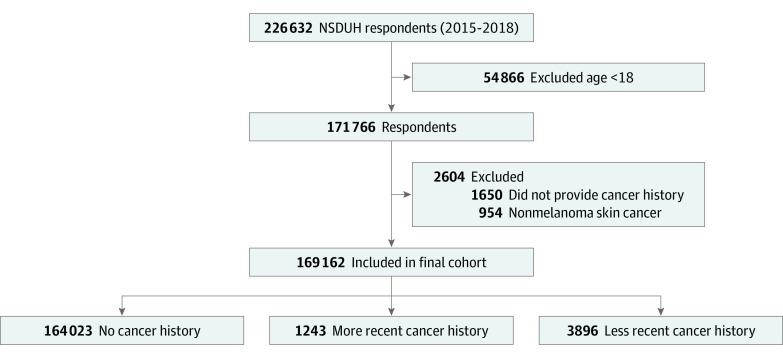
DESIGN, SETTING, AND PARTICIPANTS: This cross-sectional study is a retrospective, population-based study using data from 169 162 respondents to the National Survey on Drug Use and Health from January 2015 to December 2018. Survey data sets were queried for all respondents aged 18 years or older. Those with a reported history of cancer were termed cancer survivors and further divided into more recent (had cancer within 12 months of survey) and less recent (had cancer more than 12 months prior to survey) cohorts. Respondents with nonmelanoma skin cancer were excluded.
MAIN OUTCOMES AND MEASURES
Prescription opioid use and misuse within the past 12 months.
RESULTS
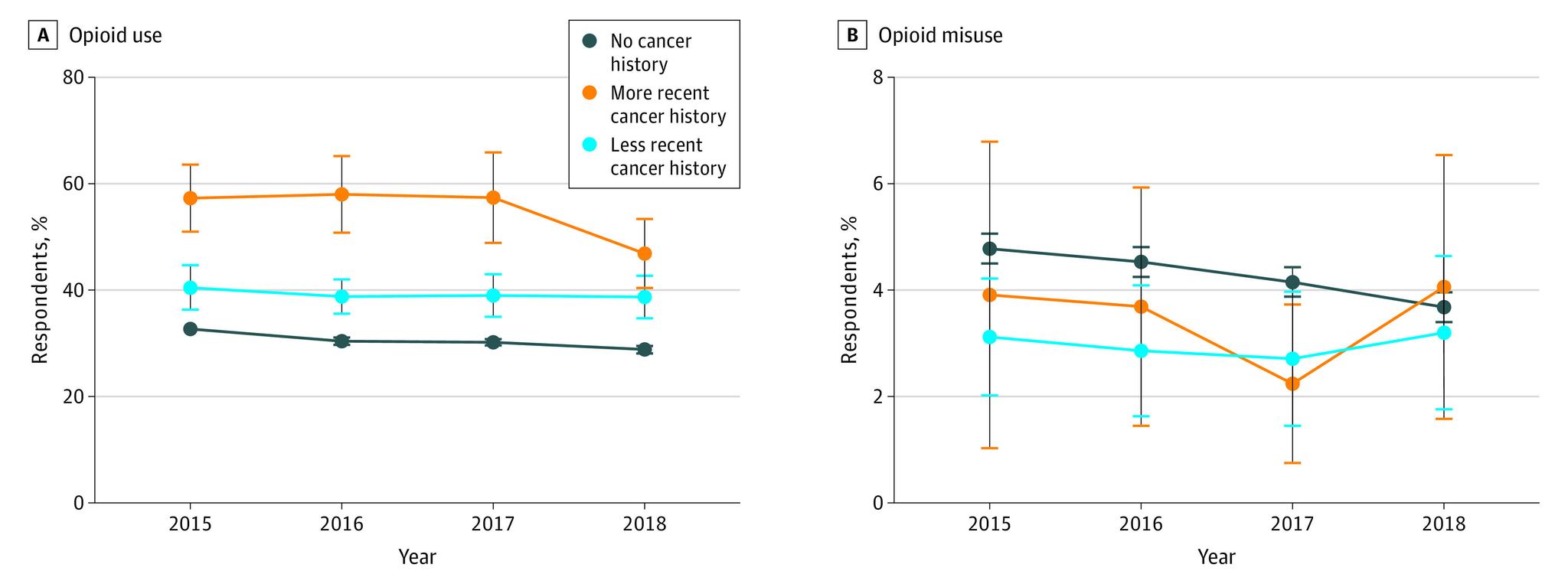
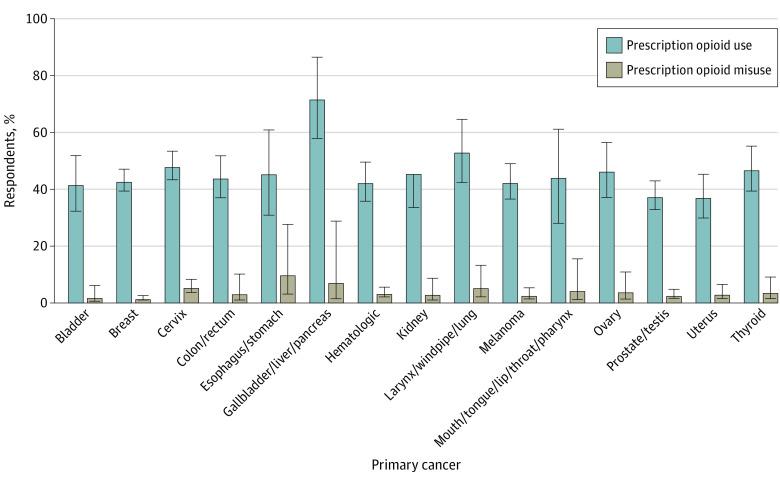
Among 169 162 respondents, 5139 (5.2%) were cancer survivors, with 1243 (1.2%) and 3896 (4.0%) reporting having more recent and less recent cancer histories, respectively. Higher rates of prescription opioid use were observed among more recent cancer survivors (54.3%; 95% CI, 50.2%-58.4%; odds ratio [OR], 1.86; 95% CI, 1.57-2.20; P < .001) and less recent cancer survivors (39.2%; 95% CI, 37.3%-41.2%; OR, 1.18; 95% CI, 1.08-1.28; P < .001) compared with respondents without cancer (30.5%, reference group). Rates of prescription opioid misuse were similar among more recent (3.5%; 95% CI, 2.4%-5.2%; OR, 1.27; 95% CI, 0.82-1.96; P = .36) and less recent (3.0%; 95% CI, 2.4%-3.6%; OR, 1.03; 95% CI, 0.83-1.28; P = .76) survivors compared with respondents without cancer (4.3%, reference group). Younger age (aged 18-34 years vs ≥65 years: OR, 7.06; 95% CI, 3.03-16.41; P < .001), alcohol use disorder (OR, 3.22; 95% CI, 1.45-7.14; P = .005), and nonopioid drug use disorder (OR, 14.76; 95% CI, 7.40-29.44; P < .001) were associated with prescription opioid misuse among cancer survivors.
CONCLUSIONS AND RELEVANCE
In this study, prescription opioid use was higher among more and less recent cancer survivors compared with the population without a history of cancer. Rates of prescription opioid misuse were low and similar among all 3 cohorts. These findings suggest that higher prescription opioid use among cancer survivors may not correspond to increased short-term or long-term misuse.
重要性
阿片类处方药物常被用于治疗与癌症相关的疼痛。然而,关于癌症患者群体中阿片类处方药物使用和滥用的发生率,相关信息有限。
目的
评估癌症幸存者与无癌症患者相比,使用和滥用阿片类处方药物的流行率和可能性,并确定与癌症幸存者中阿片类处方药物使用和滥用相关的特征。
设计、设置和参与者:本横断面研究是一项回顾性、基于人群的研究,使用了 2015 年 1 月至 2018 年 12 月全国药物使用与健康调查中 169162 名应答者的数据。查询了所有年龄在 18 岁或以上的应答者的数据。报告有癌症病史的人被称为癌症幸存者,并进一步分为近期(在调查前 12 个月内患有癌症)和非近期(在调查前 12 个月以上患有癌症)队列。排除患有非黑色素瘤皮肤癌的患者。
主要结局和测量指标
在过去 12 个月内使用和滥用阿片类处方药物的情况。
结果
在 169162 名应答者中,有 5139 人(5.2%)是癌症幸存者,其中 1243 人(1.2%)和 3896 人(4.0%)分别报告最近和非近期患有癌症。近期癌症幸存者(54.3%;95%CI,50.2%-58.4%;优势比[OR],1.86;95%CI,1.57-2.20;P<0.001)和非近期癌症幸存者(39.2%;95%CI,37.3%-41.2%;OR,1.18;95%CI,1.08-1.28;P<0.001)使用阿片类处方药物的比例均高于无癌症患者(30.5%,参照组)。近期(3.5%;95%CI,2.4%-5.2%;OR,1.27;95%CI,0.82-1.96;P=0.36)和非近期(3.0%;95%CI,2.4%-3.6%;OR,1.03;95%CI,0.83-1.28;P=0.76)幸存者中阿片类处方药物滥用的比例与无癌症患者(4.3%,参照组)相似。年龄较轻(18-34 岁与≥65 岁:OR,7.06;95%CI,3.03-16.41;P<0.001)、酒精使用障碍(OR,3.22;95%CI,1.45-7.14;P=0.005)和非阿片类药物使用障碍(OR,14.76;95%CI,7.40-29.44;P<0.001)与癌症幸存者中阿片类处方药物滥用相关。
结论和相关性
在这项研究中,与无癌症病史的人群相比,近期和非近期癌症幸存者使用阿片类处方药物的比例更高。所有 3 个队列中阿片类处方药物滥用的比例都较低且相似。这些发现表明,癌症幸存者中阿片类处方药物使用的增加可能并不对应于短期或长期滥用的增加。
 Zotero 插件