
改良HEART评分在亚洲人群中的表现。
Performance of the modified HEART score in an Asian population.
作者信息
Sajeed Shanaz Matthew, De Dios Michael P, Ong Dan Wei Jun, Punyadasa Amila Clarence
机构信息
Department of Emergency Medicine and Department of Intensive Care Medicine, Ng Teng Fong General Hospital, 1 Jurong East Street 21, Singapore, 609606, Singapore.
Department of Emergency Medicine, Ng Teng Fong General Hospital, 1 Jurong East Street 21, Singapore, 609606, Singapore.
出版信息
Int J Emerg Med. 2020 Aug 19;13(1):43. doi: 10.1186/s12245-020-00300-1.
INTRODUCTION
Chest pain is the most common potentially life-threatening presentation to the emergency department (ED). Furthermore, the identification of acute coronary syndrome (ACS) including its risk stratification and subsequent disposition can be challenging. The original HEART score was derived as a predictive tool to risk stratify patients presenting with undifferentiated chest pain (CP) and aid physician decision-making. However, it utilized conventional troponins as its cardiac biomarker component. Our study aims to assess the utility of the modified HEART score with highly sensitive troponins in an Asian setting with mixed ethnicity to determine if it corroborates the findings of another recent Chinese study by Chun-Peng et al. (Journal of Geriatric Cardiology 13:64-69, 2016).
METHODS
Clinical data from 413 patients presenting to the ED for evaluation of chest pain were analyzed. The predictive value of the modified HEART score for determining major adverse cardiac events (MACE) was then evaluated.
RESULTS
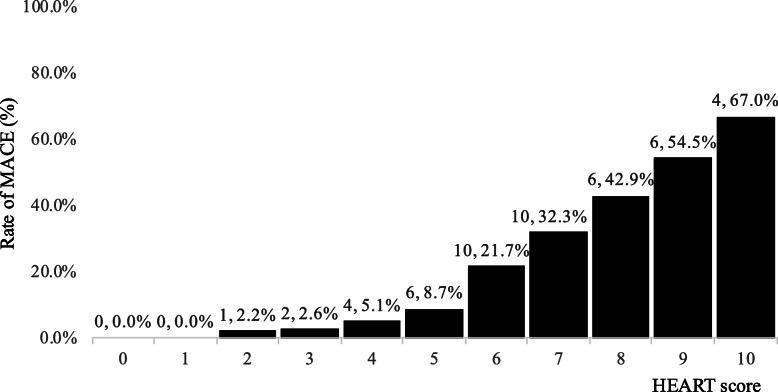
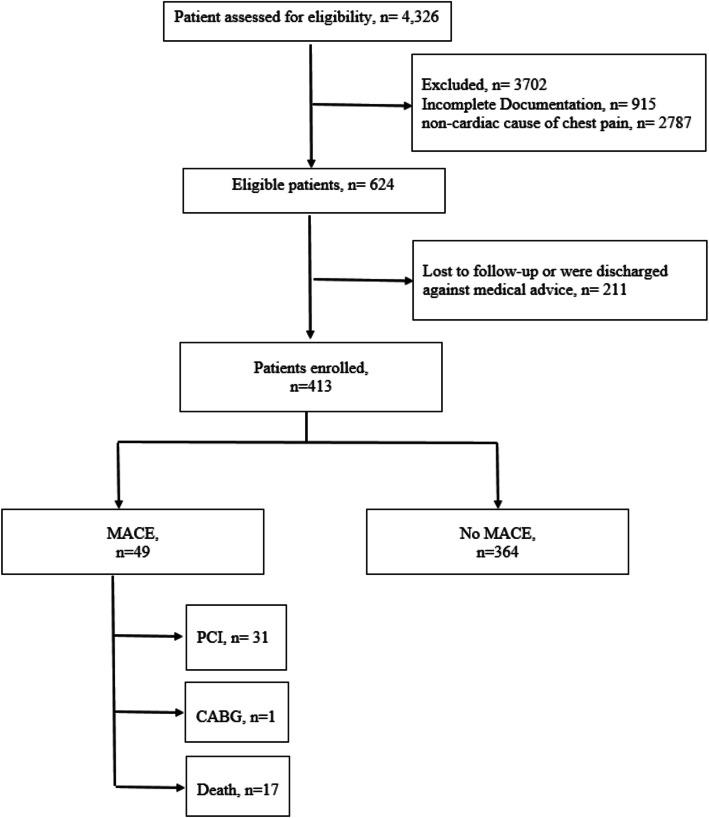
A total of 49 patients (11.9%) had a MACE: 31 patients (7.5%) underwent PCI and 1 patient (0.2%) underwent CABG. There were 17 (4.1%) deaths. Three risk groups were elucidated based on MACE. In the low-risk group (0-2), there were 72 patients (17.4%), with a MACE rate of 1.4%. In the intermediate-risk group (3-5), there were 233 patients (56.4%), with a MACE rate of 5.2%. In the high-risk group (6-10), there were 108 patients (26.2%), with a MACE rate of 33.3%.
CONCLUSION
The modified HEART score is an effective risk stratification tool in an ethnically diverse Asian population. Furthermore, it identifies low-risk patients who are candidates for early discharge from a local emergency department.
引言
胸痛是急诊科最常见的潜在危及生命的症状。此外,急性冠状动脉综合征(ACS)的识别,包括其风险分层和后续处置可能具有挑战性。最初的HEART评分是作为一种预测工具,用于对出现不明原因胸痛(CP)的患者进行风险分层,并协助医生进行决策。然而,它使用传统肌钙蛋白作为其心脏生物标志物成分。我们的研究旨在评估在亚洲多民族背景下,使用高敏肌钙蛋白的改良HEART评分的效用,以确定其是否证实了Chun-Peng等人最近另一项中国研究的结果(《老年心脏病学杂志》13:64-69,2016)。
方法
分析了413名到急诊科评估胸痛的患者的临床数据。然后评估改良HEART评分对确定主要不良心脏事件(MACE)的预测价值。
结果
共有49名患者(11.9%)发生了MACE:31名患者(7.5%)接受了PCI,1名患者(0.2%)接受了CABG。有17例(4.1%)死亡。根据MACE确定了三个风险组。在低风险组(0-2),有72名患者(17.4%),MACE发生率为1.4%。在中风险组(3-5),有233名患者(5
 Zotero 插件