
欧洲639例危重症COVID-19患者死亡风险和疾病进展的预后因素:国际RISC-19-ICU前瞻性观察队列的初步报告
Prognostic factors associated with mortality risk and disease progression in 639 critically ill patients with COVID-19 in Europe: Initial report of the international RISC-19-ICU prospective observational cohort.
作者信息
Wendel Garcia Pedro David, Fumeaux Thierry, Guerci Philippe, Heuberger Dorothea Monika, Montomoli Jonathan, Roche-Campo Ferran, Schuepbach Reto Andreas, Hilty Matthias Peter
机构信息
The RISC-19-ICU registry board, University of Zurich, Zurich, Switzerland.
Institute of Intensive Care Medicine, University Hospital of Zurich, Rämistrasse 100, Zurich 8091, Switzerland.
出版信息
EClinicalMedicine. 2020 Aug;25:100449. doi: 10.1016/j.eclinm.2020.100449. Epub 2020 Jul 6.
BACKGROUND
Coronavirus disease 2019 (COVID-19) is associated with a high disease burden with 10% of confirmed cases progressing towards critical illness. Nevertheless, the disease course and predictors of mortality in critically ill patients are poorly understood.
METHODS
Following the critical developments in ICUs in regions experiencing early inception of the pandemic, the European-based, international RIsk Stratification in COVID-19 patients in the Intensive Care Unit (RISC-19-ICU) registry was created to provide near real-time assessment of patients developing critical illness due to COVID-19.
FINDINGS
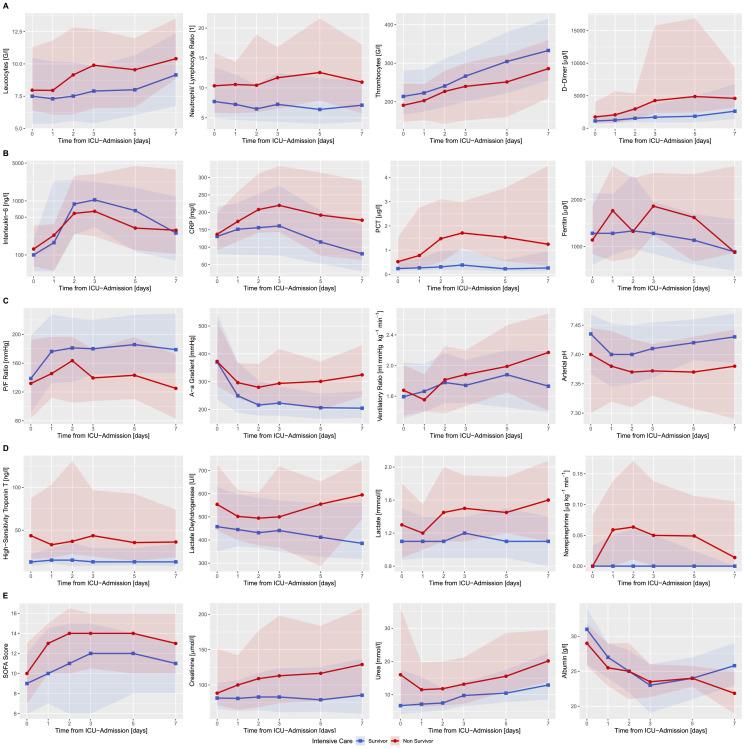
As of April 22, 2020, 639 critically ill patients with confirmed SARS-CoV-2 infection were included in the RISC-19-ICU registry. Of these, 398 had deceased or been discharged from the ICU. ICU-mortality was 24%, median length of stay 12 (IQR, 5-21) days. ARDS was diagnosed in 74%, with a minimum P/F-ratio of 110 (IQR, 80-148). Prone positioning, ECCO2R, or ECMO were applied in 57%. Off-label therapies were prescribed in 265 (67%) patients, and 89% of all bloodstream infections were observed in this subgroup ( = 66; RR=3·2, 95% CI [1·7-6·0]). While PCT and IL-6 levels remained similar in ICU survivors and non-survivors throughout the ICU stay ( = 0·35, 0·34), CRP, creatinine, troponin, d-dimer, lactate, neutrophil count, P/F-ratio diverged within the first seven days (<0·01). On a multivariable Cox proportional-hazard regression model at admission, creatinine, d-dimer, lactate, potassium, P/F-ratio, alveolar-arterial gradient, and ischemic heart disease were independently associated with ICU-mortality.
INTERPRETATION
The European RISC-19-ICU cohort demonstrates a moderate mortality of 24% in critically ill patients with COVID-19. Despite high ARDS severity, mechanical ventilation incidence was low and associated with more rescue therapies. In contrast to risk factors in hospitalized patients reported in other studies, the main mortality predictors in these critically ill patients were markers of oxygenation deficit, renal and microvascular dysfunction, and coagulatory activation. Elevated risk of bloodstream infections underscores the need to exercise caution with off-label therapies.
背景
2019冠状病毒病(COVID-19)的疾病负担较高,10%的确诊病例会发展为危重症。然而,危重症患者的病程及死亡预测因素仍知之甚少。
方法
随着疫情早期开始地区重症监护病房(ICU)的关键进展,基于欧洲的国际COVID-19患者重症监护病房风险分层(RISC-19-ICU)登记系统得以创建,以对因COVID-19发展为危重症的患者进行近实时评估。
研究结果
截至2020年4月22日,639例确诊感染严重急性呼吸综合征冠状病毒2(SARS-CoV-2)的危重症患者被纳入RISC-19-ICU登记系统。其中,398例已死亡或从ICU出院。ICU死亡率为24%,中位住院时间为12(四分位间距,5-21)天。74%的患者被诊断为急性呼吸窘迫综合征(ARDS),最低氧合指数(P/F)为110(四分位间距,80-148)。57%的患者采用了俯卧位通气、体外二氧化碳清除(ECCO2R)或体外膜肺氧合(ECMO)。265例(67%)患者接受了超说明书用药治疗,该亚组中观察到所有血流感染的89%(n = 66;相对危险度=3.2,95%置信区间[1.7-6.0])。在整个ICU住院期间,ICU幸存者和非幸存者的降钙素原(PCT)和白细胞介素-6(IL-6)水平保持相似(P = 0.35,0.34),而C反应蛋白(CRP)、肌酐、肌钙蛋白、D-二聚体、乳酸、中性粒细胞计数、P/F比值在前七天内出现差异(P<0.01)。在入院时的多变量Cox比例风险回归模型中,肌酐、D-二聚体、乳酸、钾、P/F比值、肺泡-动脉氧分压差和缺血性心脏病与ICU死亡率独立相关。
解读
欧洲RISC-19-ICU队列显示,COVID-19危重症患者的死亡率为24%,处于中等水平。尽管ARDS严重程度较高,但机械通气发生率较低且与更多挽救治疗相关。与其他研究报道的住院患者风险因素不同,这些危重症患者的主要死亡预测因素是氧合不足、肾脏和微血管功能障碍以及凝血激活的标志物。血流感染风险升高凸显了对超说明书用药治疗需谨慎的必要性。

 Zotero 插件