
鼻一氧化氮测量在原发性纤毛运动障碍诊断中的价值。
The value of nasal nitric oxide measurement in the diagnosis of primary ciliary dyskinesia.
作者信息
Zhang Xiang, Wang Xinglan, Li Huimin, Wang Wei, Zhao Shunying
机构信息
The Second Department of Respiratory Medicine Beijing Children's Hospital Capital Medical University National Center for Children's Health Beijing China.
出版信息
Pediatr Investig. 2019 Dec 21;3(4):209-213. doi: 10.1002/ped4.12160. eCollection 2019 Dec.
IMPORTANCE
Nasal nitric oxide (nNO) testing is a method used in the diagnosis of primary ciliary dyskinesia (PCD). It has not been evaluated in Chinese population.
OBJECTIVE
To establish a reference nNO value to assist in the diagnosis of PCD in Chinese children.
METHODS
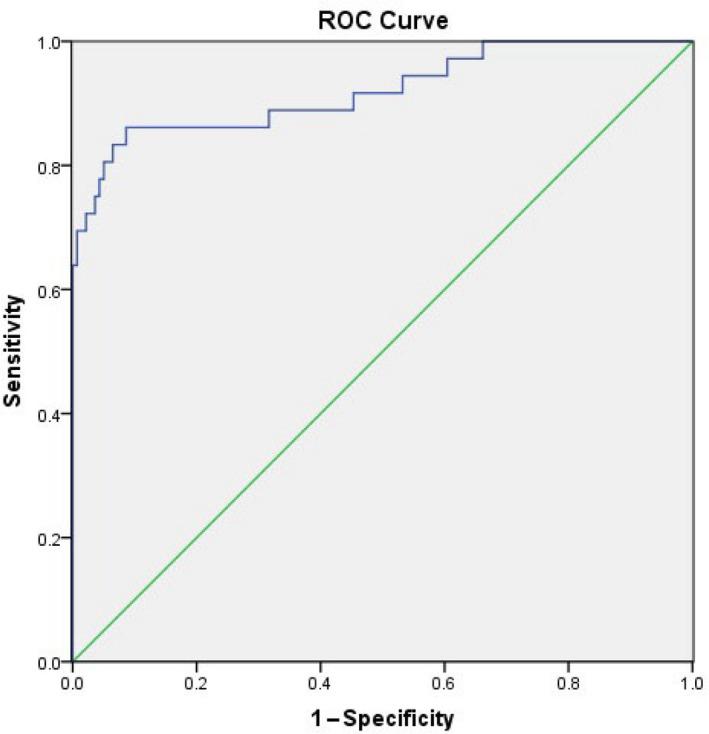
nNO values were measured in children with PCD ( 36), cystic fibrosis (CF) ( 20), asthma ( 45), post-infectious bronchiolitis obliterans (BO) ( 41) and non-PCD/non-CF bronchiectasis ( 32). The receiver operating characteristic nNO value for the diagnosis of PCD was plotted and the area under the curve was calculated.
RESULTS
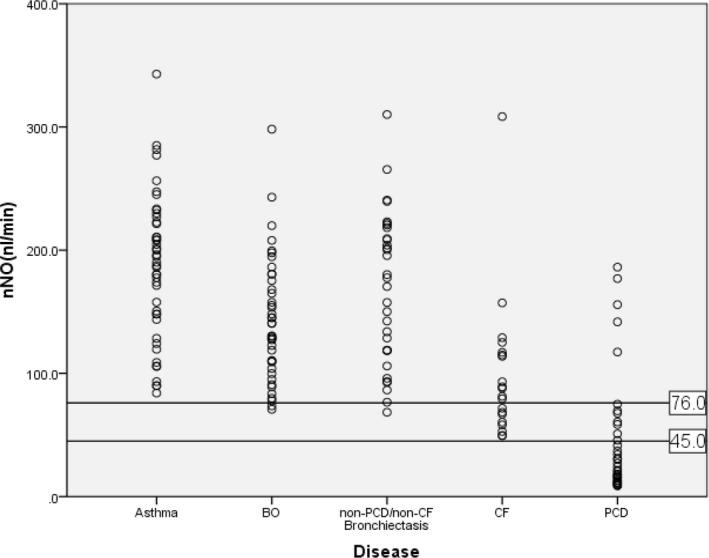
nNO values were significantly lower in children with PCD (median 25.66 nL/min) than in children with asthma (186.26 ± 58.95 nL/ min), BO (143.47 ± 49.71 nL/min) and non-PCD/non-CF bronchiectasis (173.13 ± 63.80 nL/min), but not in children with CF (90.90 ± 43.20 nL/min). Notably however, no CF patient had an nNO value < 45 nL/min. A cut-off of 76 nL/min yielded the best sensitivity of 86.1%, and specificity of 91.4%, with an area under the curve of 0.920 (95% confidence interval 0.859-0.981) for the diagnosis of PCD. If CF was ruled out the specificity increased to nearly 100%.
INTERPRETATION
nNO testing is able to discriminate between patients with PCD and those with CF, asthma, post-infectious BO and non-PCD/non-CF bronchiectasis. A cut-off of 76 nL/min could be further examined in patients suspected of PCD, to establish an nNO reference value for PCD screening in Chinese children.
重要性
鼻一氧化氮(nNO)检测是用于诊断原发性纤毛运动障碍(PCD)的一种方法。该方法尚未在中国人群中进行评估。
目的
建立一个nNO参考值,以辅助诊断中国儿童的PCD。
方法
对患有PCD(36例)、囊性纤维化(CF)(20例)、哮喘(45例)、感染后闭塞性细支气管炎(BO)(41例)和非PCD/非CF支气管扩张症(32例)的儿童测量nNO值。绘制诊断PCD的nNO值的受试者工作特征曲线,并计算曲线下面积。
结果
PCD患儿的nNO值(中位数25.66 nL/分钟)显著低于哮喘患儿(186.26±58.95 nL/分钟)、BO患儿(143.47±49.71 nL/分钟)和非PCD/非CF支气管扩张症患儿(173.13±63.80 nL/分钟),但与CF患儿(90.90±43.20 nL/分钟)无显著差异。然而,值得注意的是,没有CF患者的nNO值<45 nL/分钟。以76 nL/分钟为临界值时,诊断PCD的敏感性最佳,为86.1%,特异性为91.4%,曲线下面积为0.920(95%置信区间0.859 - 0.981)。如果排除CF,特异性可提高到近100%。
解读
nNO检测能够区分PCD患者与CF、哮喘、感染后BO和非PCD/非CF支气管扩张症患者。对于疑似PCD的患者,可进一步研究以76 nL/分钟为临界值的情况,从而建立中国儿童PCD筛查的nNO参考值。
 Zotero 插件