
保加利亚全民食盐碘化前后甲状腺癌发病率的变化:国家癌症登记数据分析。
Thyroid Cancer Incidence in Bulgaria before and after the Introduction of Universal Salt Iodization: An Analysis of the National Cancer Registry Data.
机构信息
Department of Neurology, Psychiatry, Physiotherapy and Rehabilitation, Preventive Medicine, and Public Health Sofia University “St. Kl. Ohridski” School of Medicine, Sofia, Bulgaria
Statistition-Consultant Bulgarian National Cancer Registry, Sofia, Bulgaria
出版信息
Balkan Med J. 2020 Oct 23;37(6):330-335. doi: 10.4274/balkanmedj.galenos.2020.2019.10.5. Epub 2020 Aug 28.
BACKGROUND
Thyroid cancer is the most common malignancy of the endocrine system and it has become the fastest growing cancer among women. The suspected risk factors include increased exposure to ionizing radiation during childhood, environmental pollutants, possible iodine deficiency, and excessive iodine exposure.
AIMS
To analyze the thyroid cancer incidence between 1980 and 2013 in Bulgaria and to determine the incidence rate before and after the introduction of universal salt iodization in 1994 in regions with different iodine deficiency levels.
STUDY DESIGN
Retrospective cohort.
METHODS
The study was a retrospective analysis of the total number of thyroid cancer cases with all histological types in Bulgaria (thyroid cancer, ICD10 code C73), diagnosed between 01/01/1980 and 31/12/2013, and retrieved from the anonymous cancer registry database of the Bulgarian National Cancer Registry. Age-standardized rates of thyroid cancer per 100,000 persons were calculated for each year of the periods mentioned below by sex and age, utilizing the WHO world reference populations with a special statistical module of the Bulgarian National Cancer Registry’s software CancerRegBG, 2011. Incidence rates were reported by age, sex, and period of diagnosis (1980-86, 1987-93, 1994-99, 2000-2006, 2007-2013). Trends among males and females were analyzed separately, as well as by age category: 0-19, 20-44, 45-64, and 65+. Annual percentage changes of age-standardized incidence rates were analyzed by Joinpoint regression to determine trends using the Joinpoint statistical software SEER* Stat Software, Version 4.1.1, 2014.
RESULTS
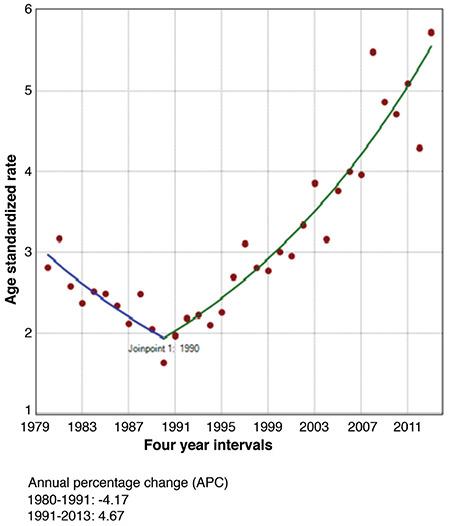
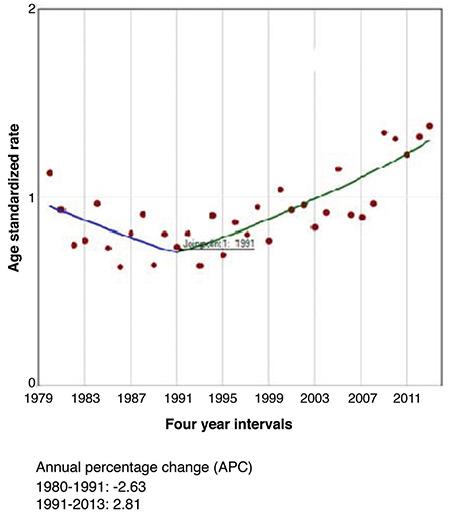
The age-standardized rates of thyroid cancer in Bulgaria has been increasing since 1990, being higher among women compared to men (4.68 vs 2.81). The highest age-standardized rates of thyroid cancer was observed in women in the 2007-2013 period. The only significant joinpoint was recorded in 1990 for females and in 1991 for males. The highest incidence rates was in the Smolyan district, a region with historically existing iodine deficiency and relatively high post-Chernobyl radiation exposure.
CONCLUSION
Our results showed that, in different regions, the age-standardized thyroid cancer rates between endemic and non-endemic differ greatly depending on the radiation dose from the Chernobyl accident. The role of iodine intake in thyroid cancer remains uncertain, but iodine deficiency could be a contributing factor to the increased risk of thyroid cancer.
背景
甲状腺癌是内分泌系统最常见的恶性肿瘤,已成为女性中增长最快的癌症。疑似风险因素包括儿童时期接触电离辐射增加、环境污染物、可能的碘缺乏以及过量碘暴露。
目的
分析 1980 年至 2013 年保加利亚甲状腺癌的发病率,并确定 1994 年普遍食盐碘化前后不同碘缺乏水平地区的发病率。
研究设计
回顾性队列研究。
方法
本研究是对保加利亚(甲状腺癌,ICD10 编码 C73)所有组织学类型甲状腺癌病例总数的回顾性分析,这些病例于 1980 年 1 月 1 日至 2013 年 12 月 31 日在保加利亚国家癌症登记处的匿名癌症登记数据库中诊断,利用世界卫生组织世界参考人群和保加利亚国家癌症登记处软件 CancerRegBG 的特殊统计模块,计算了每年每 100,000 人患甲状腺癌的年龄标准化率,2011 年。根据诊断时的年龄、性别和时期(1980-86 年、1987-93 年、1994-99 年、2000-2006 年、2007-2013 年)报告发病率。分别分析了男性和女性以及以下年龄组的趋势:0-19 岁、20-44 岁、45-64 岁和 65 岁以上。使用 Joinpoint 统计软件 SEER*Stat Software,Version 4.1.1,2014 年,通过 Joinpoint 回归分析确定年龄标准化发病率的年度百分比变化,以确定趋势。
结果
自 1990 年以来,保加利亚的甲状腺癌年龄标准化率一直在上升,女性的发病率高于男性(4.68 比 2.81)。2007-2013 年期间,女性的甲状腺癌年龄标准化率最高。仅在 1990 年记录了女性的唯一显著连接点,在 1991 年记录了男性的唯一显著连接点。发病率最高的地区是斯莫梁区,该地区历史上存在碘缺乏,切尔诺贝利事故后的辐射暴露相对较高。
结论
我们的结果表明,在不同地区,地方性和非地方性的年龄标准化甲状腺癌发病率因切尔诺贝利事故的辐射剂量而异。碘摄入在甲状腺癌中的作用仍不确定,但碘缺乏可能是甲状腺癌风险增加的一个因素。

 Zotero 插件