
马里和南非的随机临床试验中给孕妇接种流感疫苗的免疫原性。
Immunogenicity of influenza vaccines administered to pregnant women in randomized clinical trials in Mali and South Africa.
机构信息
Department of Epidemiology, Emory University Rollins School of Public Health, Atlanta, USA.
Medical Research Council: Respiratory and Meningeal Pathogens Research Unit, University of the Witwatersrand, Johannesburg, South Africa; Department of Science and Technology-National Research Foundation, Vaccine-Preventable Diseases, Johannesburg, South Africa.
出版信息
Vaccine. 2020 Sep 22;38(41):6478-6483. doi: 10.1016/j.vaccine.2020.07.020. Epub 2020 Aug 29.
BACKGROUND
A key consideration for expanding recommendations for influenza vaccination is a robust assessment of immunogenicity and efficiency of transplacental antibody transfer after maternal vaccination.
METHODS
We pooled data from two trials of maternal influenza vaccination to analyze vaccine immunogenicity with more power than either trial had alone. We compared hemagglutination-inhibition (HAI) titers and titer factor change for women and their infants between trial arms using t-tests; maternal and infant putative seroprotective titers (HAI ≥ 1:40) within each trial arm and maternal seroconversion between trial arms using exact tests; and transplacental antibody transfer between trial arms using t-tests. We used marginal linear models and generalized estimating equations to examine the impact of time between maternal vaccination and delivery on transplacental antibody transfer, infant titers, and infant seroprotection.
RESULTS
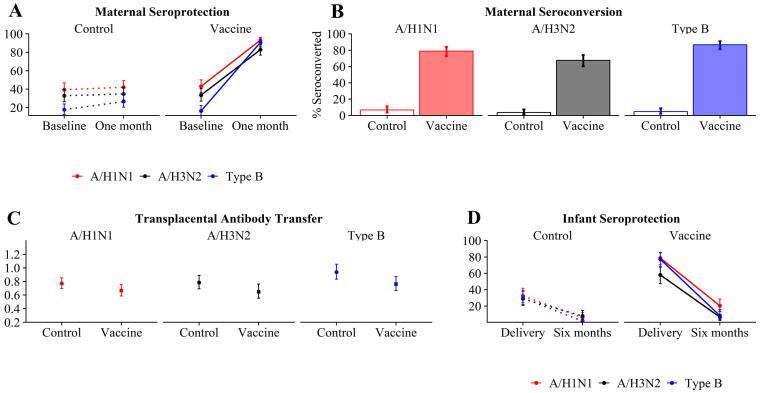
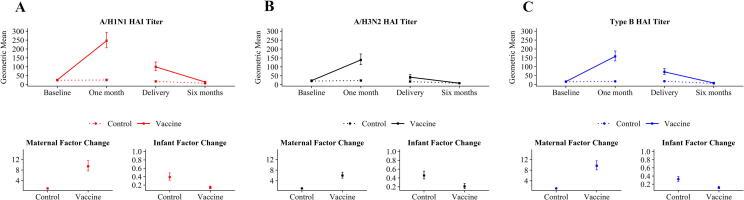
For all vaccine components (A/H1N1, A/H3N2, and Type B), >80% of vaccinated women had seroprotective titers, >60% of them seroconverted, and >50% of their infants were born with seroprotective titers. These immunogenicity outcomes occurred more often in vaccine recipients and their infants than in controls. No difference in efficiency of transplacental antibody transfer was observed between vaccine recipients and controls.
CONCLUSIONS
Our results provide robust support for further expansion of maternal influenza vaccination recommendations.
CLINICAL TRIALS REGISTRATION
NCT01430689 and NCT01306669.
背景
扩大流感疫苗接种建议的一个关键考虑因素是对母体接种疫苗后胎盘抗体转移的免疫原性和效率进行强有力的评估。
方法
我们汇集了两项母体流感疫苗接种试验的数据,以比任何一项试验都更强大的能力分析疫苗的免疫原性。我们使用 t 检验比较了试验组中女性及其婴儿的血凝抑制(HAI)滴度和滴度变化因子;使用确切检验比较了每个试验组中的母体和婴儿假定的保护性滴度(HAI≥1:40)以及试验组之间的母体血清转化率;使用 t 检验比较了试验组之间的胎盘抗体转移。我们使用边缘线性模型和广义估计方程来检查母体接种疫苗和分娩之间的时间对胎盘抗体转移、婴儿滴度和婴儿血清保护的影响。
结果
对于所有疫苗成分(A/H1N1、A/H3N2 和 B 型),超过 80%的接种疫苗的女性具有保护性滴度,超过 60%的女性发生血清转化率,超过 50%的婴儿出生时具有保护性滴度。这些免疫原性结果在疫苗接种者及其婴儿中比对照组更常见。在胎盘抗体转移的效率方面,疫苗接种者和对照组之间没有观察到差异。
结论
我们的结果为进一步扩大母体流感疫苗接种建议提供了有力支持。
临床试验注册
NCT01430689 和 NCT01306669。

 Zotero 插件