
考虑中国政府奖惩机制下绿色发展绩效的建筑和拆除废物回收的演化博弈理论研究。
An Evolutionary Game Theory Study for Construction and Demolition Waste Recycling Considering Green Development Performance under the Chinese Government's Reward-Penalty Mechanism.
机构信息
School of Civil Engineering and Geomatics, Southwest Petroleum University, Chengdu 610500, China.
College of Architecture and Urban-Rural Planning, Sichuan Agricultural University, Chengdu 611830, China.
出版信息
Int J Environ Res Public Health. 2020 Aug 29;17(17):6303. doi: 10.3390/ijerph17176303.
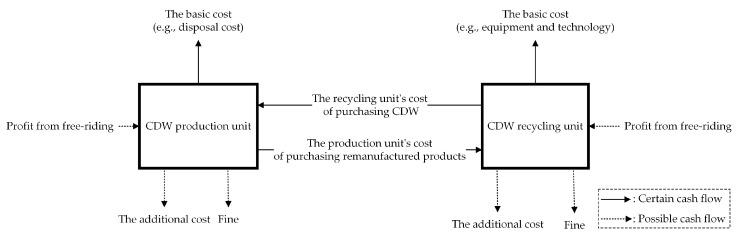
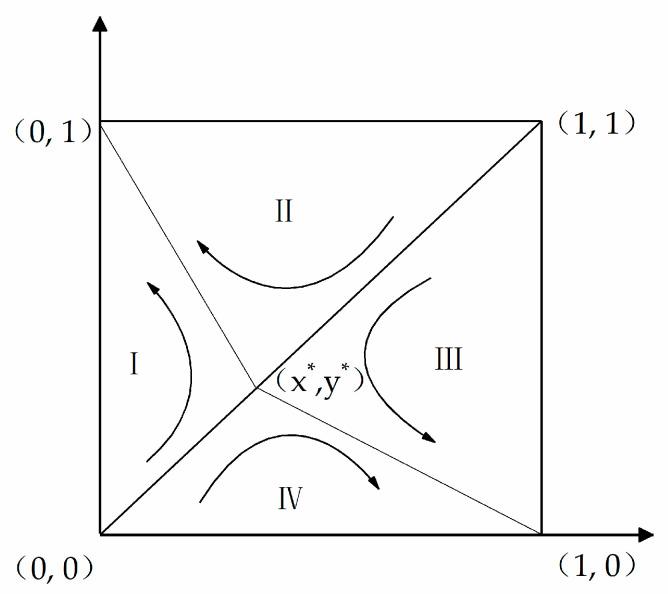
The low efficiency of the closed-loop supply chain in construction and demolition waste (CDW) recycling has restricted the green development of China's construction industry. Additionally, the government's reward-penalty mechanism has a huge influence on green development. This study aimed to investigate the effect of green development performance (GDP) and the government's reward-penalty mechanism on the decision-making process of production and recycling units, as well as to reveal the optimal strategies under different conditions. Therefore, the strategies' evolutionary paths of production and recycling units were investigated by using evolutionary game theory. Firstly, an evolutionary game model between production units and recycling units was proposed under the government's reward-penalty mechanism. Then, the evolutionary stability strategies in different scenarios were discussed. Finally, the effects of the relevant parameters on the evolutionary paths of the game model were analyzed using numerical simulations. The main conclusions are as follows. (1) When the range of GDP changes, the evolutionary stable strategy changes accordingly. GDP plays a positive role in promoting the high-quality development of the CDW recycling supply chain, but an increase in GDP can easily lead to the simultaneous motivation of free-riding. (2) The government's reward-penalty mechanism effectively regulates the decision-making process of production and recycling units. An increase in the subsidy rate and supervision probability helps to reduce free-riding behavior. Moreover, the incentive effect of the subsidy probability on recycling units is more obvious, while the effect of the supervision probability on improving the motivation of active participation for production units is more remarkable. This paper not only provides a decision-making basis to ensure production and recycling units to make optimal strategy choices under different conditions but also provides a reference for the government to formulate a reasonable reward-penalty mechanism that is conducive to a macro-control market.
闭环供应链在建筑和拆除废物 (CDW) 回收方面的低效率限制了中国建筑行业的绿色发展。此外,政府的奖惩机制对绿色发展有巨大影响。本研究旨在探讨绿色发展绩效 (GDP) 和政府的奖惩机制对生产和回收单位决策过程的影响,以及揭示不同条件下的最优策略。因此,本研究采用演化博弈理论研究了生产和回收单位的策略演化路径。首先,在政府奖惩机制下提出了生产单位和回收单位之间的演化博弈模型。然后,讨论了不同情况下的演化稳定策略。最后,通过数值模拟分析了相关参数对博弈模型演化路径的影响。主要结论如下。(1)当 GDP 变化范围变化时,演化稳定策略也随之变化。GDP 对 CDW 回收供应链的高质量发展起到了积极的推动作用,但 GDP 的增加容易导致搭便车行为的同时激励。(2)政府的奖惩机制有效地调节了生产和回收单位的决策过程。补贴率和监督概率的增加有助于减少搭便车行为。此外,补贴概率对回收单位的激励作用更为明显,而监督概率对提高生产单位积极参与的动机的影响更为显著。本文不仅为生产和回收单位在不同条件下做出最优策略选择提供了决策依据,也为政府制定有利于宏观调控市场的合理奖惩机制提供了参考。



 Zotero 插件