
用于电化学氮还原的原子精确掺杂剂控制的单簇催化
Atomically-precise dopant-controlled single cluster catalysis for electrochemical nitrogen reduction.
作者信息
Yao Chuanhao, Guo Na, Xi Shibo, Xu Cong-Qiao, Liu Wei, Zhao Xiaoxu, Li Jing, Fang Hanyan, Su Jie, Chen Zhongxin, Yan Huan, Qiu Zhizhan, Lyu Pin, Chen Cheng, Xu Haomin, Peng Xinnan, Li Xinzhe, Liu Bin, Su Chenliang, Pennycook Stephen J, Sun Cheng-Jun, Li Jun, Zhang Chun, Du Yonghua, Lu Jiong
机构信息
Department of Chemistry, National University of Singapore, 3 Science Drive 3, Singapore, 117543, Singapore.
Frontiers Science Center for Flexible Electronics (FSCFE), Shaanxi Institute of Flexible Electronics (SIFE) & Shaanxi Institute of Biomedical Materials and Engineering (SIBME), Northwestern Polytechnical University (NPU), 127 West Youyi Road, 710072, Xi'an, China.
出版信息
Nat Commun. 2020 Sep 1;11(1):4389. doi: 10.1038/s41467-020-18080-w.
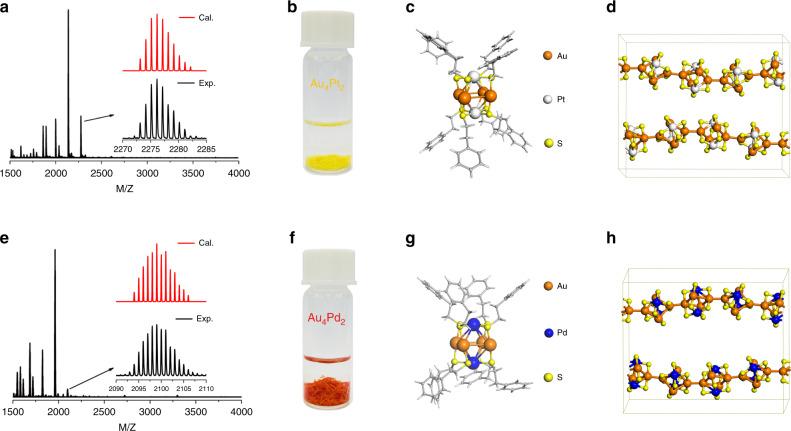
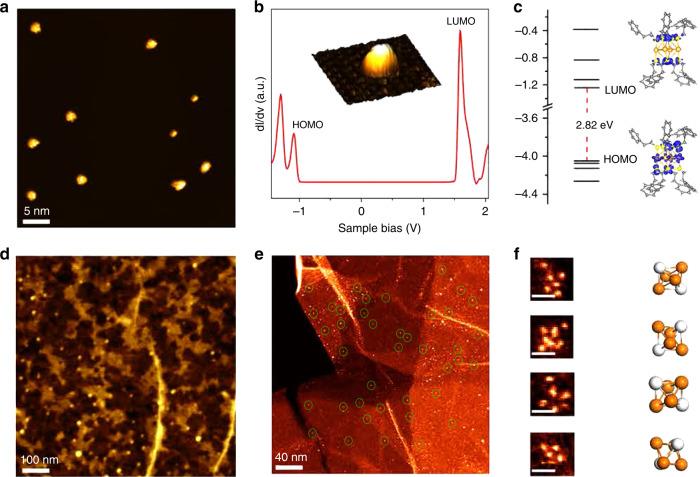
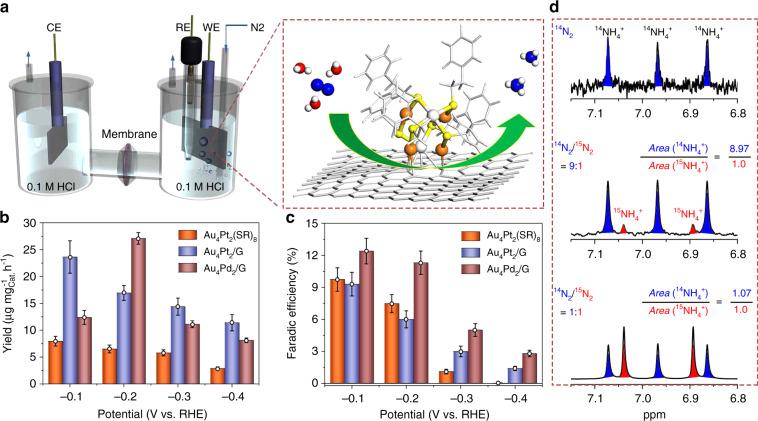
The ability to precisely engineer the doping of sub-nanometer bimetallic clusters offers exciting opportunities for tailoring their catalytic performance with atomic accuracy. However, the fabrication of singly dispersed bimetallic cluster catalysts with atomic-level control of dopants has been a long-standing challenge. Herein, we report a strategy for the controllable synthesis of a precisely doped single cluster catalyst consisting of partially ligand-enveloped AuPt clusters supported on defective graphene. This creates a bimetal single cluster catalyst (AuPt/G) with exceptional activity for electrochemical nitrogen (N) reduction. Our mechanistic study reveals that each N molecule is activated in the confined region between cluster and graphene. The heteroatom dopant plays an indispensable role in the activation of N via an enhanced back donation of electrons to the N LUMO. Moreover, besides the heteroatom Pt, the catalytic performance of single cluster catalyst can be further tuned by using Pd in place of Pt as the dopant.
精确设计亚纳米双金属团簇的掺杂,为以原子精度调整其催化性能提供了令人兴奋的机会。然而,在原子水平上控制掺杂剂制备单分散双金属团簇催化剂一直是一个长期存在的挑战。在此,我们报告了一种可控合成精确掺杂单团簇催化剂的策略,该催化剂由负载在缺陷石墨烯上的部分配体包裹的AuPt团簇组成。这产生了一种对电化学氮还原具有卓越活性的双金属单团簇催化剂(AuPt/G)。我们的机理研究表明,每个氮分子在团簇和石墨烯之间的受限区域被激活。杂原子掺杂剂通过增强向氮最低未占分子轨道的电子反馈,在氮的激活中发挥不可或缺的作用。此外,除了杂原子铂之外,通过使用钯代替铂作为掺杂剂,可以进一步调节单团簇催化剂的催化性能。


 Zotero 插件