
COVID-19大流行早期中国普通公众的抑郁及心理行为反应:调查研究
Depression and Psychological-Behavioral Responses Among the General Public in China During the Early Stages of the COVID-19 Pandemic: Survey Study.
作者信息
Zhang Weiyu, Yang Xiaoting, Zhao Jinfeng, Yang Fengzhi, Jia Yajing, Cui Can, Yang Xiaoshi
机构信息
Department of Social Medicine, School of Public Health, China Medical University, Shenyang, China.
Department of Gastroenterology, Benxi General Hospital, Liaoning Health Industry Group, Benxi, China.
出版信息
J Med Internet Res. 2020 Sep 4;22(9):e22227. doi: 10.2196/22227.
BACKGROUND
The COVID-19 pandemic has recently spread dramatically worldwide, raising considerable concerns and resulting in detrimental effects on the psychological health of people who are vulnerable to the disease. Therefore, assessment of depression in members of the general public and their psychological and behavioral responses is essential for the maintenance of health.
OBJECTIVE
This study aimed to assess the prevalence of depression and the associated factors among the general public during the early stages of the COVID-19 pandemic in China.
METHODS
A cross-sectional survey with convenience sampling was conducted from February 11 to 16, 2020, in the early stages of the COVID-19 outbreak in China. A self-administrated smartphone questionnaire based on the Patient Health Questionnaire-9 (PHQ-9) and psychological and behavioral responses was distributed to the general public. Hierarchical multiple regression analysis and multivariate logistic regression analysis were conducted to explore the associated factors of depression.aA cross-sectional survey with convenience sampling was conducted from February 11 to 16, 2020, in the early stages of the COVID-19 outbreak in China. A self-administrated smartphone questionnaire based on the Patient Health Questionnaire-9 (PHQ-9) and psychological and behavioral responses was distributed to the general public. Hierarchical multiple regression analysis and multivariate logistic regression analysis were conducted to explore the associated factors of depression.
RESULTS
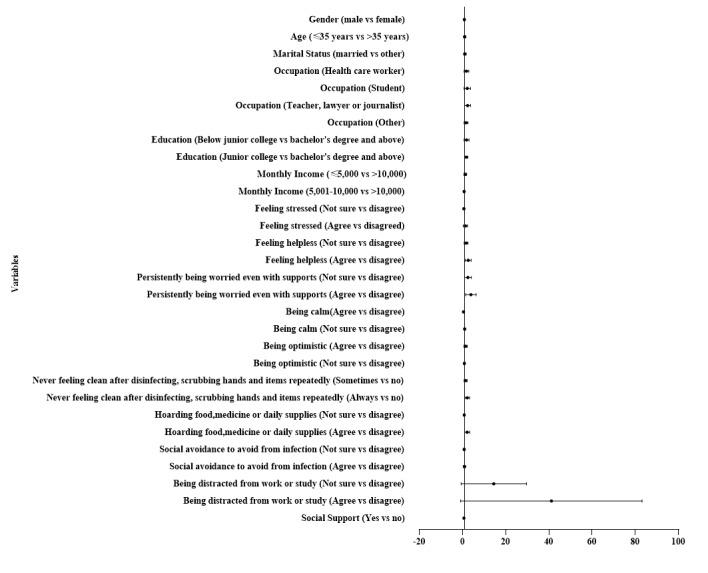
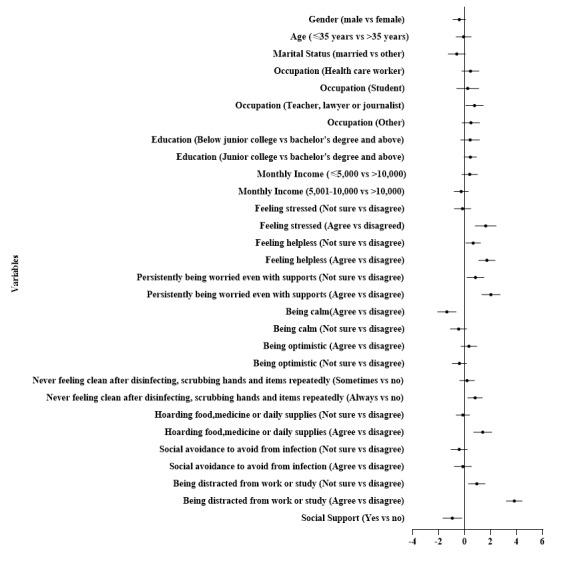
The prevalence of depression (PHQ-9 score ≥10) among the general public during the COVID-19 pandemic was 182/1342 (13.6%). Regression analysis indicated that feeling stressed, feeling helpless, persistently being worried even with support, never feeling clean after disinfecting, scrubbing hands and items repeatedly, hoarding food, medicine, or daily supplies, and being distracted from work or study were positively associated with depression, while social support and being calm were negatively associated with depression.
CONCLUSIONS
The general public suffered from high levels of depression during the early stages of the COVID-19 pandemic. Thus, COVID-19-related mood management and social support should be provided to attenuate depression in the general public.
背景
新型冠状病毒肺炎(COVID-19)疫情近期在全球范围内急剧蔓延,引发了广泛关注,并对易感染该疾病人群的心理健康产生了不利影响。因此,评估普通公众的抑郁状况及其心理和行为反应对于维护健康至关重要。
目的
本研究旨在评估中国COVID-19疫情早期普通公众中抑郁症的患病率及其相关因素。
方法
于2020年2月11日至16日在中国COVID-19疫情早期进行了一项采用便利抽样的横断面调查。向普通公众发放了基于患者健康问卷-9(PHQ-9)以及心理和行为反应的自填式智能手机问卷。进行了分层多元回归分析和多因素逻辑回归分析以探究抑郁症的相关因素。
结果
COVID-19疫情期间普通公众中抑郁症(PHQ-9评分≥10)的患病率为182/1342(13.6%)。回归分析表明,感到压力、感到无助、即使有支持仍持续担忧、消毒、反复洗手和清洁物品后仍感觉不干净、囤积食物、药品或日常用品以及工作或学习分心与抑郁症呈正相关,而社会支持和平静与抑郁症呈负相关。
结论
在COVID-19疫情早期,普通公众患有高水平的抑郁症。因此,应提供与COVID-19相关的情绪管理和社会支持以减轻普通公众的抑郁情绪。
 Zotero 插件