
双精子克隆(DSC)是哺乳动物基因工程和干细胞研究中很有前途的一种策略。
Double sperm cloning (DSC) is a promising strategy in mammalian genetic engineering and stem cell research.
机构信息
College of Veterinary Medicine, Henan Agricultural University, Zhengzhou, 450046, China.
出版信息
Stem Cell Res Ther. 2020 Sep 7;11(1):388. doi: 10.1186/s13287-020-01907-0.
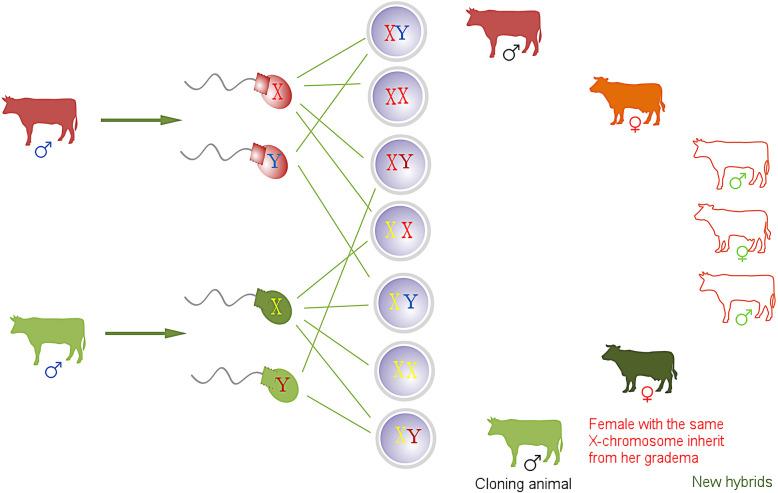
Embryonic stem cells (ESCs) derived from somatic cell nuclear transfer (SCNT) and induced pluripotent stem cells (iPSCs) are promising tools for meeting the personalized requirements of regenerative medicine. However, some obstacles need to be overcome before clinical trials can be undertaken. First, donor cells vary, and the reprogramming procedures are diverse, so standardization is a great obstacle regarding SCNT and iPSCs. Second, somatic cells derived from a patient may carry mitochondrial DNA mutations and exhibit telomere instability with aging or disease, and SCNT-ESCs and iPSCs retain the epigenetic memory or epigenetic modification errors. Third, reprogramming efficiency has remained low. Therefore, in addition to improving their success rate, other alternatives for producing ESCs should be explored. Producing androgenetic diploid embryos could be an outstanding strategy; androgenic diploid embryos are produced through double sperm cloning (DSC), in which two capacitated sperms (XY or XX, sorted by flow cytometer) are injected into a denucleated oocyte by intracytoplasmic sperm injection (ICSI) to reconstruct embryo and derive DSC-ESCs. This process could avoid some potential issues, such as mitochondrial interference, telomere shortening, and somatic epigenetic memory, all of which accompany somatic donor cells. Oocytes are naturally activated by sperm, which is unlike the artificial activation that occurs in SCNT. The procedure is simple and practical and can be easily standardized. In addition, DSC-ESCs can overcome ethical concerns and resolve immunological response matching with sperm providers. Certainly, some challenges must be faced regarding imprinted genes, epigenetics, X chromosome inactivation, and dosage compensation. In mice, DSC-ESCs have been produced and have shown excellent differentiation ability. Therefore, the many advantages of DSC make the study of this process worthwhile for regenerative medicine and animal breeding.
胚胎干细胞(ESCs)来源于体细胞核移植(SCNT)和诱导多能干细胞(iPSCs),是满足再生医学个性化需求的有前途的工具。然而,在进行临床试验之前,需要克服一些障碍。首先,供体细胞存在差异,重编程程序也多种多样,因此 SCNT 和 iPSCs 的标准化是一个巨大的障碍。其次,患者来源的体细胞可能携带线粒体 DNA 突变,并随着衰老或疾病表现出端粒不稳定,而 SCNT-ESCs 和 iPSCs 保留了表观遗传记忆或表观遗传修饰错误。第三,重编程效率仍然很低。因此,除了提高成功率外,还应该探索产生 ESCs 的其他替代方法。产生雄激素二倍体胚胎可能是一种出色的策略;雄激素二倍体胚胎是通过双精子克隆(DSC)产生的,其中两个获能精子(XY 或 XX,通过流式细胞仪分选)通过胞质内精子注射(ICSI)注入去核卵母细胞中,以重建胚胎并衍生 DSC-ESCs。这个过程可以避免一些潜在的问题,例如线粒体干扰、端粒缩短和体细胞表观遗传记忆,这些都伴随着体细胞供体细胞。卵母细胞被精子自然激活,这与 SCNT 中发生的人工激活不同。该过程简单实用,易于标准化。此外,DSC-ESCs 可以克服伦理问题,并解决与精子提供者的免疫反应匹配问题。当然,在印迹基因、表观遗传学、X 染色体失活和剂量补偿方面还存在一些挑战。在小鼠中,已经产生了 DSC-ESCs,并表现出优异的分化能力。因此,DSC 的诸多优势使得该过程的研究对于再生医学和动物繁殖具有重要意义。


 Zotero 插件