
社交媒体宣传的数据分析以加强家庭废物管理。
Data analytics of social media publicity to enhance household waste management.
作者信息
Jiang Peng, Fan Yee Van, Klemeš Jiří Jaromír
机构信息
Department of Systems Science, Institute of High Performance Computing, Agency for Science, Technology and Research (ASTAR), Singapore 138632, Singapore.
Sustainable Process Integration Laboratory - SPIL, NETME Centre, Faculty of Mechanical Engineering, Brno University of Technology - VUT Brno, Technická 2896/2, 616 69 Brno, Czechia.
出版信息
Resour Conserv Recycl. 2021 Jan;164:105146. doi: 10.1016/j.resconrec.2020.105146. Epub 2020 Sep 2.
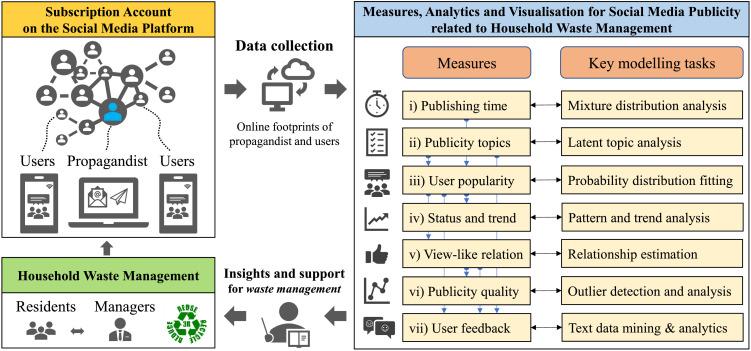
Household waste segregation and recycling is ranked at a high priority of the waste management hierarchy. Its management remains a great challenge due to the high dependency on social behaviours. The integration of Internet of Things (IoT) and subscription accounts on social media platforms related to household waste management could be an effective and environmentally friendly publicity approach than traditional publicity via posters and newspapers. However, there is a paucity of literature on measuring social media publicity in household waste management, which brings challenges for practitioners to characterise and improve this publicity pathway. In this study, under an integrated framework, data mining approaches are employed or extended for multidimensional publicity analytics using the data of online footprints of propagandist and users. A real-world case study based on a subscription account on the WeChat platform, Shanghai Green Account, is analysed to reveal useful insights for personalised improvements of household waste management. This study suggests that the current publicity related to household waste management leans towards propagandist-centred in both timing and topic dimensions. The identified timing, which has high user engagement, is 12:00-13:00 and 21:00-22:00 on Thursday. The overall relative publicity quality of historical posts is calculated as 0.95. Average user engagement under the macro policy in Shanghai was elevated by 138.5% from 2018 to 2019, during which the collections of biodegradable food waste and recyclable waste were elevated by 88.8% and 431.8%. Intelligent decision support by publicity analytics could enhance household waste management through effective communication.
家庭垃圾分类与回收在废物管理体系中被列为高度优先事项。由于对社会行为的高度依赖,其管理仍然是一项巨大挑战。与传统的通过海报和报纸进行宣传相比,将物联网(IoT)与社交媒体平台上与家庭废物管理相关的订阅账户相结合,可能是一种有效且环保的宣传方式。然而,关于衡量社交媒体在家庭废物管理中的宣传效果的文献较少,这给从业者刻画和改进这种宣传途径带来了挑战。在本研究中,在一个综合框架下,采用或扩展数据挖掘方法,利用宣传者和用户的在线足迹数据进行多维度宣传分析。通过对基于微信平台“上海绿色账户”订阅账户的一个实际案例研究进行分析,以揭示对家庭废物管理进行个性化改进的有用见解。本研究表明,当前与家庭废物管理相关的宣传在时间和主题维度上都倾向于以宣传者为中心。确定的用户参与度较高的时间是周四的12:00 - 13:00和21:00 - 22:00。历史帖子的总体相对宣传质量计算为0.95。2018年至2019年期间,上海宏观政策下的平均用户参与度提高了138.5%,在此期间,可生物降解食物垃圾和可回收垃圾的收集量分别提高了88.8%和431.8%。通过宣传分析提供的智能决策支持可以通过有效沟通来加强家庭废物管理。




 Zotero 插件