
假性进展和疾病进展后治疗对接受免疫检查点抑制剂治疗的非小细胞肺癌患者预后的影响。
Impact of pseudoprogression and treatment beyond progression on outcome in patients with non-small cell lung cancer treated with immune checkpoint inhibitors.
作者信息
Won Sang Eun, Park Hyo Jung, Byun Sangil, Pyo Junhee, Kim Jwa Hoon, Choi Chang-Min, Lee Jae Cheol, Lee Dae Ho, Kim Sang-We, Yoon Shinkyo, Kim Kyung Won
机构信息
Department of Radiology and Research Institute of Radiology, Asan Image Metrics, Asan Medical Center, Seoul, Republic of Korea.
WHO Collaborating Center for Pharmaceutical Policy and Regulation, Department of Pharmaceutical Science, Utrecht University, Utrecht, The Netherlands.
出版信息
Oncoimmunology. 2020 Jun 19;9(1):1776058. doi: 10.1080/2162402X.2020.1776058.
BACKGROUND
Immune checkpoint inhibitors (ICI) have become an important treatment option for non-small cell lung cancer (NSCLC). We aimed to evaluate the clinical impact of pseudoprogression (PsP) and treatment beyond RECIST1.1-defined progressive disease (TBP) on outcome in NSCLC patients treated with ICI.
METHODS
NSCLC patients treated with ICI between Mar 2016 and July 2018 were recruited in a consecutive manner. Response was assessed every 8-12 weeks using RECIST1.1 and iRECIST. Based on iRECIST, PsP was defined as progressive disease (PD) on RECIST1.1 subsequently reset to non-PD categories. Using log-rank test, progression-free survival (PFS) was compared between patients with and without PsP, and overall survival (OS) was compared between patients treated with and without TBP. The impact of TBP on OS was evaluated through multivariate Cox proportional hazard models.
RESULTS
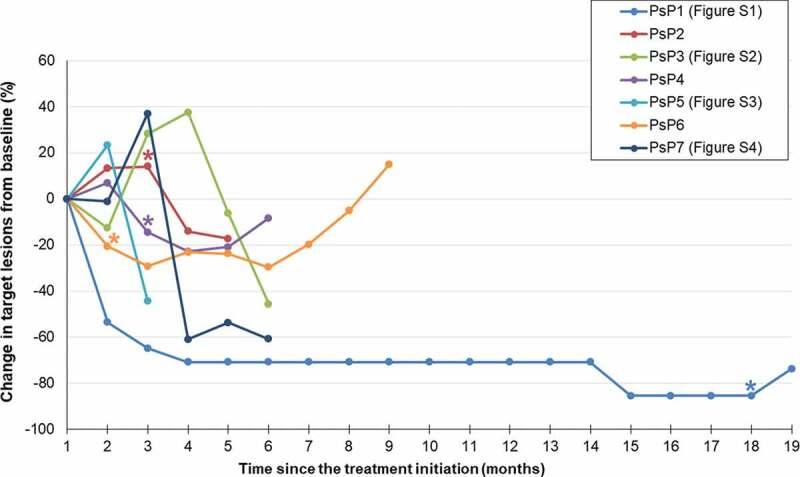
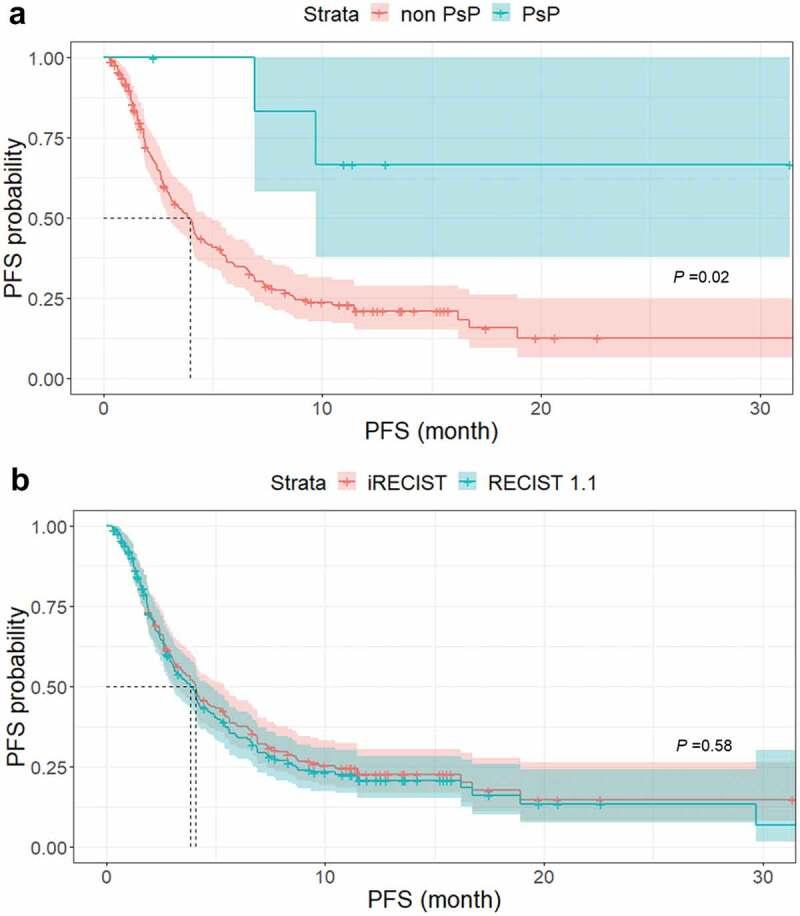
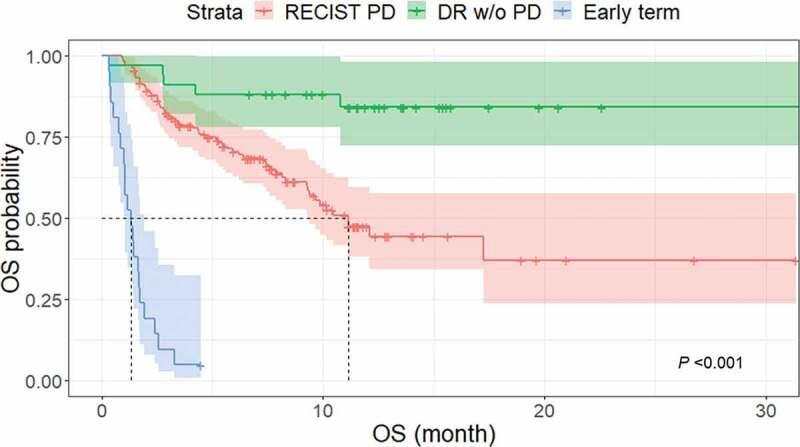
Of the 189 patients, seven (3.7%) experienced PsP which mostly occurred approximately 3 months after baseline. The median PFS was significantly longer in patients with PsP (not reached) than those without PsP (3.8 months, .02). Among patients who demonstrated PD according to RECIST1.1, median OS was significantly longer in patients with TBP (17.2 months) than those without TBP (7.4 months, < .001). On multivariate analysis adjusting other covariates, TBP (HR, 0.4; 95% CI, 0.2-0.7) remained as a significant protective factor for mortality.
CONCLUSION
PsP occurred in 3.7% of NSCLC patients under ICI treatment. Based on iRECIST scheme, PsP and TBP may be associated with survival benefit.
背景
免疫检查点抑制剂(ICI)已成为非小细胞肺癌(NSCLC)的重要治疗选择。我们旨在评估假性进展(PsP)和RECIST1.1定义的疾病进展后治疗(TBP)对接受ICI治疗的NSCLC患者预后的临床影响。
方法
连续招募2016年3月至2018年7月期间接受ICI治疗的NSCLC患者。每8 - 12周使用RECIST1.1和iRECIST评估反应。基于iRECIST,PsP被定义为RECIST1.1上的疾病进展(PD),随后重新分类为非PD类别。使用对数秩检验,比较有和没有PsP的患者的无进展生存期(PFS),并比较接受和未接受TBP治疗的患者的总生存期(OS)。通过多变量Cox比例风险模型评估TBP对OS的影响。
结果
189例患者中,7例(3.7%)出现PsP,大多发生在基线后约3个月。有PsP的患者中位PFS(未达到)显著长于无PsP的患者(3.8个月,P = 0.02)。在根据RECIST1.1显示为PD的患者中,接受TBP的患者中位OS(17.2个月)显著长于未接受TBP的患者(7.4个月,P < 0.001)。在调整其他协变量的多变量分析中,TBP(风险比,0.4;95%置信区间,0.2 - 0.7)仍然是死亡率的显著保护因素。
结论
在接受ICI治疗的NSCLC患者中,3.7%发生了PsP。基于iRECIST方案,PsP和TBP可能与生存获益相关。

 Zotero 插件