
磷掺杂碳量子点作为用于铁检测的荧光探针
Phosphorus-Doped Carbon Quantum Dots as Fluorometric Probes for Iron Detection.
作者信息
Kalaiyarasan Gopi, Joseph James, Kumar Pankaj
机构信息
Department of Chemistry, Indian Institute of Science Education and Research (IISER), Tirupati, Andhra Pradesh 517507, India.
Electrodics and Electrocatalysis Division, CSIR-Central Electrochemical Research Institute, Karaikudi, Tamil Nadu 630003, India.
出版信息
ACS Omega. 2020 Aug 26;5(35):22278-22288. doi: 10.1021/acsomega.0c02627. eCollection 2020 Sep 8.
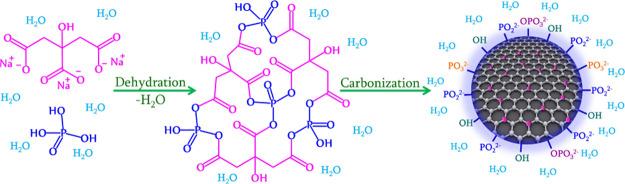
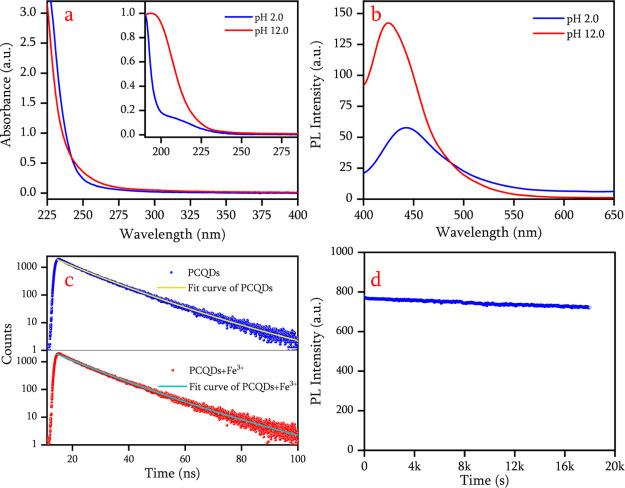
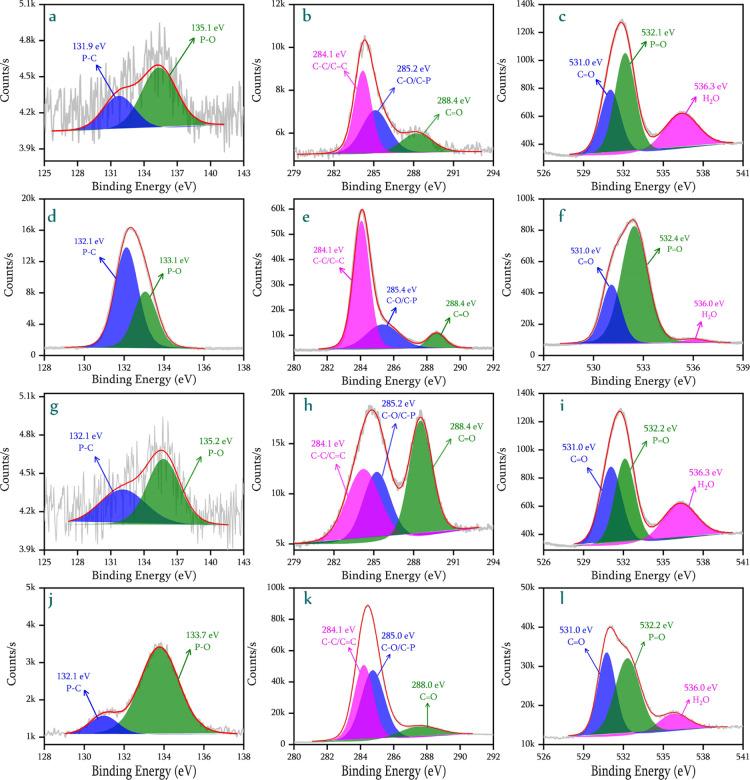
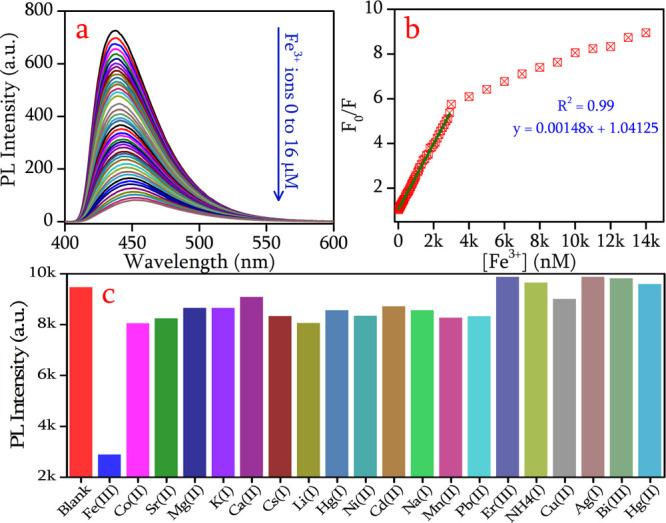
Carbon quantum dots (CQDs), a novel fluorescent nanomaterial, have been extensively employed/explored in various applications, that is, biosensors, bioimaging, nanomedicine, therapeutics, photocatalysis, electrocatalysis, energy storage system, and so forth. In this study, we report the synthesis, characterization, and the application of phosphorus-doped CQDs (PCQDs), synthesized using trisodium citrate and phosphoric acid by the hydrothermal method. The effect of phosphorus doping on optical features and the formation of PCQDs have been explored elaborately by controlling the concentrations of precursors, reaction time, and the temperature. The fluorescent quantum yield for PCQDs was determined to be 16.1% at an excitation/emission wavelength of 310/440 nm. Also, the optical and structural properties of PCQDs were determined by using various spectroscopic and microscopic techniques. Static quenching of fluorescence was determined upon the addition of Fe to PCQDs because of the formation of the fluorescent inactive complex (PCQDs-Fe). Hence, this chemistry leads to the development of a new fluorometric assay for the detection of Fe. The lower limit of Fe detection is determined to be 9.5 nM (3σ/slope), with the linear fit from 20 nM to 3.0 μM ( = 0.99). We have validated this new assay in the raw, ejected, and purified water samples of the RO plant by the standard addition method. These results suggest the possibility of developing a new commercial assay for Fe detection in blood, urine, and various industrial waste and sewage water samples. Furthermore, recycling the pollutant water into the freshwater using filters that consist of PCQDs offers a great deal.
碳量子点(CQDs)是一种新型荧光纳米材料,已被广泛应用于各种领域,即生物传感器、生物成像、纳米医学、治疗学、光催化、电催化、储能系统等。在本研究中,我们报道了通过水热法使用柠檬酸钠和磷酸合成的磷掺杂碳量子点(PCQDs)的合成、表征及应用。通过控制前驱体浓度、反应时间和温度,详细探究了磷掺杂对PCQDs光学特性和形成的影响。在激发/发射波长为310/440 nm时,PCQDs的荧光量子产率测定为16.1%。此外,使用各种光谱和显微镜技术测定了PCQDs的光学和结构性质。由于形成了荧光无活性络合物(PCQDs-Fe),向PCQDs中添加Fe后荧光发生静态猝灭。因此,这种化学方法导致开发了一种用于检测Fe的新型荧光测定法。Fe检测的下限测定为9.5 nM(3σ/斜率),线性拟合范围为20 nM至3.0 μM(R² = 0.99)。我们通过标准加入法在反渗透工厂的原水、排放水和净化水样品中验证了这种新的测定方法。这些结果表明开发一种用于检测血液、尿液以及各种工业废水和污水样品中Fe的新型商业测定法具有可能性。此外,使用由PCQDs组成的过滤器将污染水回收为淡水具有很大意义。




 Zotero 插件