
细菌感染是 1 型糖尿病患者发生严重糖尿病视网膜病变的新危险因素。
Bacterial infections as novel risk factors of severe diabetic retinopathy in individuals with type 1 diabetes.
机构信息
Folkhälsan Research Center, Folkhälsan Institute of Genetics, Helsinki, Finland.
Nephrology, Helsinki University Central Hospital Abdominal Center, Helsinki, Finland.
出版信息
Br J Ophthalmol. 2021 Aug;105(8):1104-1110. doi: 10.1136/bjophthalmol-2020-316202. Epub 2020 Sep 14.
BACKGROUND/AIMS: Diabetic retinopathy (DR) is associated and shares many risk factors with other diabetic complications, including inflammation. Bacterial infections, potent inducers of inflammation have been associated with the development of diabetic complications apart from DR. Our aim was to investigate the association between bacterial infections and DR.
METHODS
Adult individuals with type 1 diabetes (n=1043) were recruited from the Finnish Diabetic Nephropathy Study (FinnDiane), a prospective follow-up study. DR was defined as incident severe diabetic retinopathy (SDR), identified as first laser treatment. Data on DR were obtained through fundus photographs and medical records, data on bacterial infections from comprehensive national registries (1 January 1995 to 31 December 2015). Risk factors for DR and serum bacterial lipopolysaccharide (LPS) activity were determined at baseline.
RESULTS
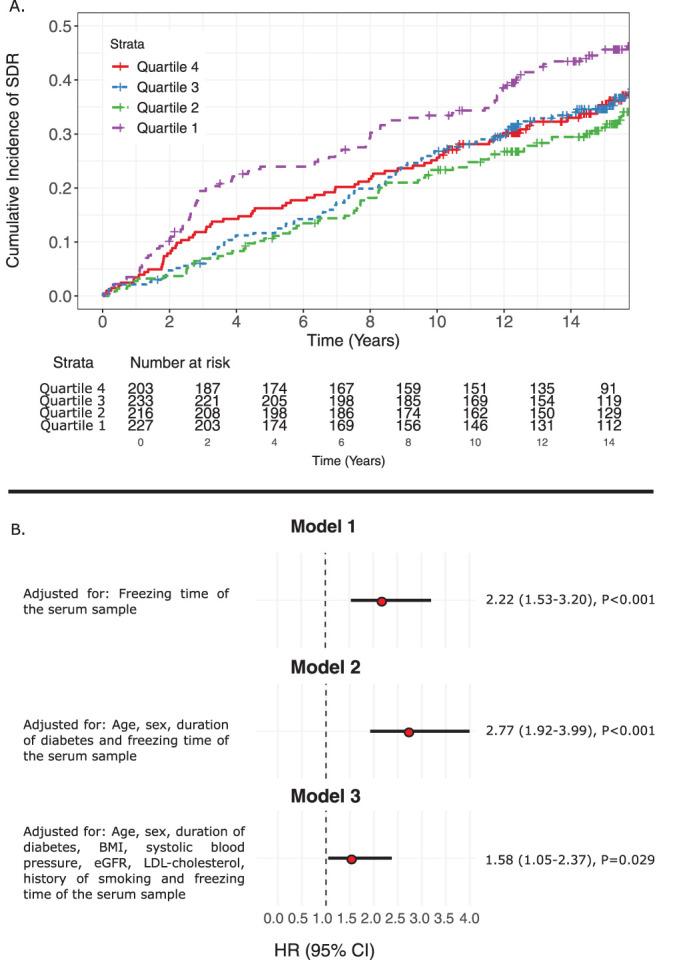
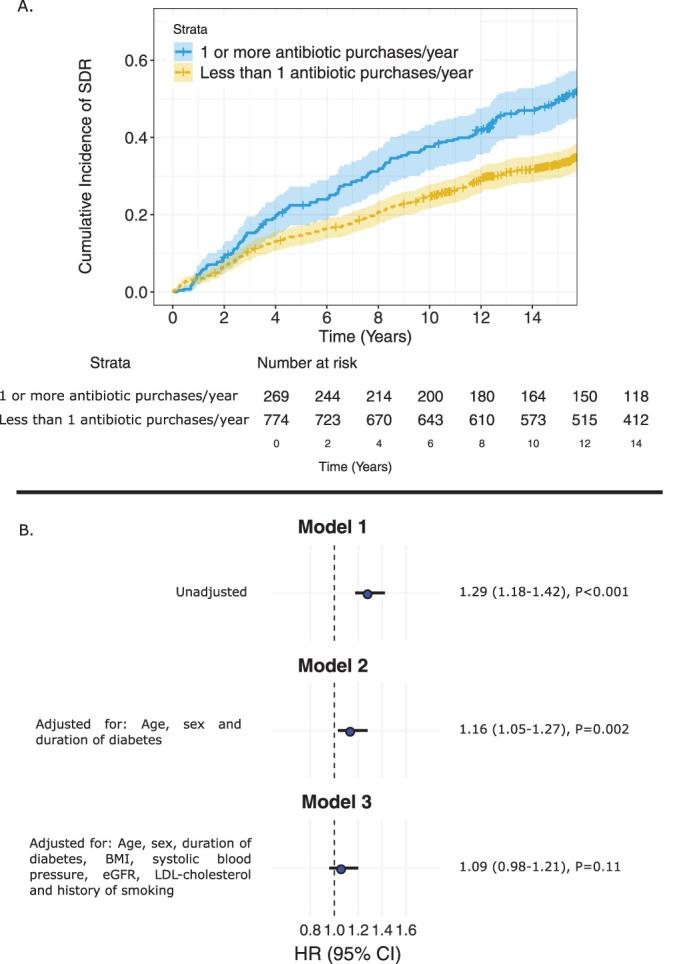
Individuals with incident SDR (n=413) had a higher mean number of antibiotic purchases/follow-up year compared with individuals without incident SDR (n=630) (0.92 [95% CI 0.82 to 1.02] vs 0.67 [0.62-0.73], p=0.02), as well as higher levels of LPS activity (0.61 [0.58-0.65] vs 0.56 [0.54-0.59] EU/mL, p=0.03). Individuals with on average ≥1 purchase per follow-up year (n=269) had 1.5 times higher cumulative incidence of SDR, compared with individuals with <1 purchase (n=774) per follow-up year (52% vs 35%, p<0.001). In multivariable Cox survival models, the mean number of antibiotic purchases per follow-up year as well as LPS activity were risk factors for SDR after adjusting for static confounders (HR 1.16 [1.05-1.27], p=0.002 and HR 2.77 [1.92-3.99], p<0.001, respectively).
CONCLUSION
Bacterial infections are associated with an increased risk of incident SDR in type 1 diabetes.
背景/目的:糖尿病视网膜病变(DR)与其他糖尿病并发症(包括炎症)相关,且具有许多共同的危险因素。除 DR 外,细菌感染(炎症的有力诱导因素)也与糖尿病并发症的发展有关。我们的目的是研究细菌感染与 DR 之间的关系。
方法
本研究招募了来自芬兰糖尿病肾病研究(FinnDiane)的 1043 名成年 1 型糖尿病患者,这是一项前瞻性随访研究。DR 定义为首次激光治疗的严重糖尿病性视网膜病变(SDR)。通过眼底照片和病历获得 DR 数据,通过全面的国家登记处(1995 年 1 月 1 日至 2015 年 12 月 31 日)获得细菌感染数据。在基线时确定 DR 和血清细菌脂多糖(LPS)活性的危险因素。
结果
发生 SDR 的患者(n=413)与未发生 SDR 的患者(n=630)相比,平均每年抗生素购买量/随访年数(0.92[95%CI 0.82-1.02]比 0.67[0.62-0.73],p=0.02)更高,LPS 活性也更高(0.61[0.58-0.65]比 0.56[0.54-0.59]EU/mL,p=0.03)。与每年抗生素购买量<1 次(n=774)相比,每年抗生素购买量≥1 次(n=269)的患者 SDR 累积发生率高 1.5 倍(52%比 35%,p<0.001)。在多变量 Cox 生存模型中,在校正静态混杂因素后,每年抗生素购买量的平均值和 LPS 活性是 SDR 的危险因素(HR 1.16[1.05-1.27],p=0.002 和 HR 2.77[1.92-3.99],p<0.001)。
结论
细菌感染与 1 型糖尿病患者发生 SDR 的风险增加相关。

 Zotero 插件