
代际接触频率与老年中国父母抑郁症状之间的剂量-反应关系:一项横断面研究。
Dose-response relationship between intergenerational contact frequency and depressive symptoms amongst elderly Chinese parents: a cross-sectional study.
机构信息
Wuhan University, No.115 of Donghu Road, Wuhan, 430000, China.
Wuhan Blood Center, No.8 of Baofeng One Road, Wuhan, 430000, China.
出版信息
BMC Geriatr. 2020 Sep 15;20(1):349. doi: 10.1186/s12877-020-01751-0.
BACKGROUND
Given the high prevalence of depressive symptoms amongst the elderly Chinese population and the significance of intergenerational contact in this demographic group, the purpose of this study was to examine the association and dose-response relationship between the frequency of intergenerational contact and depressive symptoms.
METHODS
Data were obtained from the third wave of the China Health and Retirement Longitudinal Study. A total of 5791 participants at age 60 or older were included in this study. Depressive symptoms were defined by the 10-item version of the Centre for Epidemiologic Studies Depression Scale. Intergenerational contact included in-person meeting and remote connecting, and they were analysed separately. Intergenerational contact frequency was classified into ten categories and then treated as a continuous variable for analysis. We performed univariate and multivariate logistic regressions to identify risk covariables. Restrictive cubic spline analysis was used to examine the dose-response relationship between intergenerational contact frequency and the outcome of depressive symptoms.
RESULTS
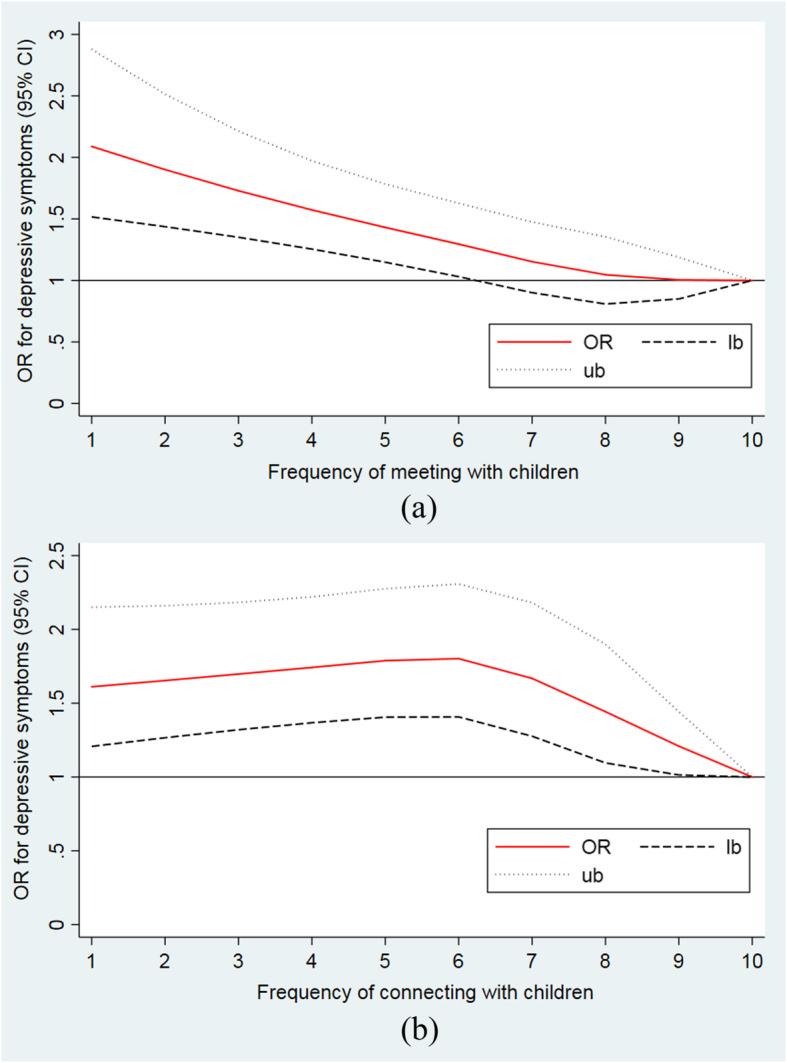
Both the frequency of meeting and the frequency of connecting with children were independently associated with depressive symptoms in the elderly, and the odds ratios for depressive symptoms increased with decreasing frequencies (P < 0.01). There was a negative dose-response relationship between intergenerational contact frequency and depressive symptoms. The odds of depressive symptoms steadily decreased with increasing frequency of meeting with their children. Following an initial increase, the odds rapidly decreased as the frequency of connecting with children increased with an inflection point at once a monthly. Both associations were nonlinear (P < 0.001).
CONCLUSIONS
Our findings revealed a negative dose-response relationship between intergenerational contact frequency and depressive symptoms in the elderly Chinese population. Thus, future health interventions should consider cultural norms in shaping the mental well-being of Chinese elderly persons.
背景
鉴于中国老年人群体中抑郁症状的高发率,以及代际接触在这一人群中的重要性,本研究旨在探讨代际接触频率与抑郁症状之间的关联和剂量-反应关系。
方法
数据来自中国健康与退休纵向研究的第三波调查。本研究共纳入了 5791 名年龄在 60 岁及以上的参与者。抑郁症状由流行病学研究中心抑郁量表的 10 项版本定义。代际接触包括面对面的会面和远程联系,分别进行分析。代际接触频率分为十个类别,并作为连续变量进行分析。我们进行了单变量和多变量逻辑回归分析,以确定风险协变量。限制性三次样条分析用于检验代际接触频率与抑郁症状结果之间的剂量-反应关系。
结果
与子女见面的频率和与子女远程联系的频率均与老年人的抑郁症状独立相关,抑郁症状的比值比随着频率的降低而增加(P<0.01)。代际接触频率与抑郁症状之间存在负向的剂量-反应关系。与子女见面的频率增加,患抑郁症状的几率稳步下降。与子女远程联系的频率增加后,患病几率先迅速下降,随后在每月一次的频率上出现拐点,呈非线性关系(P<0.001)。
结论
我们的研究结果揭示了代际接触频率与中国老年人群体抑郁症状之间存在负向的剂量-反应关系。因此,未来的健康干预措施应考虑文化规范,以塑造中国老年人的心理健康。

 Zotero 插件