
导管原位癌诊断与乳腺癌死亡的关联。
Association of a Diagnosis of Ductal Carcinoma In Situ With Death From Breast Cancer.
机构信息
Women's College Research Institute, Toronto, Ontario, Canada.
Dalla Lana School of Public Health, University of Toronto, Toronto, Ontario, Canada.
出版信息
JAMA Netw Open. 2020 Sep 1;3(9):e2017124. doi: 10.1001/jamanetworkopen.2020.17124.
IMPORTANCE
It is not clear to what extent a diagnosis of ductal carcinoma in situ (DCIS) impacts a woman's lifetime risk of dying of breast cancer. Under ideal circumstances, treatment will eliminate the risk of invasive ipsilateral recurrence and prevent subsequent mortality from breast cancer. The risk of dying of breast cancer after a diagnosis of DCIS had not been compared with that of women without cancer in the general population.
OBJECTIVE
To determine the risk of death from breast cancer in a large cohort of patients treated for DCIS and to compare the risk with that of women in the general population.
DESIGN, SETTING, AND PARTICIPANTS: This cohort study included data for women who had first primary DCIS diagnosed between 1995 and 2014 from the Surveillance, Epidemiology and End Results (SEER) registries database. Women with DCIS underwent surgical treatment, and approximately half also received radiotherapy. These women were followed from the date of DCIS diagnosis until death from breast cancer or date of last follow-up. Women in the general population without breast cancer were analyzed as controls. Follow-up information was available up to December 2016. The data were analyzed in March 2020.
EXPOSURES
Patients with DCIS who underwent surgical treatment.
MAIN OUTCOMES AND MEASURES
Breast cancer death was the main outcome. Standardized mortality ratios were estimated by comparing deaths from breast cancer among women diagnosed with DCIS with expected deaths from breast cancer among women in the general population who did not have cancer. Expected probability of death from breast cancer in the general population was calculated by an incidence-based mortality approach using standardized SEER-based incidence and case-fatality rates. Probability of breast cancer death was estimated based on the assumption that a cancer-free control was cancer free on the date the woman with DCIS was diagnosed and was studied until the end of follow-up.
RESULTS
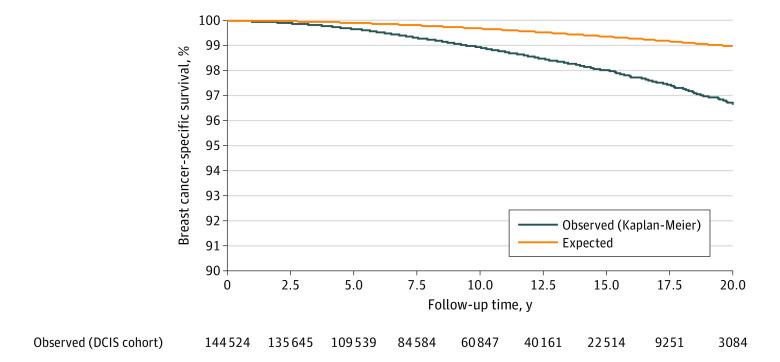
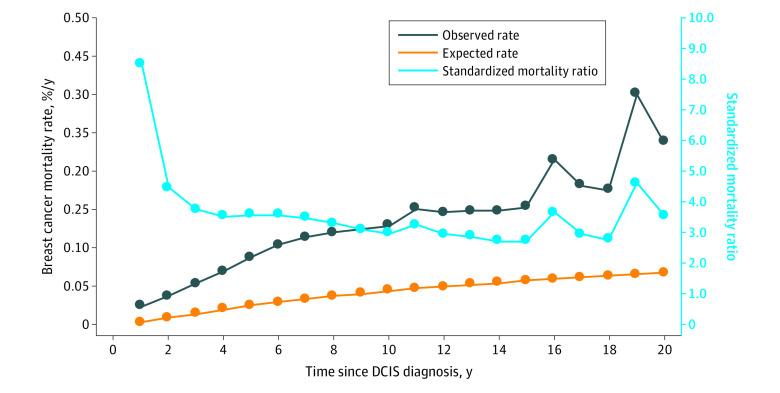
A total of 144 524 women diagnosed with first primary DCIS were included (mean [SD] age at diagnosis, 57.4 [11.0] years). There were 1540 deaths from breast cancer in the cohort. Based on SEER-based incidence and case-fatality rates, 458 breast cancer deaths were expected in an equivalent number of cancer-free women from the general population with equal follow-up. The standardized mortality ratio for death from breast cancer among women with DCIS was 3.36 (95% CI, 3.20-3.53). The elevated risk of death persisted more than 15 years after diagnosis.
CONCLUSIONS AND RELEVANCE
In the population studied, the risk of dying of breast cancer was increased 3-fold after a diagnosis of DCIS. This suggests that our current treatment focus on preventing invasive recurrence is insufficient to eliminate all deaths from breast cancer after DCIS.
重要性
目前尚不清楚导管原位癌 (DCIS) 的诊断在多大程度上影响女性死于乳腺癌的终生风险。在理想情况下,治疗将消除同侧浸润性复发的风险,并防止随后因乳腺癌而死亡。DCIS 诊断后的乳腺癌死亡风险尚未与普通人群中无癌症女性的风险进行比较。
目的
在接受 DCIS 治疗的大量患者队列中确定死于乳腺癌的风险,并将其与普通人群中女性的风险进行比较。
设计、环境和参与者:这项队列研究纳入了 1995 年至 2014 年期间来自监测、流行病学和最终结果 (SEER) 登记数据库的首次原发性 DCIS 诊断患者的数据。患有 DCIS 的女性接受了手术治疗,其中约一半还接受了放疗。这些女性从 DCIS 诊断之日起接受随访,直至死于乳腺癌或最后一次随访之日。未患有乳腺癌的普通人群中的女性被作为对照进行分析。截至 2016 年 12 月,可获得随访信息。数据分析于 2020 年 3 月进行。
暴露情况
接受手术治疗的 DCIS 患者。
主要结局和测量指标
乳腺癌死亡是主要结局。通过比较 DCIS 诊断后女性的乳腺癌死亡人数与普通人群中未患有癌症的女性的乳腺癌预期死亡人数来估计标准化死亡率。普通人群中乳腺癌预期死亡概率通过基于发病率的死亡率方法计算,该方法使用标准化 SEER 发病率和病死率。基于假设患有 DCIS 的女性的无癌症对照在诊断该女性之日无癌症且随访至随访结束,估计了乳腺癌死亡的概率。
结果
共纳入 144524 例首次原发性 DCIS 诊断女性(诊断时的平均[标准差]年龄为 57.4[11.0]岁)。队列中有 1540 例死于乳腺癌。根据 SEER 发病率和病死率,在具有同等随访时间的普通人群中,无癌症的 458 名女性中预计会有 458 例乳腺癌死亡。DCIS 女性乳腺癌死亡的标准化死亡率为 3.36(95%CI,3.20-3.53)。诊断后超过 15 年,死亡风险仍然升高。
结论和相关性
在研究人群中,DCIS 诊断后死于乳腺癌的风险增加了 3 倍。这表明,我们目前专注于预防浸润性复发的治疗方法不足以消除 DCIS 后所有的乳腺癌死亡。
 Zotero 插件