
在原发性硬化性胆管炎患者中检测胆管癌——DNA甲基化和分子生物标志物的前景
Detecting cholangiocarcinoma in patients with primary sclerosing cholangitis - The promise of DNA methylation and molecular biomarkers.
作者信息
Vedeld Hege Marie, Folseraas Trine, Lind Guro Elisabeth
机构信息
Department of Molecular Oncology, Institute for Cancer Research, Oslo University Hospital - Norwegian Radium Hospital, Oslo, Norway.
K.G. Jebsen Colorectal Cancer Research Centre, Oslo University Hospital, Oslo, Norway.
出版信息
JHEP Rep. 2020 Jul 11;2(5):100143. doi: 10.1016/j.jhepr.2020.100143. eCollection 2020 Oct.
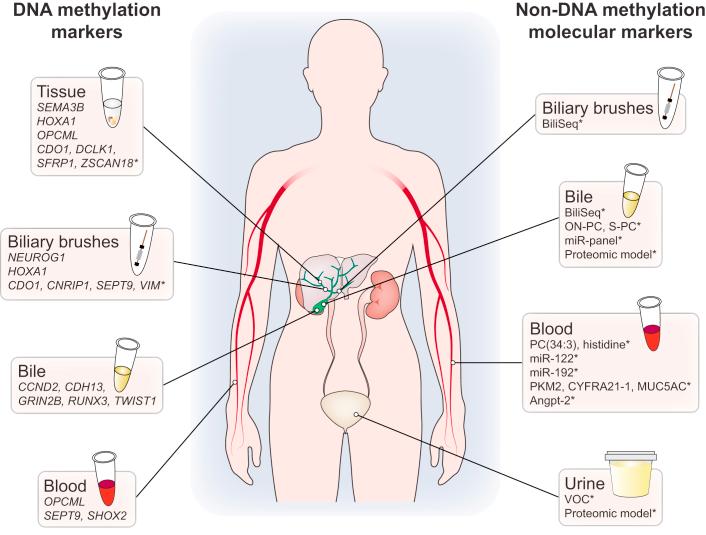
Cholangiocarcinoma (CCA) is a highly fatal malignancy of the bile ducts that arises in up to 20% of patients with primary sclerosing cholangitis (PSC). Current detection methods for CCA display suboptimal sensitivity and/or specificity, and there is no evidence-based screening strategy for CCA in patients with PSC. Consequently, CCA is often detected too late for surgical resection, contributing to the high mortality associated with this malignancy. Recently, biomarkers have emerged with potential to complement current detection methods, and/or be used for cancer surveillance in high-risk patient groups, including patients with PSC. Aberrant DNA methylation patterns represent promising biomarkers with great potential for CCA detection. Such aberrations are frequent in CCA, often occur early, and can be detected in liquid biopsies, including blood, bile and urine. This review summarises and highlights the most promising DNA methylation biomarkers identified for CCA detection so far, focusing on patients with PSC. Other promising molecular biomarkers for detection of PSC-associated CCA in liquid biopsies will also be briefly covered.
胆管癌(CCA)是一种高度致命的胆管恶性肿瘤,在高达20%的原发性硬化性胆管炎(PSC)患者中发生。目前CCA的检测方法灵敏度和/或特异性欠佳,且尚无基于证据的PSC患者CCA筛查策略。因此,CCA往往在发现时已错过手术切除时机,导致这种恶性肿瘤相关的高死亡率。最近,出现了一些有潜力补充当前检测方法和/或用于高危患者群体(包括PSC患者)癌症监测的生物标志物。异常的DNA甲基化模式是很有前景的生物标志物,在CCA检测方面具有巨大潜力。此类异常在CCA中很常见,通常发生较早,并且可以在液体活检样本(包括血液、胆汁和尿液)中检测到。本综述总结并重点介绍了迄今为止确定的用于CCA检测的最有前景的DNA甲基化生物标志物,重点关注PSC患者。还将简要介绍液体活检中用于检测PSC相关CCA的其他有前景的分子生物标志物。
 Zotero 插件