
积雪草苷通过抑制结直肠癌细胞中的 NF-κB 信号通路抑制细胞增殖。
Asiaticoside suppresses cell proliferation by inhibiting the NF‑κB signaling pathway in colorectal cancer.
机构信息
Department of Colorectal Cancer, Cancer Center, The First Affiliated Hospital of Xiamen University, Teaching Hospital of Fujian Medical University, Xiamen, Fujian 361003, P.R. China.
Department of Radiotherapy, The First Affiliated Hospital of Fujian Medical University, Fuzhou, Fujian 350005, P.R. China.
出版信息
Int J Mol Med. 2020 Oct;46(4):1525-1537. doi: 10.3892/ijmm.2020.4688. Epub 2020 Jul 28.
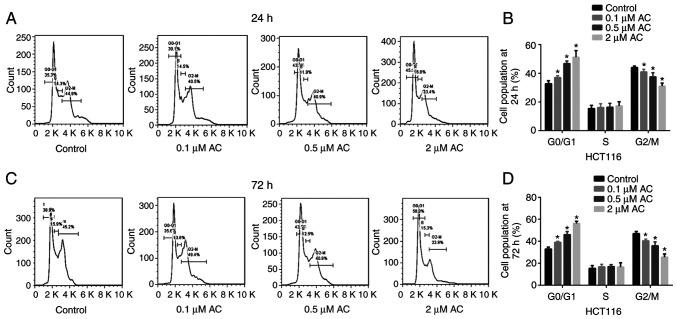
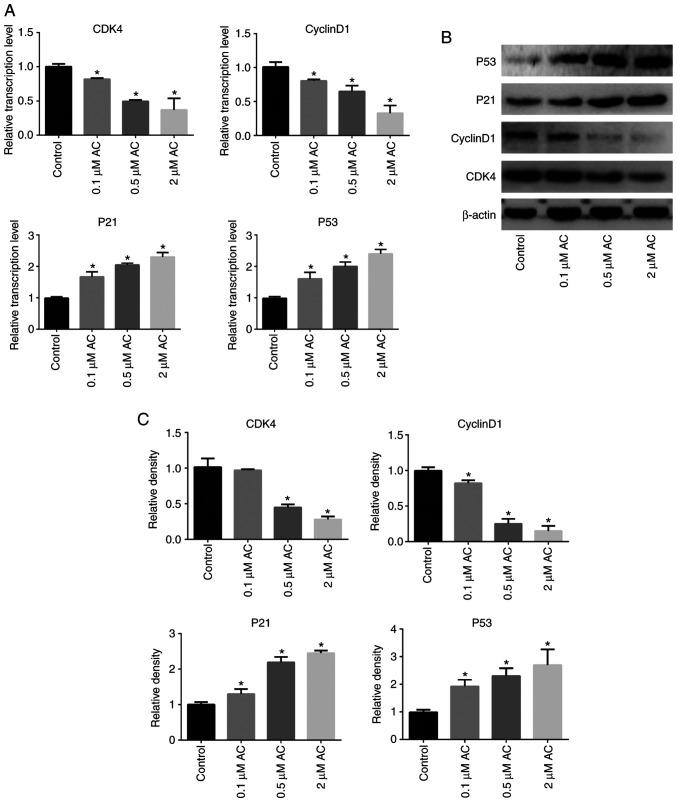
Colorectal cancer (CRC) is one of the leading causes of cancer‑associated mortality. Asiaticoside (AC) exhibits antitumor effects; however, to the best of our knowledge, the biological function of AC in CRC cells remains unclear. Therefore, the aim of the present study was to investigate the effect of AC on CRC cells. In the present study, CCK‑8 and colony formation assays were performed to assess the effects of AV on human CRC cell lines (HCT116, SW480 and LoVo). Mitochondrial membrane potential was examined by JC‑1 staining. Cell apoptosis and cell cycle were monitored by flow cytometry, and the expression of genes was evaluated using RT‑qPCR and western blot analysis. Furthermore, the biological effect of AC in vivo was detected using a xenograft mouse model. The findings revealed that 2 µM AC suppressed the proliferation of CRC cells in a time‑ and dose‑dependent manner, but had no adverse effects on normal human intestinal FHC cells at a range of concentrations. AC decreased the mitochondrial membrane potential and increased the apoptosis of CRC cells in a dose‑dependent manner. Furthermore, AC induced cell cycle arrest at the G0/G1 phase. AC attenuated IκBα phosphorylation in a dose‑dependent manner, thereby preventing P65 from entering the nucleus, and resulting in inhibition of the NF‑κB signaling pathway. In addition, AC significantly reduced the expression of CDK4 and Cyclin D1 in a dose‑dependent manner, significantly upregulated the activation of caspase‑9 and caspase‑3, and decreased the Bcl‑2/Bax mRNA ratio. Furthermore, treatment with the NF‑κB signaling pathway inhibitor JSH‑23 significantly increased the cytotoxicity of AC in CRC cells. Findings of the xenograft mice model experiments revealed that AC significantly inhibited colorectal tumor growth in a dose‑dependent manner. Overall, AC suppressed activation of the NF‑κB signaling pathway by downregulating IκBα phosphorylation. This resulted in inhibition of CRC cell viability and an increase of cell apoptosis, which may form the basis of AC use in the treatment of patients with CRC.
结直肠癌(CRC)是癌症相关死亡的主要原因之一。积雪草苷(AC)具有抗肿瘤作用;然而,据我们所知,AC 在 CRC 细胞中的生物学功能尚不清楚。因此,本研究旨在探讨 AC 对 CRC 细胞的影响。在本研究中,通过 CCK-8 和集落形成实验评估 AV 对人 CRC 细胞系(HCT116、SW480 和 LoVo)的影响。通过 JC-1 染色检测线粒体膜电位。通过流式细胞术监测细胞凋亡和细胞周期,并通过 RT-qPCR 和 Western blot 分析评估基因表达。此外,通过异种移植小鼠模型检测 AC 的体内生物学效应。研究结果表明,2 μM AC 呈时间和剂量依赖性抑制 CRC 细胞增殖,但在一定浓度范围内对正常人类肠道 FHC 细胞无不良影响。AC 呈剂量依赖性降低 CRC 细胞的线粒体膜电位并增加细胞凋亡。此外,AC 诱导细胞周期停滞在 G0/G1 期。AC 呈剂量依赖性抑制 IκBα 磷酸化,从而阻止 P65 进入细胞核,抑制 NF-κB 信号通路。此外,AC 呈剂量依赖性显著降低 CDK4 和 Cyclin D1 的表达,显著上调 caspase-9 和 caspase-3 的激活,并降低 Bcl-2/Bax mRNA 比值。此外,NF-κB 信号通路抑制剂 JSH-23 的处理显著增加了 AC 在 CRC 细胞中的细胞毒性。异种移植小鼠模型实验结果表明,AC 呈剂量依赖性显著抑制结直肠肿瘤生长。总之,AC 通过下调 IκBα 磷酸化抑制 NF-κB 信号通路的激活。这导致 CRC 细胞活力受到抑制,细胞凋亡增加,这可能为 AC 在 CRC 患者治疗中的应用提供依据。




 Zotero 插件