
非奈利酮对盐皮质激素受体的拮抗作用足以改善临床前肌肉营养不良的功能。
Mineralocorticoid receptor antagonism by finerenone is sufficient to improve function in preclinical muscular dystrophy.
作者信息
Lowe Jeovanna, Kolkhof Peter, Haupt Michael J, Peczkowski Kyra K, Rastogi Neha, Hauck J Spencer, Kadakia Feni K, Zins Jonathan G, Ciccone Pierce C, Smart Suzanne, Sandner Peter, Raman Subha V, Janssen Paul M L, Rafael-Fortney Jill A
机构信息
Department of Physiology and Cell Biology, College of Medicine, The Ohio State University, Columbus, OH, 43210, USA.
R&D Preclinical Research Cardiovascular, Bayer AG, Wuppertal, Germany.
出版信息
ESC Heart Fail. 2020 Dec;7(6):3983-3995. doi: 10.1002/ehf2.12996. Epub 2020 Sep 18.
AIMS
Duchenne muscular dystrophy (DMD) is an X-linked inherited disease due to dystrophin deficiency causing skeletal and cardiac muscle dysfunction. Affected patients lose ambulation by age 12 and usually die in the second to third decades of life from cardiac and respiratory failure. Symptomatic treatment includes the use of anti-inflammatory corticosteroids, which are associated with side effects including weight gain, osteoporosis, and increased risk of cardiovascular disease. Novel treatment options include blockade of the renin-angiotensin-aldosterone system, because angiotensin as well as aldosterone contribute to persistent inflammation and fibrosis, and aldosterone blockade represents an efficacious anti-fibrotic approach in cardiac failure. Recent preclinical findings enabled successful clinical testing of a combination of steroidal mineralocorticoid receptor antagonists (MRAs) and angiotensin converting enzyme inhibitors in DMD boys. The efficacy of MRAs alone on dystrophic skeletal muscle and heart has not been investigated. Here, we tested efficacy of the novel non-steroidal MRA finerenone as a monotherapy in a preclinical DMD model.
METHODS AND RESULTS
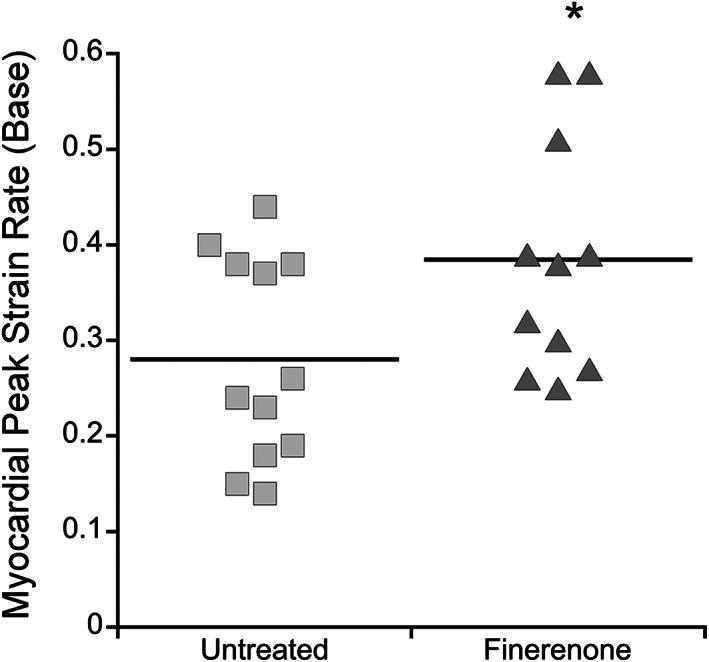
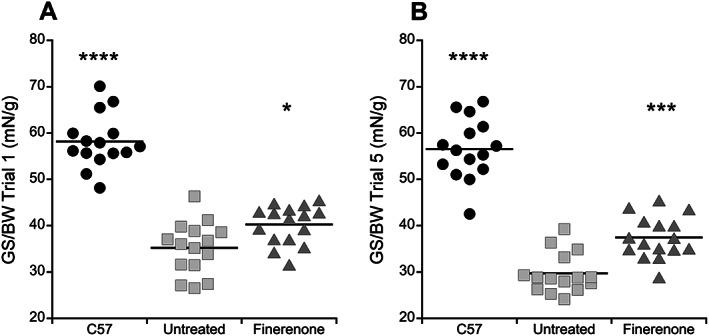
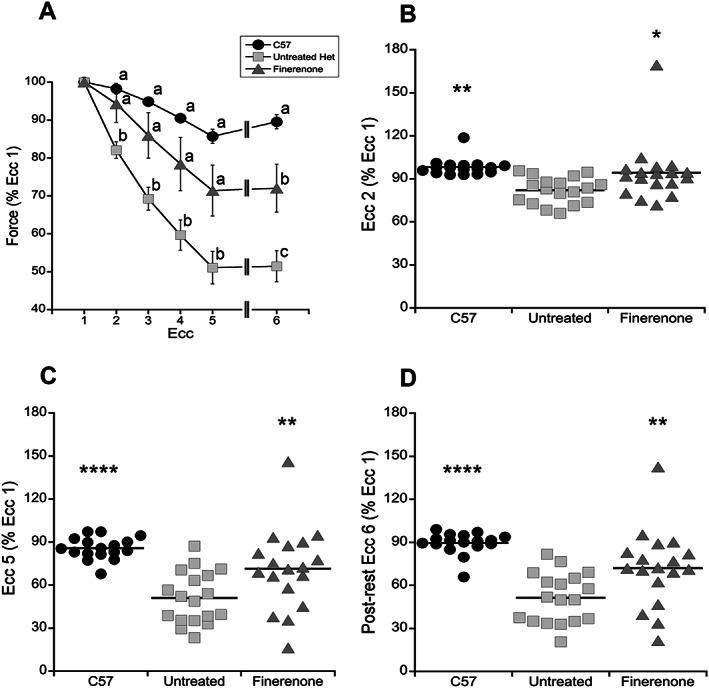
The dystrophin-deficient, utrophin haploinsufficient mouse model of DMD was treated with finerenone and compared with untreated dystrophic and wild-type controls. Grip strength, electrocardiography, cardiac magnetic resonance imaging, muscle force measurements, histological quantification, and gene expression studies were performed. Finerenone treatment alone resulted in significant improvements in clinically relevant functional parameters in both skeletal muscle and heart. Normalized grip strength in rested dystrophic mice treated with finerenone (40.3 ± 1.0 mN/g) was significantly higher (P = 0.0182) compared with untreated dystrophic mice (35.2 ± 1.5 mN/g). Fatigued finerenone-treated dystrophic mice showed an even greater relative improvement (P = 0.0003) in normalized grip strength (37.5 ± 1.1 mN/g) compared with untreated mice (29.7 ± 1.1 mN/g). Finerenone treatment also led to significantly lower (P = 0.0075) susceptibility to limb muscle damage characteristic of DMD measured during a contraction-induced injury protocol. Normalized limb muscle force after five lengthening contractions resulted in retention of 71 ± 7% of baseline force in finerenone-treated compared with only 51 ± 4% in untreated dystrophic mice. Finerenone treatment also prevented significant reductions in myocardial strain rate (P = 0.0409), the earliest sign of DMD cardiomyopathy. Moreover, treatment with finerenone led to very specific cardiac gene expression changes in clock genes that might modify cardiac pathophysiology in this DMD model.
CONCLUSIONS
Finerenone administered as a monotherapy is disease modifying for both skeletal muscle and heart in a preclinical DMD model. These findings support further evaluation of finerenone in DMD clinical trials.
目的
杜氏肌营养不良症(DMD)是一种X连锁遗传病,由于肌营养不良蛋白缺乏导致骨骼肌和心肌功能障碍。受影响的患者在12岁时失去行走能力,通常在生命的第二个或第三个十年死于心脏和呼吸衰竭。对症治疗包括使用抗炎皮质类固醇,其与包括体重增加、骨质疏松症和心血管疾病风险增加在内的副作用相关。新的治疗选择包括阻断肾素-血管紧张素-醛固酮系统,因为血管紧张素以及醛固酮会导致持续的炎症和纤维化,而醛固酮阻断是心力衰竭中一种有效的抗纤维化方法。最近的临床前研究结果使得在患有DMD的男孩中成功地对甾体盐皮质激素受体拮抗剂(MRAs)和血管紧张素转换酶抑制剂的组合进行了临床试验。单独使用MRAs对营养不良的骨骼肌和心脏的疗效尚未得到研究。在此,我们在临床前DMD模型中测试了新型非甾体MRA非奈利酮作为单一疗法的疗效。
方法与结果
用非奈利酮治疗DMD的肌营养不良蛋白缺陷、抗肌萎缩蛋白单倍体不足小鼠模型,并与未治疗的营养不良和野生型对照进行比较。进行握力、心电图、心脏磁共振成像、肌肉力量测量、组织学定量和基因表达研究。单独使用非奈利酮治疗可使骨骼肌和心脏的临床相关功能参数得到显著改善。与未治疗的营养不良小鼠(35.2±1.5mN/g)相比,用非奈利酮治疗的休息状态下的营养不良小鼠的标准化握力(40.3±1.0mN/g)显著更高(P=0.0182)。与未治疗的小鼠(29.7±1.1mN/g)相比,疲劳的非奈利酮治疗的营养不良小鼠在标准化握力(37.5±1.1mN/g)方面显示出更大的相对改善(P=0.0003)。非奈利酮治疗还导致在收缩诱导损伤方案中测量的DMD特征性肢体肌肉损伤的易感性显著降低(P=0.0075)。五次延长收缩后的标准化肢体肌肉力量在非奈利酮治疗的小鼠中保留了71±7%的基线力量,而在未治疗的营养不良小鼠中仅保留了51±4%。非奈利酮治疗还预防了心肌应变率的显著降低(P=0.0409),这是DMD心肌病的最早迹象。此外,用非奈利酮治疗导致时钟基因中非常特定的心脏基因表达变化,这可能会改变该DMD模型中的心脏病理生理学。
结论
在临床前DMD模型中,作为单一疗法给药的非奈利酮对骨骼肌和心脏均具有疾病修饰作用。这些发现支持在DMD临床试验中进一步评估非奈利酮。

 Zotero 插件