
NaCl 胁迫下外源甜菜碱和水杨酸对棉花(Gossypium hirsutum L.)幼苗叶片气体交换特性、光合色素和抗氧化酶的响应。
Responses of leaf gas exchange attributes, photosynthetic pigments and antioxidant enzymes in NaCl-stressed cotton (Gossypium hirsutum L.) seedlings to exogenous glycine betaine and salicylic acid.
机构信息
Farmland Irrigation Research Institute, Chinese Academy of Agriculture Sciences/Key Laboratory of Crop Water Use and Regulation, Ministry of Agriculture and Rural Affairs, Xinxiang, Henan, 453002, PR China.
Graduate School of Chinese Academy of Agricultural Sciences, Beijing, 100081, PR China.
出版信息
BMC Plant Biol. 2020 Sep 21;20(1):434. doi: 10.1186/s12870-020-02624-9.
BACKGROUND
Application of exogenous glycine betaine (GB) and exogenous salicylic acid (SA) mitigates the adverse effects of salinity. Foliar spraying with exogenous GB or SA alleviates salt stress in plants by increasing leaf gas exchange and stimulating antioxidant enzyme activity. The effects of foliar application of exogenous GB and SA on the physiology and biochemistry of cotton seedlings subjected to salt stress remain unclear.
RESULTS
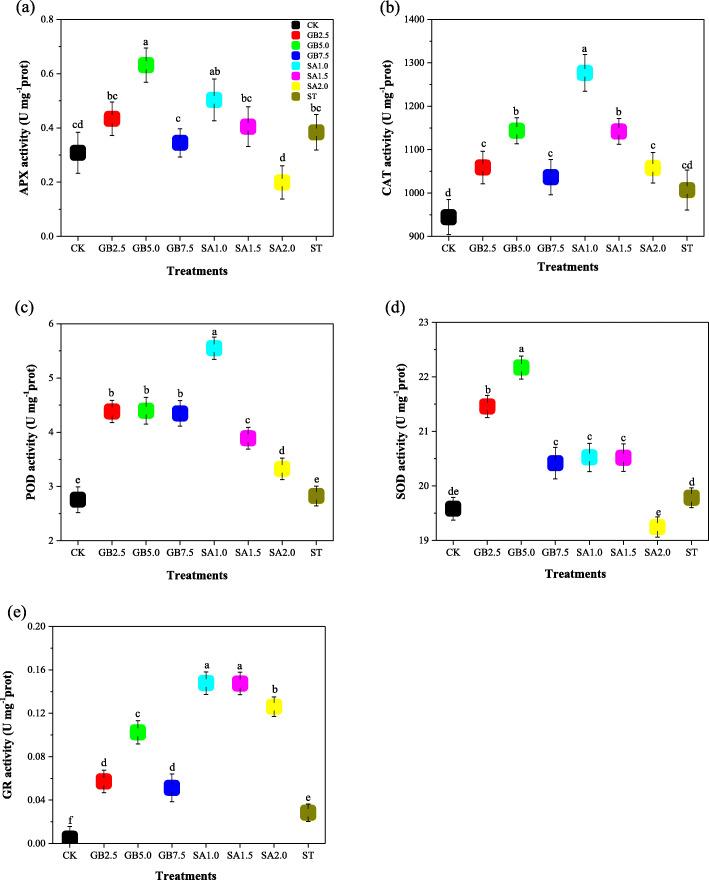
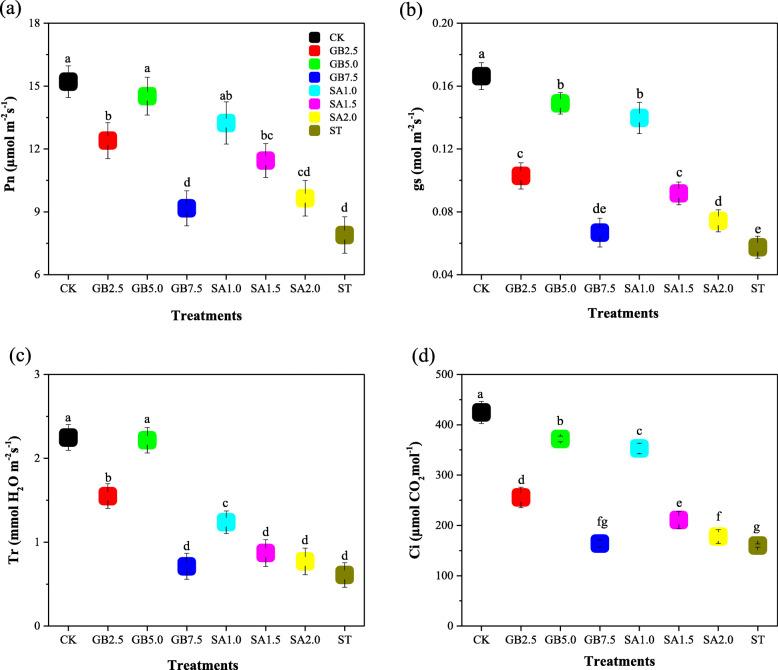
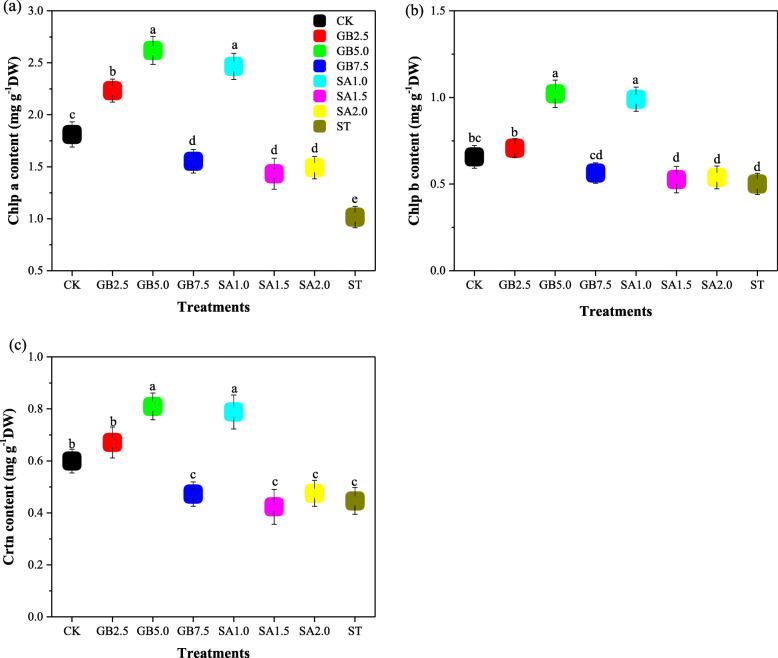
Results showed that salt stress of 150 mM NaCl significantly reduced leaf gas exchange and chlorophyll fluorescence and decreased photosynthetic pigment quantities and leaf relative water content. Foliar spray concentrations of 5.0 mM exogenous GB and 1.0 mM exogenous SA promoted gas exchange and fluorescence in cotton seedlings, increased quantities of chlorophyll pigments, and stimulated the antioxidant enzyme activity. The foliar spray also increased leaf relative water content and endogenous GB and SA content in comparison with the salt-stressed only control. Despite the salt-induced increase in antioxidant enzyme content, exogenous GB and SA in experimental concentrations significantly increased the activity of glutathione reductase, ascorbate peroxidase, superoxide dismutase, catalase and peroxidase, and decreased malondialdehyde content under salt stress. Across all experimental foliar spray GB and SA concentrations, the photochemical efficiency of photosystem II (F/F) reached a peak at a concentration of 5.0 mM GB. The net photosynthetic rate (P) and F/F were positively correlated with chlorophyll a and chlorophyll b content in response to foliar spraying of exogenous GB and SA under salt stress.
CONCLUSIONS
We concluded, from our results, that concentrations of 5.0 mM GB or 1.0 mM SA are optimal choices for mitigating NaCl-induced damage in cotton seedlings because they promote leaf photosynthesis, increase quantities of photosynthetic pigments, and stimulate antioxidant enzyme activity. Among, 5.0 mM GB and 1.0 mM SA, the best performance in enhancing endogenous GB and SA concentrations was obtained with the foliar application of 1.0 mM SA under salt stress.
背景
外施甘氨酸甜菜碱(GB)和水杨酸(SA)可减轻盐胁迫的不利影响。叶面喷施外源 GB 或 SA 通过增加叶片气体交换和刺激抗氧化酶活性来缓解植物的盐胁迫。外源 GB 和 SA 叶面喷施对盐胁迫下棉花幼苗生理生化的影响尚不清楚。
结果
结果表明,150mM NaCl 盐胁迫显著降低了叶片气体交换和叶绿素荧光,降低了光合色素含量和叶片相对含水量。5.0mM 外源 GB 和 1.0mM 外源 SA 的叶面喷施促进了棉花幼苗的气体交换和荧光,增加了叶绿素色素的含量,并刺激了抗氧化酶的活性。与仅受盐胁迫的对照相比,叶面喷施还增加了叶片相对含水量以及内源 GB 和 SA 的含量。尽管盐诱导了抗氧化酶含量的增加,但在实验浓度下,外源 GB 和 SA 显著增加了谷胱甘肽还原酶、抗坏血酸过氧化物酶、超氧化物歧化酶、过氧化氢酶和过氧化物酶的活性,并降低了盐胁迫下的丙二醛含量。在所有实验叶面喷施 GB 和 SA 浓度下,光系统 II(F/F)的光化学效率在 5.0mM GB 浓度下达到峰值。在盐胁迫下,外源 GB 和 SA 叶面喷施后,净光合速率(P)和 F/F 与叶绿素 a 和叶绿素 b 含量呈正相关。
结论
我们的研究结果表明,5.0mM GB 或 1.0mM SA 浓度是缓解棉花幼苗 NaCl 损伤的最佳选择,因为它们可以促进叶片光合作用,增加光合色素含量,刺激抗氧化酶活性。在 5.0mM GB 和 1.0mM SA 中,在盐胁迫下叶面喷施 1.0mM SA 可获得最佳的内源 GB 和 SA 浓度增强效果。


 Zotero 插件