
衰减成像技术在肝脂肪变性检测中的性能。
Performance of the Attenuation Imaging Technology in the Detection of Liver Steatosis.
机构信息
Department of Clinical, Surgical, Diagnostic, and Pediatric Sciences, University of Pavia, Pavia, Italy.
Department of Clinical Sciences and Infectious Diseases, Fondazione Istituto di Ricovero e Cura a Carattere Scientifico Policlinico San Matteo, Pavia, Italy.
出版信息
J Ultrasound Med. 2021 Jul;40(7):1325-1332. doi: 10.1002/jum.15512. Epub 2020 Sep 22.
OBJECTIVES
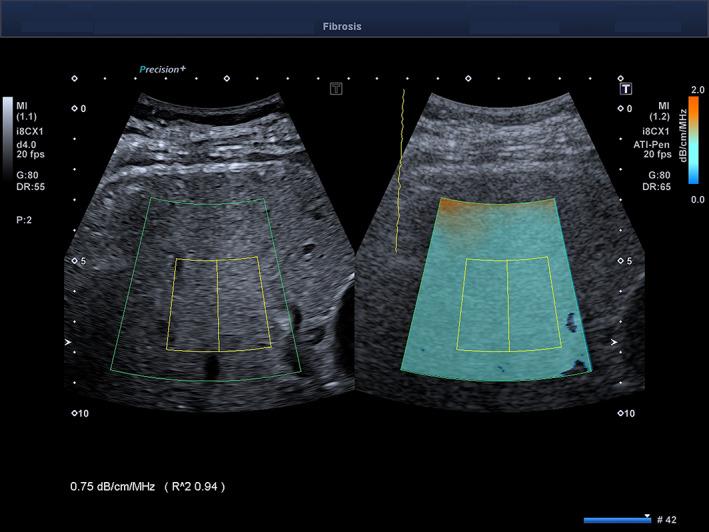
The main aim was to assess the performance and cutoff value for the detection of liver steatosis (grade S > 0) with the Attenuation Imaging-Penetration (ATI-Pen) algorithm available on the Aplio i-series ultrasound systems (Canon Medical Systems, Otawara, Japan). The magnetic resonance imaging-derived proton density fat fraction (MRI-PDFF) was used as the reference standard. Secondary aims were to compare the results to those obtained with the previous ATI algorithm (Attenuation Imaging-General [ATI-Gen]) and with the controlled attenuation parameter (CAP) and to generate a regression equation between ATI-Pen and ATI-Gen values.
METHODS
Consecutive adult patients potentially at risk of liver steatosis were prospectively enrolled. Each patient underwent ultrasound quantification of liver steatosis with ATI-Pen and ATI-Gen and a CAP assessment with the FibroScan system (Echosens, Paris, France). The MRI-PDFF evaluation was performed within a week. The correlations between ATI-Pen, ATI-Gen, the CAP, and the MRI-PDFF were analyzed with the Pearson rank correlation coefficient. The diagnostic performance of ATI-Pen, ATI-Gen, and the CAP was assessed with receiver operating characteristic curves and an area under the receiver operating characteristic curve (AUROC) analysis.
RESULTS
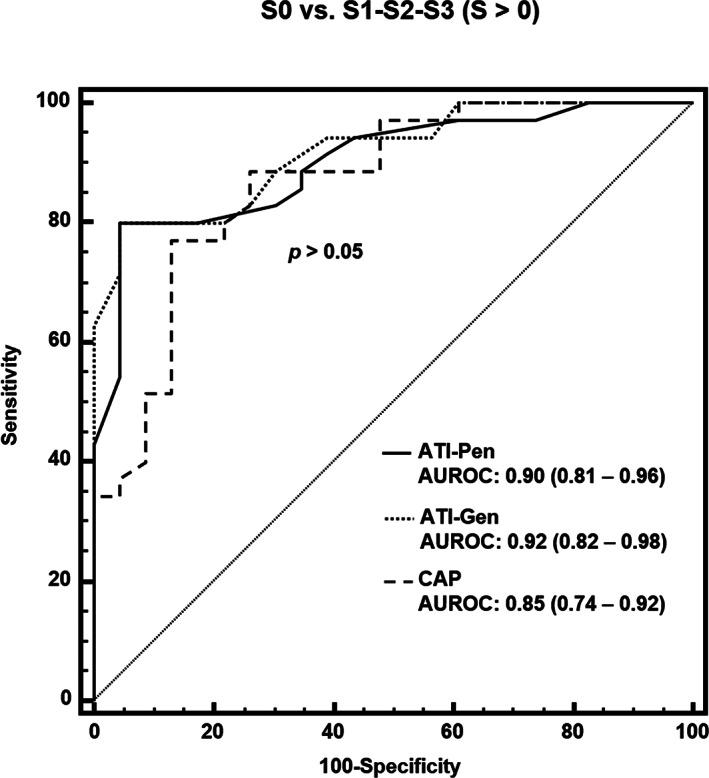
Seventy-two individuals (31 male and 41 female) were enrolled. Correlation coefficients of ATI-Pen, ATI-Gen, and the CAP with the MRI-PDFF were 0.78, 0.83, and 0.58, respectively. The AUROCs of ATI-Pen, ATI-Gen, and the CAP for detecting steatosis (S > 0) were 0.90 (95% confidence interval, 0.81-0.96), 0.92 (0.82-0.98), and 0.85 (0.74-0.92), and the cutoffs were greater than 0.69 dB/cm/MHz, greater than 0.62 dB/cm/MHz, and greater than 273 dB/m. The regression equation between ATI-Pen and ATI-Gen was ATI-Pen = 0.88 ATI-Gen + 0.13.
CONCLUSIONS
Attenuation Imaging is a reliable tool for detecting liver steatosis, showing an excellent correlation with the MRI-PDFF and high performance with AUROCs of 0.90 or higher.
目的
本研究旨在评估 Aplio i 系列超声系统(佳能医疗系统,鸟取,日本)上的衰减成像-穿透(ATI-Pen)算法检测肝脂肪变性(S>0)的性能和截断值。磁共振成像衍生的质子密度脂肪分数(MRI-PDFF)被用作参考标准。次要目的是将结果与之前的 ATI 算法(衰减成像-一般[ATI-Gen])和受控衰减参数(CAP)进行比较,并生成 ATI-Pen 和 ATI-Gen 值之间的回归方程。
方法
连续入组有潜在肝脂肪变性风险的成年患者。每位患者均接受超声检测肝脂肪变性,采用 ATI-Pen 和 ATI-Gen 进行定量分析,同时采用 FibroScan 系统(Echosens,巴黎,法国)进行 CAP 评估。MRI-PDFF 评估在一周内进行。采用 Pearson 秩相关系数分析 ATI-Pen、ATI-Gen、CAP 与 MRI-PDFF 之间的相关性。采用受试者工作特征曲线和曲线下面积(AUROC)分析评估 ATI-Pen、ATI-Gen 和 CAP 的诊断性能。
结果
共纳入 72 名个体(31 名男性和 41 名女性)。ATI-Pen、ATI-Gen 和 CAP 与 MRI-PDFF 的相关系数分别为 0.78、0.83 和 0.58。ATI-Pen、ATI-Gen 和 CAP 检测脂肪变性(S>0)的 AUROCs 分别为 0.90(95%置信区间,0.81-0.96)、0.92(0.82-0.98)和 0.85(0.74-0.92),截断值大于 0.69 dB/cm/MHz、大于 0.62 dB/cm/MHz 和大于 273 dB/m。ATI-Pen 和 ATI-Gen 之间的回归方程为 ATI-Pen=0.88ATI-Gen+0.13。
结论
衰减成像(Attenuation Imaging)是一种可靠的检测肝脂肪变性的工具,与 MRI-PDFF 具有极好的相关性,AUROCs 高达 0.90 或更高,具有较高的性能。

 Zotero 插件