
三棱草精油对曼氏血吸虫及其中间宿主光滑双脐螺的杀软体动物和杀寄生虫活性,双重作用。
Molluscicidal and parasiticidal activities of Eryngium triquetrum essential oil on Schistosoma mansoni and its intermediate snail host Biomphalaria glabrata, a double impact.
机构信息
University Perpignan Via Domitia, IHPE, UMR 5244, CNRS, IFREMER, Perpignan, France.
University Montpellier, IHPE, UMR 5244, CNRS, IFREMER, Montpellier, France.
出版信息
Parasit Vectors. 2020 Sep 23;13(1):486. doi: 10.1186/s13071-020-04367-w.
BACKGROUND
Freshwater snails are the intermediate hosts of a large variety of trematode flukes such as Schistosoma mansoni responsible for one of the most important parasitic diseases caused by helminths, affecting 67 million people worldwide. Recently, the WHO Global Vector Control Response 2017-2030 (GVCR) programme reinforced its message for safer molluscicides as part of required strategies to strengthen vector control worldwide. Here, we present the essential oil from Eryngium triquetrum as a powerful product with molluscicide and parasiticide effect against S. mansoni and the snail intermediate host Biomphalaria glabrata.
METHODS
In the present study, we describe using several experimental approaches, the chemical composition of E. triquetrum essential oil extract and its biological effects against the snail B. glabrata and its parasite S. mansoni. Vector and the free-swimming larval stages of the parasite were exposed to different oil concentrations to determine the lethal concentration required to produce a mortality of 50% (LC) and 90% (LC). In addition, toxic activity of this essential oil was analyzed against embryos of B. glabrata snails by monitoring egg hatching and snail development. Also, short-time exposure to sublethal molluscicide concentrations on S. mansoni miracidia was performed to test a potential effect on parasite infectivity on snails. Mortality of miracidia and cercariae of S. mansoni is complete for 5, 1 and 0.5 ppm of oil extract after 1 and 4 h exposure.
RESULTS
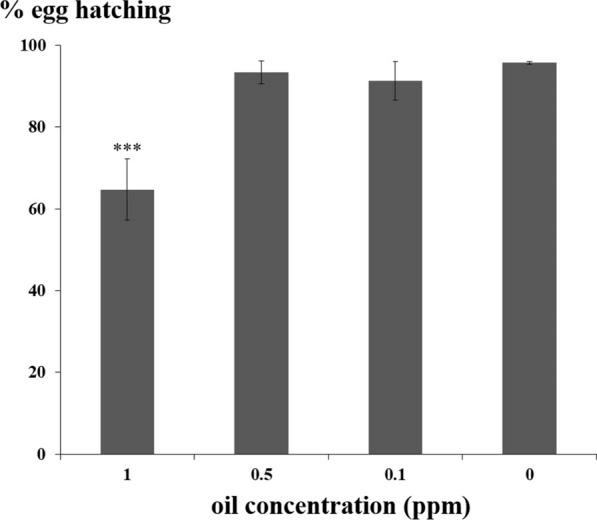
The major chemical component found in E. triquetrum oil determined by GC-FID and GC/MS analyses is an aliphatic polyacetylene molecule, the falcarinol with 86.9-93.1% of the total composition. The LC and LC values for uninfected snails were 0.61 and 1.02 ppm respectively for 24 h exposure. At 0.5 ppm, the essential oil was two times more toxic to parasitized snails with a mortality rate of 88.8 ± 4.8%. Moderate embryonic lethal effects were observed at the concentration of 1 ppm. Severe surface damage in miracidia was observed with a general loss of cilia that probably cause their immobility. Miracidia exposed 30 min to low concentration of plant extract (0.1 ppm) were less infective with 3.3% of prevalence compare to untreated with a prevalence of 44%.
CONCLUSIONS
Essential oil extracted from E. triquetrum and falcarinol must be considered as a promising product for the development of new interventions for schistosomiasis control and could proceed to be tested on Phase II according to the WHO requirements.
背景
淡水蜗牛是多种吸虫(如曼氏血吸虫)的中间宿主,这些吸虫是由寄生虫引起的最重要的寄生性疾病之一,影响着全球 6700 万人。最近,世界卫生组织(WHO)的全球病媒控制应对 2017-2030 年(GVCR)计划加强了其关于更安全的杀螺剂的信息,作为加强全球病媒控制所需策略的一部分。在这里,我们展示了来自三肋针茅的精油,作为一种具有杀螺和杀寄生虫效果的强大产品,可对抗曼氏血吸虫和中间宿主双脐螺。
方法
在本研究中,我们使用了几种实验方法来描述三肋针茅精油提取物的化学成分及其对双脐螺和曼氏血吸虫自由游动幼虫阶段的生物学效应。将矢量和寄生虫的幼虫阶段暴露于不同的油浓度下,以确定产生 50%(LC)和 90%(LC)死亡率所需的致死浓度。此外,通过监测卵孵化和蜗牛发育,分析了这种精油对双脐螺蜗牛胚胎的毒性作用。还对曼氏血吸虫的幼体进行了亚致死浓度的短时间暴露,以测试其对蜗牛感染性的潜在影响。暴露于 5、1 和 0.5 ppm 的油提取物 1 和 4 小时后,曼氏血吸虫的幼体和尾蚴完全死亡。
结果
通过 GC-FID 和 GC/MS 分析确定,三肋针茅油中的主要化学成分是一种脂肪族聚乙炔分子,即法卡林醇,其总成分占 86.9-93.1%。未感染蜗牛的 LC 和 LC 值分别为 24 小时暴露时为 0.61 和 1.02 ppm。在 0.5 ppm 时,精油对感染蜗牛的毒性是未感染蜗牛的两倍,死亡率为 88.8±4.8%。在 1 ppm 的浓度下,胚胎出现中等致死效应。幼体表现出严重的表面损伤,一般失去纤毛,可能导致它们无法移动。与未处理的相比,暴露于植物提取物(0.1 ppm) 30 分钟的幼体感染率降低到 3.3%,而未处理的感染率为 44%。
结论
从三肋针茅中提取的精油和法卡林醇必须被认为是一种有前途的产品,可用于开发新的血吸虫病控制干预措施,并可能根据世界卫生组织的要求进行第二阶段的测试。




 Zotero 插件