
室内表面金黄色葡萄球菌和其他葡萄球菌属物种采样方法的评估。
Evaluation of Methods for Sampling of Staphylococcus aureus and Other Staphylococcus Species from Indoor Surfaces.
机构信息
National Research Centre for the Working Environment, Lersø Parkallé, Copenhagen Ø, Denmark.
出版信息
Ann Work Expo Health. 2020 Nov 16;64(9):1020-1034. doi: 10.1093/annweh/wxaa080.
OBJECTIVES
Methicillin-resistant Staphylococcus aureus (MRSA) is an increasing public and occupational health concern. As transmission of MRSA can occur via contact with fomites, it is crucial to have sensitive methods for sampling of bacteria. The overall aim of this study was to obtain knowledge about methods and strategies for quantitative sampling Staphylococcus species on surfaces.
METHODS
The study was designed as a comparative sampling experiment with different samplers [dipslide (two agar types), swabs (three brands, used wet and dry, and elution from swabs or plate diluted)] on smooth stainless steel surfaces spiked with MRSA and methicillin-sensitive S. aureus (MSSA). Furthermore, bacteria sampled from indoor surfaces with frequent or infrequent contact with hands were quantified and identified using matrix-assisted laser desorption-ionization time-of-flight (MALDI-TOF) mass spectrometry (MS).
RESULTS
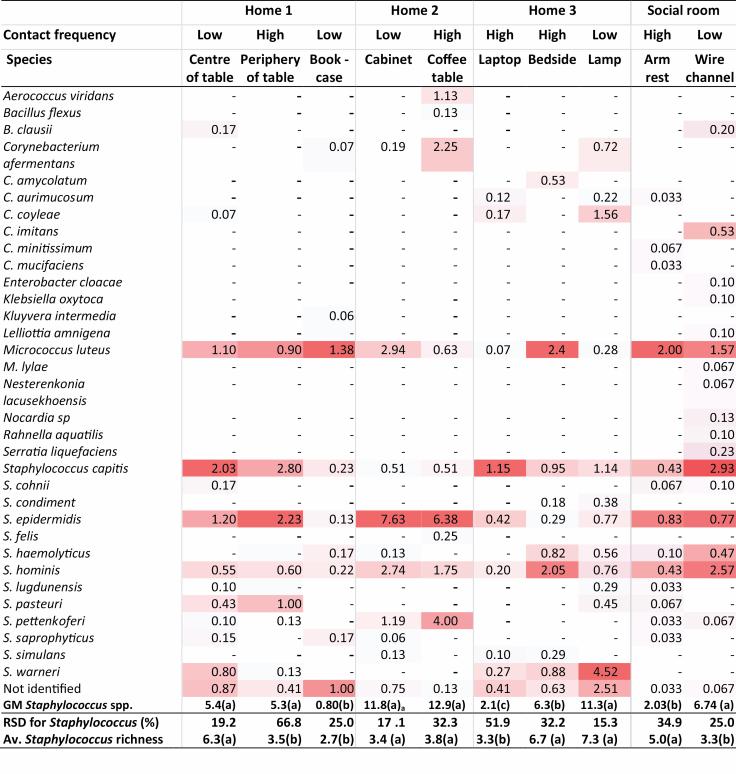
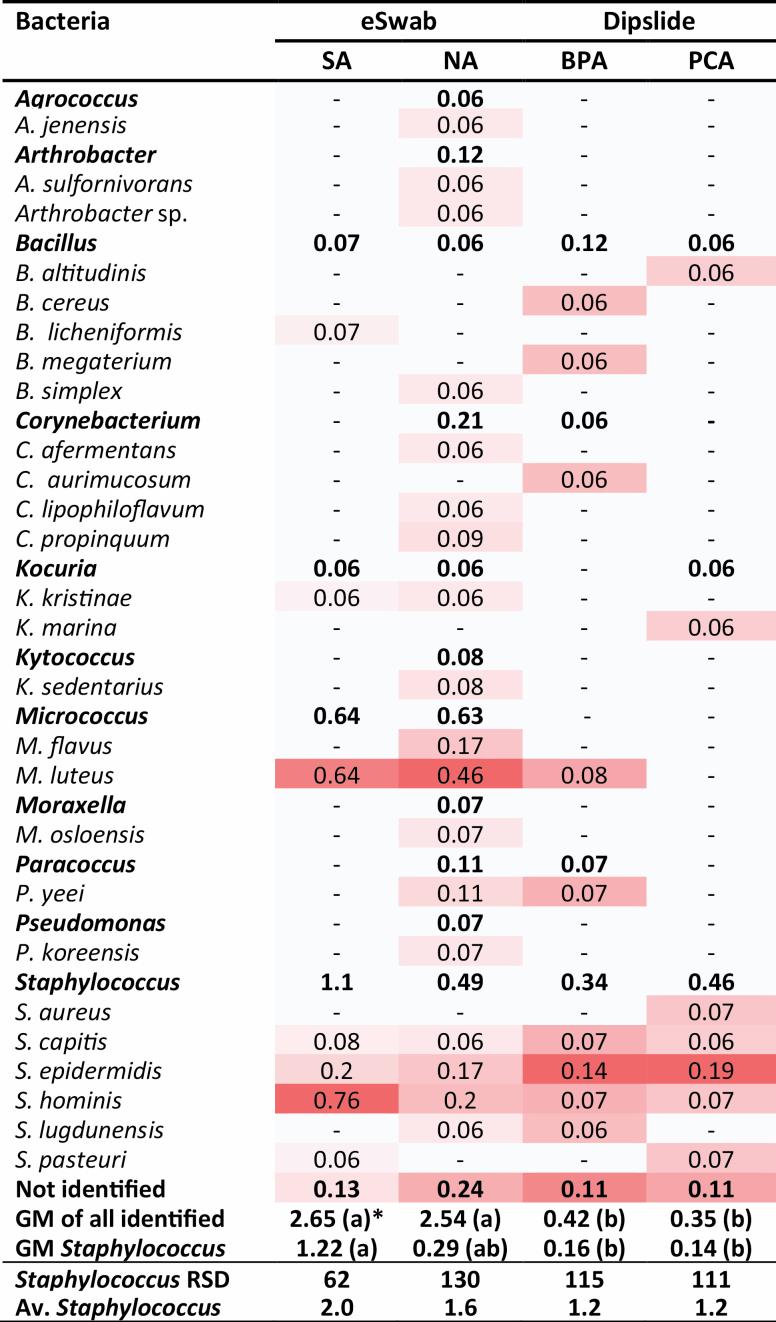
Pre-moistened swabs in combination with dilution plating and dipslides were more sensitive than dry swabs. For recovery of MRSA and MSSA from surfaces with eSwabs, at least 0.3-100 CFU MRSA cm-2 and 5.3-8.6 CFU MSSA cm-2 should be present. The sensitivities of pre-moistened eSwabs were approximately 10-fold higher than those of dipslides and pre-moistened viscose and cotton swabs. The variation in concentrations of Staphylococcus species in replicate sampling of adjacent squares on indoor surfaces was higher for surfaces frequently touched by hands than for surfaces infrequently touched. In total 16 different Staphylococcus species were identified, and S. aureus was found only in 2 of 66 surface samples. A considerable overlap was found between species in replicate sampling within an environment and between the air and surfaces within an environment.
CONCLUSIONS
Pre-moistened eSwabs in combination with dilution plating were found to be the best method for surface sampling of MSSA and MRSA. The method can be used for assessing the risk of exposure and transmission of MRSA from environmental surfaces. To obtain a reliable measure of concentrations and the presence of Staphylococccus species a higher number of samples should be taken from surfaces with hand contact than from surfaces dominated by sedimented bacteria.
目的
耐甲氧西林金黄色葡萄球菌(MRSA)是一个日益严重的公共和职业健康问题。由于 MRSA 可以通过接触污染物传播,因此对细菌进行敏感的采样方法至关重要。本研究的总体目的是获得关于定量采样表面葡萄球菌的方法和策略的知识。
方法
该研究设计为比较采样实验,使用不同的采样器(两种琼脂类型的浸片、三种品牌的拭子(湿用和干用)以及从拭子或平板稀释洗脱)对不锈钢光滑表面进行采样,这些表面被 MRSA 和甲氧西林敏感的金黄色葡萄球菌(MSSA)污染。此外,使用基质辅助激光解吸电离飞行时间(MALDI-TOF)质谱(MS)对经常或不常接触手的室内表面采样的细菌进行定量和鉴定。
结果
预湿拭子与稀释平板和浸片结合比干拭子更敏感。为了从 eSwabs 表面回收 MRSA 和 MSSA,至少应该存在 0.3-100 CFU MRSA cm-2 和 5.3-8.6 CFU MSSA cm-2。预湿 eSwabs 的灵敏度比浸片和预湿粘胶和棉拭子高约 10 倍。在经常接触手的室内表面相邻方格的重复采样中,葡萄球菌种浓度的变化高于不常接触手的表面。共鉴定出 16 种不同的葡萄球菌种,仅在 66 个表面样本中的 2 个中发现了金黄色葡萄球菌。在一个环境中,同一环境中空气和表面的重复采样以及不同环境中空气和表面之间的物种都有很大的重叠。
结论
预湿 eSwabs 与稀释平板相结合被发现是 MSSA 和 MRSA 表面采样的最佳方法。该方法可用于评估从环境表面接触和传播 MRSA 的风险。为了可靠地测量浓度和存在的葡萄球菌种,从有手接触的表面上采集的样本数量应多于从以细菌沉降为主的表面上采集的样本数量。
 Zotero 插件