
Nutil:用于组织学啮齿动物脑切片图像的预处理和后处理工具箱。
Nutil: A Pre- and Post-processing Toolbox for Histological Rodent Brain Section Images.
作者信息
Groeneboom Nicolaas E, Yates Sharon C, Puchades Maja A, Bjaalie Jan G
机构信息
Neural Systems Laboratory, Institute of Basic Medical Sciences, University of Oslo, Oslo, Norway.
出版信息
Front Neuroinform. 2020 Aug 21;14:37. doi: 10.3389/fninf.2020.00037. eCollection 2020.
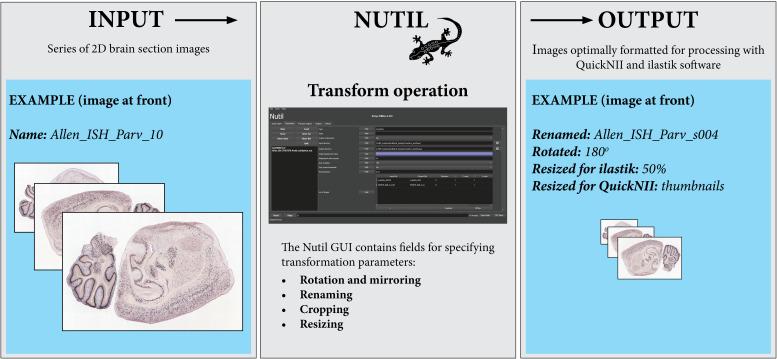
With recent technological advances in microscopy and image acquisition of tissue sections, further developments of tools are required for viewing, transforming, and analyzing the ever-increasing amounts of high-resolution data produced. In the field of neuroscience, histological images of whole rodent brain sections are commonly used for investigating brain connections as well as cellular and molecular organization in the normal and diseased brain, but present a problem for the typical neuroscientist with no or limited programming experience in terms of the pre- and post-processing steps needed for analysis. To meet this need we have designed , an open access and stand-alone executable software that enables automated transformations, post-processing, and analyses of 2D section images using multi-core processing (OpenMP). The software is written in C++ for efficiency, and provides the user with a clean and easy graphical user interface for specifying the input and output parameters. currently contains four separate tools: (1) A transformation toolchain named "Transform" that allows for rotation, mirroring and scaling, resizing, and renaming of very large tiled tiff images. (2) "TiffCreator" enables the generation of tiled TIFF images from other image formats such as PNG and JPEG. (3) A "Resize" tool completes the preprocessing toolset and allows downscaling of PNG and JPEG images with output in PNG format. (4) The fourth tool is a post-processing method called "Quantifier" that enables the quantification of segmented objects in the context of regions defined by brain atlas maps generated with the software based on a 3D reference atlas (mouse or rat). The output consists of a set of report files, point cloud coordinate files for visualization in reference atlas space, and reference atlas images superimposed with color-coded objects. The software is made available by the Human Brain Project (https://www.humanbrainproject.eu) at https://www.nitrc.org/projects/nutil/.
随着显微镜技术和组织切片图像采集技术的最新进展,需要进一步开发工具来查看、转换和分析所产生的数量不断增加的高分辨率数据。在神经科学领域,完整啮齿动物脑切片的组织学图像通常用于研究正常和患病大脑中的脑连接以及细胞和分子组织,但对于没有编程经验或编程经验有限的典型神经科学家来说,在分析所需的预处理和后处理步骤方面存在问题。为满足这一需求,我们设计了Nutil,这是一款开放获取的独立可执行软件,它能够使用多核处理(OpenMP)对二维切片图像进行自动转换、后处理和分析。该软件用C++编写以提高效率,并为用户提供一个简洁易用的图形用户界面来指定输入和输出参数。Nutil目前包含四个独立工具:(1)一个名为“Transform”的转换工具链,它允许对非常大的平铺式tiff图像进行旋转、镜像、缩放、调整大小和重命名。(2)“TiffCreator”能够从其他图像格式(如PNG和JPEG)生成平铺式TIFF图像。(3)“Resize”工具完善了预处理工具集,并允许对PNG和JPEG图像进行降尺度处理,输出格式为PNG。(4)第四个工具是一种名为“Quantifier”的后处理方法,它能够在由基于三维参考图谱(小鼠或大鼠)使用该软件生成的脑图谱地图所定义的区域背景下,对分割对象进行量化。输出包括一组报告文件、用于在参考图谱空间中可视化的点云坐标文件,以及叠加有颜色编码对象的参考图谱图像。Nutil软件由人类大脑计划(https://www.humanbrainproject.eu)在https://www.nitrc.org/projects/nutil/上提供。



 Zotero 插件