
间充质干细胞及其衍生的细胞外囊泡在类风湿关节炎中的免疫调节作用。
Immunomodulatory Effects of Mesenchymal Stem Cells and Mesenchymal Stem Cell-Derived Extracellular Vesicles in Rheumatoid Arthritis.
机构信息
Department of Rheumatology and Immunology, West China Hospital, Sichuan University, Chengdu, China.
Health Management Center, West China Hospital, Sichuan University, Chengdu, China.
出版信息
Front Immunol. 2020 Aug 20;11:1912. doi: 10.3389/fimmu.2020.01912. eCollection 2020.
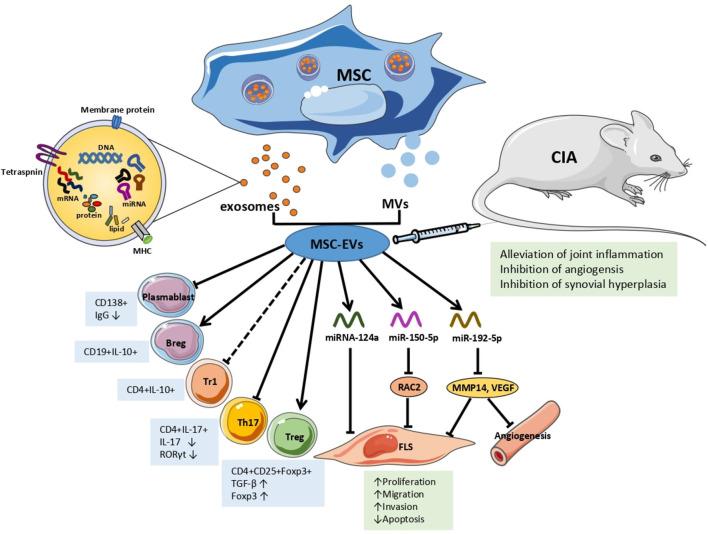
Rheumatoid arthritis (RA) is a chronic autoimmune disease that affects the joints and other organs for which there is currently no effective treatment. Mesenchymal stem cells (MSCs) have therapeutic potential due to their immunomodulatory and differentiation effects. While extensive experimental studies and clinical trials have demonstrated the effects of MSCs in various diseases, MSCs have been found to cause abnormal differentiation and tumor formation. Therefore, extracellular vesicles derived from MSCs (MSC-EVs) are more effective, less toxic, and more stable than the parental cells. MSC-EVs transfer various nucleic acids, proteins, and lipids from parent cells to recipient cells, and thus participate in chronic inflammatory and immune processes. In this review, we summarize the properties and biological functions of MSCs and MSC-EVs in RA. Improvement in our understanding of the mechanisms underlying MSC and MSC-EVs in RA provides an insight into potential biomarkers and therapeutic strategies for RA.
类风湿关节炎(RA)是一种慢性自身免疫性疾病,目前尚无有效的治疗方法,影响关节和其他器官。间充质干细胞(MSCs)具有治疗潜力,因为它们具有免疫调节和分化作用。尽管广泛的实验研究和临床试验已经证明了 MSCs 在各种疾病中的作用,但已经发现 MSCs 会导致异常分化和肿瘤形成。因此,源自 MSCs 的细胞外囊泡(MSC-EVs)比亲代细胞更有效、毒性更小且更稳定。MSC-EVs 将各种核酸、蛋白质和脂质从亲代细胞转移到受体细胞,从而参与慢性炎症和免疫过程。在这篇综述中,我们总结了 MSCs 和 MSC-EVs 在 RA 中的特性和生物学功能。对 MSC 和 MSC-EVs 在 RA 中作用机制的深入了解,为 RA 的潜在生物标志物和治疗策略提供了新的思路。
 Zotero 插件