
英格兰无家可归人群中的 COVID-19:一项建模研究。
COVID-19 among people experiencing homelessness in England: a modelling study.
机构信息
UCL Collaborative Centre for Inclusion Health, University College London, London, UK.
UCL Public Health Data Science Research Group, Institute of Health Informatics, University College London, London, UK.
出版信息
Lancet Respir Med. 2020 Dec;8(12):1181-1191. doi: 10.1016/S2213-2600(20)30396-9. Epub 2020 Sep 23.
BACKGROUND
People experiencing homelessness are vulnerable to COVID-19 due to the risk of transmission in shared accommodation and the high prevalence of comorbidities. In England, as in some other countries, preventive policies have been implemented to protect this population. We aimed to estimate the avoided deaths and health-care use among people experiencing homelessness during the so-called first wave of COVID-19 in England-ie, the peak of infections occurring between February and May, 2020-and the potential impact of COVID-19 on this population in the future.
METHODS
We used a discrete-time Markov chain model of severe acute respiratory syndrome coronavirus 2 (SARS-CoV-2) infection that included compartments for susceptible, exposed, infectious, and removed individuals, to explore the impact of the pandemic on 46 565 individuals experiencing homelessness: 35 817 living in 1065 hostels for homeless people, 3616 sleeping in 143 night shelters, and 7132 sleeping outside. We ran the model under scenarios varying the incidence of infection in the general population and the availability of prevention measures: specialist hotel accommodation, infection control in homeless settings, and mixing with the general population. We divided our scenarios into first wave scenarios (covering Feb 1-May 31, 2020) and future scenarios (covering June 1, 2020-Jan 31, 2021). For each scenario, we ran the model 200 times and reported the median and 95% prediction interval (2·5% and 97·5% quantiles) of the total number of cases, the number of deaths, the number hospital admissions, and the number of intensive care unit (ICU) admissions.
FINDINGS
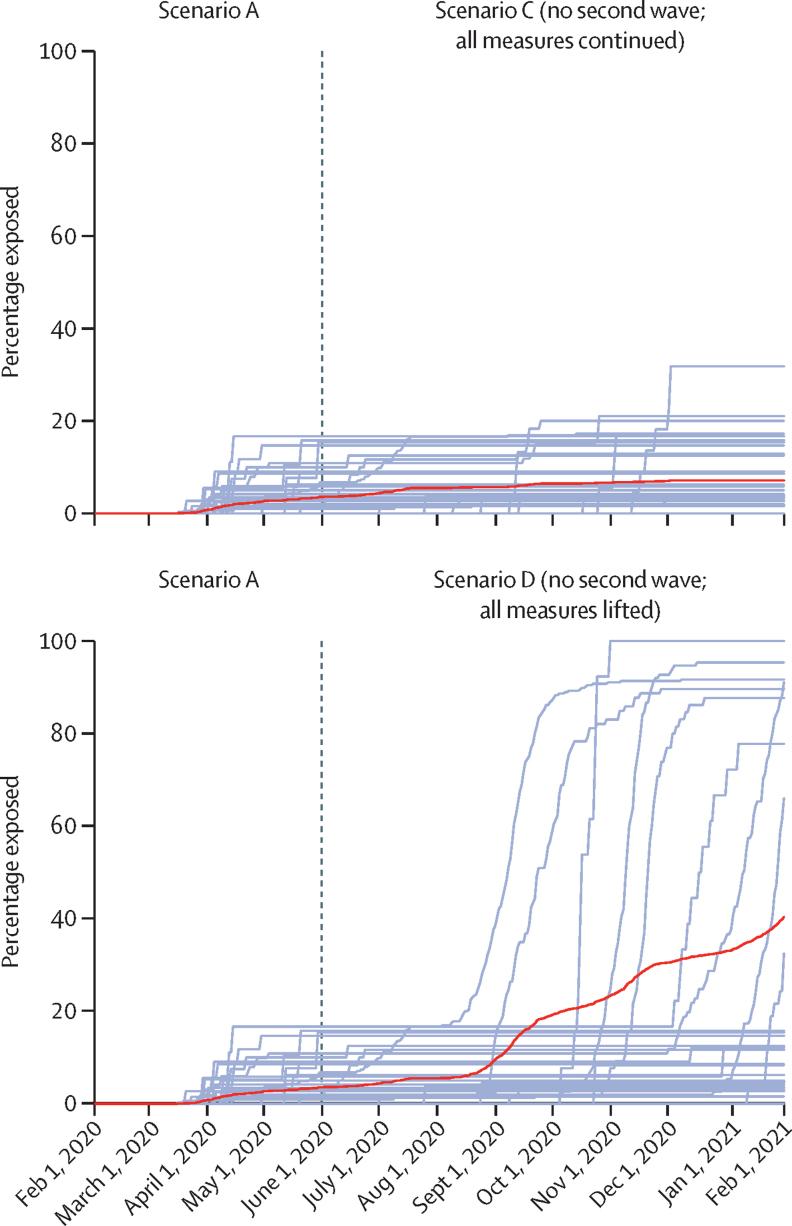
Up to May 31, 2020, we calibrated the model to 4% of the homeless population acquiring SARS-CoV-2, and estimated that 24 deaths (95% prediction interval 16-34) occurred. In this first wave of SARS-CoV-2 infections in England, we estimated that the preventive measures imposed might have avoided 21 092 infections (19 777-22 147), 266 deaths (226-301), 1164 hospital admissions (1079-1254), and 338 ICU admissions (305-374) among the homeless population. If preventive measures are continued, we projected a small number of additional cases between June 1, 2020, and Jan 31, 2021, with 1754 infections (1543-1960), 31 deaths (21-45), 122 hospital admissions (100-148), and 35 ICU admissions (23-47) with a second wave in the general population. However, if preventive measures are lifted, outbreaks in homeless settings might lead to larger numbers of infections and deaths, even with low incidence in the general population. In a scenario with no second wave and relaxed measures in homeless settings in England, we projected 12 151 infections (10 718-13 349), 184 deaths (151-217), 733 hospital admissions (635-822), and 213 ICU admissions (178-251) between June 1, 2020, and Jan 31, 2021.
INTERPRETATION
Outbreaks of SARS-CoV-2 in homeless settings can lead to a high attack rate among people experiencing homelessness, even if incidence remains low in the general population. Avoidance of deaths depends on prevention of transmission within settings such as hostels and night shelters.
FUNDING
National Institute for Health Research, Wellcome, and Medical Research Council.
背景
由于在共享住所中传播的风险以及合并症的高发率,无家可归者易感染 COVID-19。在英国,与一些其他国家一样,已经实施了预防性政策来保护这一人群。我们旨在估计在英格兰所谓的 COVID-19 第一波期间(即 2020 年 2 月至 5 月之间感染高峰期)无家可归者的死亡人数和卫生保健使用量,并预测 COVID-19 对这一人群未来的潜在影响。
方法
我们使用严重急性呼吸综合征冠状病毒 2(SARS-CoV-2)感染的离散时间马尔可夫链模型,该模型包括易感者、暴露者、传染性和清除者的隔室,以探索大流行对 46565 名无家可归者的影响:35817 人居住在 1065 家无家可归者收容所,3616 人在 143 家夜间收容所睡觉,7132 人在外面睡觉。我们在不同的一般人群感染发生率和预防措施可获得性的情景下运行模型:专门的酒店住宿、无家可归者环境中的感染控制,以及与一般人群混合。我们将我们的情景分为第一波情景(涵盖 2020 年 2 月 1 日至 5 月 31 日)和未来情景(涵盖 2020 年 6 月 1 日至 2021 年 1 月 31 日)。对于每个情景,我们运行了 200 次模型,并报告了总病例数、死亡人数、住院人数和重症监护病房(ICU)入院人数的中位数和 95%预测区间(2.5%和 97.5%分位数)。
结果
截至 2020 年 5 月 31 日,我们将模型校准到 4%的无家可归者感染 SARS-CoV-2,并估计有 24 人死亡(95%预测区间 16-34)。在英格兰的 SARS-CoV-2 感染第一波中,我们估计实施的预防措施可能避免了 21092 例感染(19777-22147)、266 例死亡(226-301)、1164 例住院(1079-1254)和 338 例 ICU 入院(305-374)。如果继续采取预防措施,我们预计在 2020 年 6 月 1 日至 2021 年 1 月 31 日期间会有少量额外的病例,有 1754 例感染(1543-1960)、31 例死亡(21-45)、122 例住院(100-148)和 35 例 ICU 入院(23-47),而在一般人群中会有第二波感染。然而,如果取消预防措施,无家可归者环境中的疫情可能会导致更多的感染和死亡,即使一般人群的发病率较低。在英格兰,无家可归者环境中没有第二波疫情且措施放宽的情况下,我们预计在 2020 年 6 月 1 日至 2021 年 1 月 31 日期间,会有 12151 例感染(10718-13153)、184 例死亡(151-217)、733 例住院(635-822)和 213 例 ICU 入院(178-251)。
解释
即使在一般人群的发病率较低的情况下,无家可归者环境中 SARS-CoV-2 的爆发也可能导致无家可归者中出现高发病率。避免死亡取决于在收容所和夜间收容所等环境中防止传播。
资金
英国国民保健制度、惠康和医学研究理事会。


 Zotero 插件